Portuguese
  Spanish


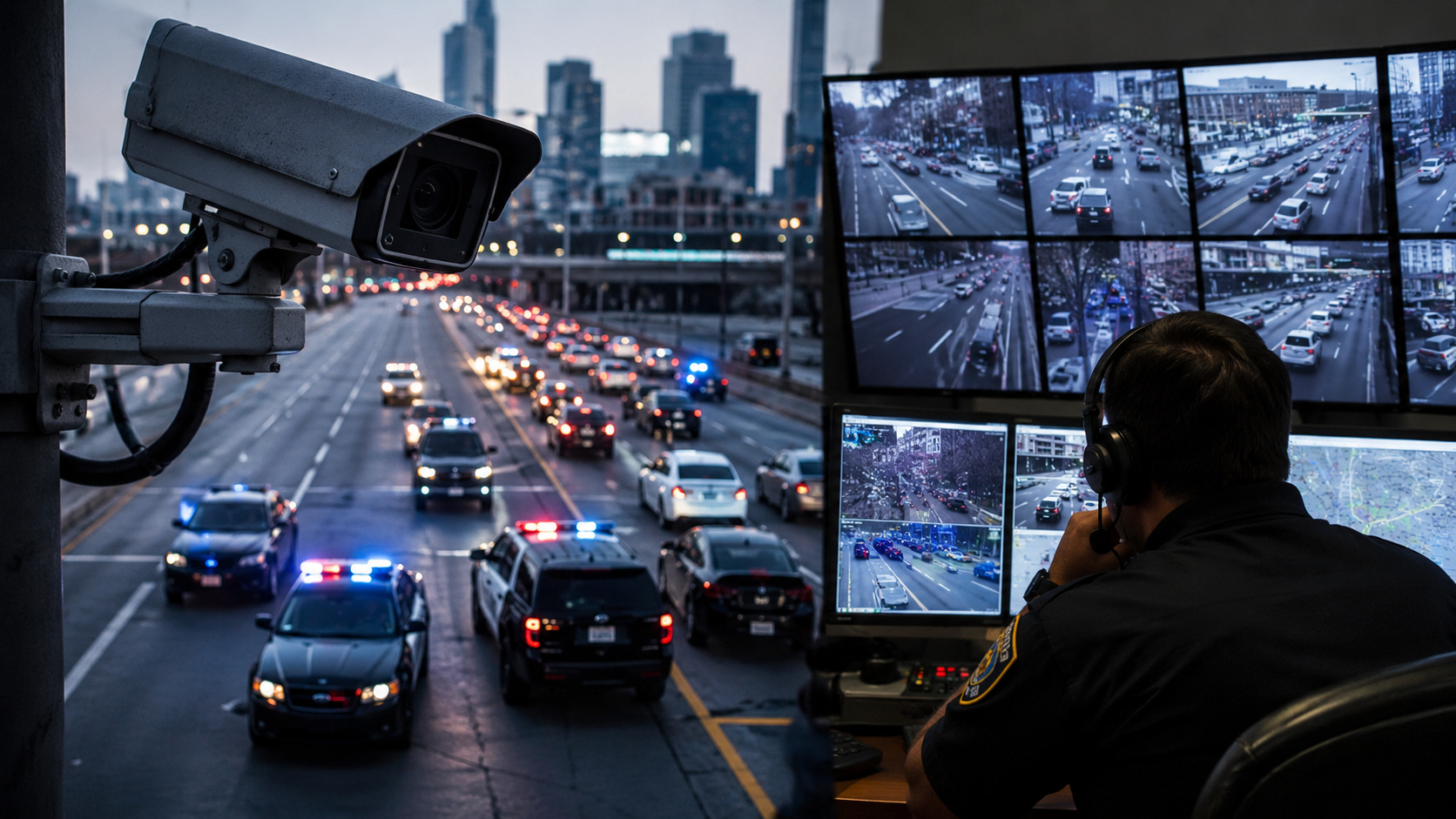

Camera network created to locate stolen cars generated over 1 million alerts in one year, overwhelmed the police, and led an American city to disable its main function.
When the city of Oakland, California, invested millions of dollars in a network of smart cameras to identify stolen cars and vehicles linked to crimes, the promise was clear: to help the police act in real-time whenever a wanted car was detected. But the result turned out to be very different from expected. According to an investigation released in 2026 by the portal Backfire News, the automatic license plate reading system generated over 1 million alerts in approximately one year. The volume was so large that the police began to face difficulties in identifying which notifications really required an immediate response.
Over time, the Oakland Police Department decided to deactivate the operational use of real-time automatic alerts, precisely the functionality presented as one of the main benefits of the technology. Instead, the cameras began to be used mainly for later consultations during investigations. The case reignited the debate about the limits of surveillance technologies and showed that, in some cases, excess information can reduce — and not increase — police efficiency.
How the camera network works
The system installed in Oakland uses automatic license plate reading cameras, known by the acronym ALPR (Automatic License Plate Recognition). These devices continuously record the license plates of vehicles passing through streets and avenues. Each reading is automatically compared with databases that include stolen cars, vehicles associated with criminal investigations, and other lists of police interest.
-
Young people from Minas created a robot without screws or metal parts, betting on a strong and flexible structure to compete against a thousand teams in Houston and took Brazil to the top of world robotics for the first time; Sofia, 15, also made history with an unprecedented leadership award.

-
It seems like an invented animal, but it really exists: meet the only mammal with scales on the planet and find out why it is disappearing.

-
Son of a truck driver who lost his income after a work accident, he grew up in a low-income family, was the first to attend college, took over a small chain of coffee shops, and transformed Starbucks into a global giant with over 38,000 stores in more than 80 countries.

-
He started with a moving van in New York, entered the real estate market in Miami, and acquired land in neighborhoods that later became targets for art, tourism, commerce, and construction.





When a match occurs, the system generates an alert so that agents can act quickly. In theory, it is a tool capable of locating wanted vehicles just seconds after they pass by a camera.
The problem was the number of alerts
In practice, however, the number of notifications has become a challenge. According to the investigation, the system registered more than a million alerts in about a year. This enormous flow of information complicated the routine of the police officers, who needed to continuously analyze alerts generated by the platform.
With so many alerts coming in, it became increasingly difficult to quickly distinguish which situations truly required an urgent response. Experts call this phenomenon alert fatigue. When notifications appear in excess, operators may stop responding with the same attention to each new alert, reducing the system’s efficiency.
The main function ended up being turned off
In this scenario, the Oakland Police Department changed the way it uses the technology. Instead of relying on real-time automatic alerts, investigators began using the cameras primarily for later consultations.
This means that after a crime, agents can search which vehicles passed through a certain area and at what times, reconstructing movements and gathering evidence for the investigation. Although this function is still considered useful, it represents a different use from what was initially presented when the system was acquired.
The cameras continue to record millions of vehicles
Even with the operational change, the network continues to collect a huge amount of data. Whenever a vehicle passes in front of one of the cameras, the system records information such as the license plate, the time of passage, the location, and visual characteristics of the car, such as color and model.
These records can be consulted later by authorized investigators. It is precisely this ability to reconstruct routes and locate vehicles that makes this type of technology an increasingly used tool by police departments in the United States.
The technology also raises privacy concerns
In addition to operational difficulties, automatic license plate reading systems have been criticized by civil rights organizations. Critics argue that these networks end up recording millions of vehicles belonging to people who have not committed any crime on a daily basis.
According to these organizations, storing large volumes of data on movements can create privacy risks if the information is accessed improperly or used for purposes other than those intended. Companies responsible for the systems claim that there are access controls, audit logs, and specific policies to limit the use of this information.
The case shows a common challenge of data intelligence-based technologies
The Oakland episode highlights a problem that also appears in other areas, such as healthcare, digital security, and aviation. Automated systems can identify enormous amounts of events in a few seconds, but this does not always mean that human operators can process all this information at the same speed.
When the number of alerts grows beyond the capacity for analysis, efficiency tends to decrease. Therefore, experts argue that such technologies need to balance sensitivity and precision, reducing unnecessary notifications without failing to identify truly important situations.
More data does not always mean better results
The Oakland experience shows that the success of a technology does not depend solely on the amount of information it can collect. It is also necessary for this data to be presented in a useful way to those who need to make quick decisions.
In the case of intelligent cameras, the system was able to identify a huge number of occurrences, but the excess of alerts ended up making it more difficult precisely what it promised to facilitate: the immediate response of the police.
The episode became an example of a growing challenge in the era of artificial intelligence and automated surveillance: finding ways to turn large volumes of data into truly actionable information, without overloading those on the other side of the screen.