






 Portuguese
  Spanish


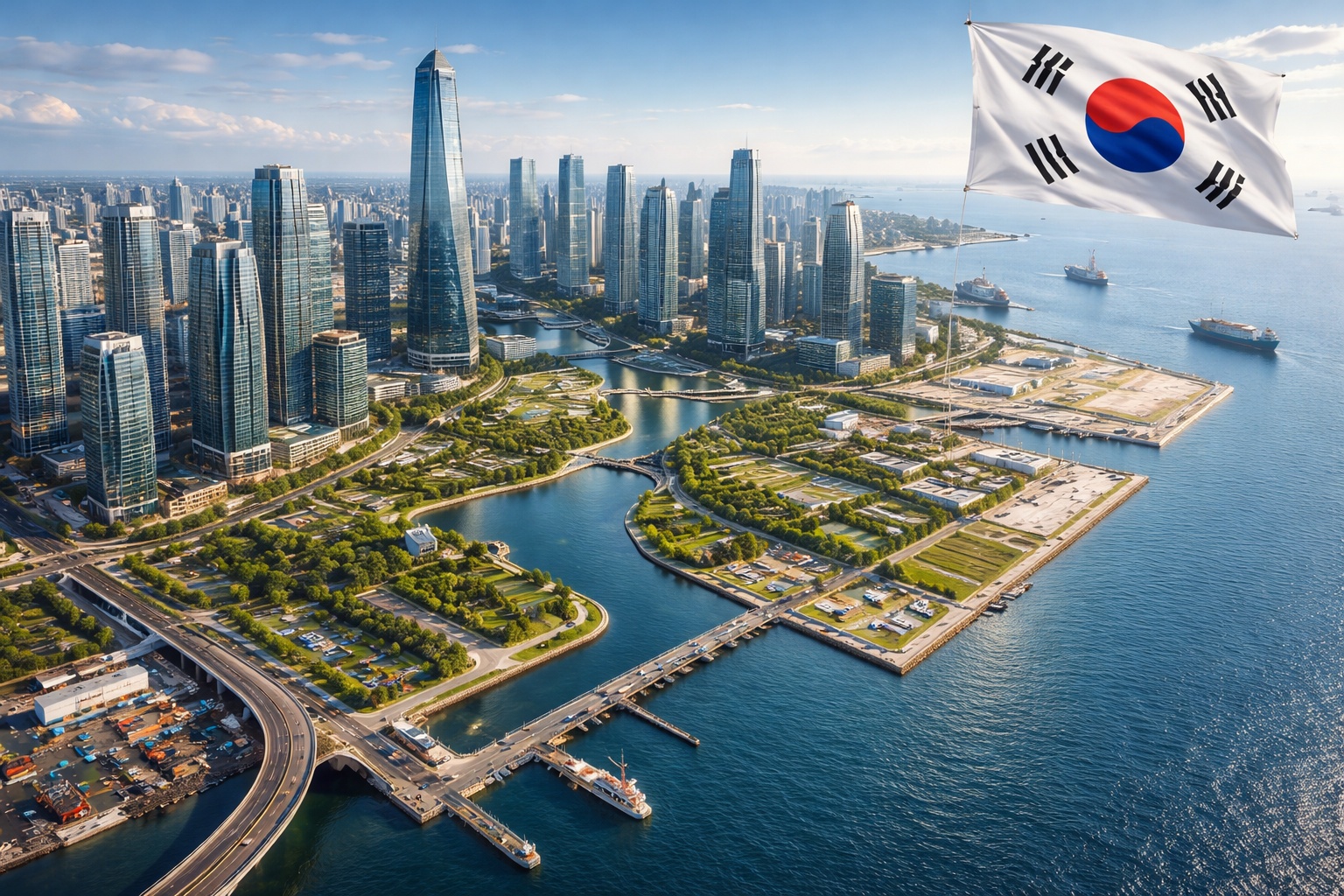


With 600 Hectares of Land Reclaimed and US$ 40 Billion Invested, South Korea Built Songdo, A Smart City Raised Entirely Over the Sea.
For decades, the west coast of South Korea was marked by marshy areas, extreme tides, and fragmented industrial zones. Instead of expanding its cities into the already saturated inland, the country made a radical decision: to create land where there was nothing, moving directly onto the Yellow Sea. Thus was born Songdo International Business District, one of the most ambitious urban projects of the 21st century.
The plan was not only to gain physical space but also to build an entire city from scratch, integrated into the global economy, with digital infrastructure, advanced logistics, and unprecedented environmental standards for artificial territory.
600 Hectares of Sea Transformed into Urban Territory
Songdo was built on approximately 600 hectares of artificial land, obtained through extensive processes of dredging, reclaiming, and compacting marine sediments. To achieve this, millions of cubic meters of sand and sedimentary material were moved from the seabed and nearby coastal areas.
-
After 79 Months and $145 Million Investment, Nepal Set to Open First 2.7 km Road Tunnel to Ease Traffic in Kathmandu Valley

-
In China, 23 Families Spent Over 4 Years Carving a 1.2 km Road Through a Cliff to Overcome Isolation and Transform a Remote Village

-
Giant 3,600-ton Crane Breaks Two World Records by Installing World’s Largest Single-Piece Forged and Welded Hydrogenation Reactor, Weighing 3,037 Tons, in Chinese Petrochemical Plant in Just Six Days

-
$80 Million Bridge in Brazil Cuts Travel Time from 30 Minutes to 1 Minute, but Audit Reveals Major Flaws


This type of construction requires strict control of soil stability, as newly reclaimed land is subject to settlement, liquefaction, and deformation over decades.
An Estimated Investment of US$ 40 Billion
The total cost of the Songdo project is estimated to be around US$ 40 billion, comprising public and private investments. This amount includes not only the land reclamation but also underground infrastructure, transportation systems, digital networks, commercial and residential buildings, and green areas planned from the foundation.

This represents one of the largest urban investments concentrated in a single area ever made outside national capitals.
Foundation Engineering on Artificial Soil
Building tall buildings on newly created land required advanced engineering solutions. Much of the structures utilize deep piles driven to more stable layers of the subsoil, penetrating the reclaimed material until reaching consolidated soils.
Without this care, it would be impossible to support skyscrapers, shopping centers, and heavy infrastructure on land that, until recently, was just ocean.
Urban Planning Done Before the First Construction
Unlike cities that grow organically, Songdo was entirely planned before the construction of the first building. Streets, blocks, energy, water, sewage, transportation, and data networks were designed in an integrated manner.
About 40% of the urban area was allocated to green spaces, including parks, artificial canals, and water retention areas, inspired by models of sustainable cities worldwide.
A Smart City from Birth
Songdo became known as one of the first “smart cities” conceived from scratch. Digital systems were embedded in urban infrastructure from the outset, allowing for automated control of traffic, energy consumption, public lighting, and waste management.
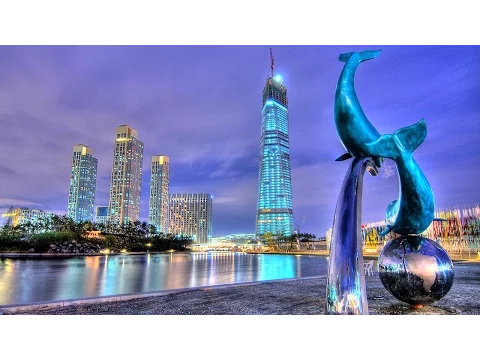
Sensors distributed throughout the city monitor everything from vehicle flow to water usage in residential and commercial buildings.
Logistics and Strategic Location
The city is located near the Incheon International Airport, one of the largest air hubs in Asia, and is integrated with national ports and rail networks. This position transforms Songdo into a logistics and financial platform, designed to attract multinational companies, research centers, and corporate headquarters.
The project aimed to position South Korea as an economic bridge between East Asia and the rest of the world.
Advancing Over the Sea as a State Policy
The construction of Songdo is part of a broader strategy of the country, which historically uses land reclamation to expand urban and industrial areas due to the limitation of available territory on solid ground.
This type of project requires complex environmental authorizations, marine impact studies, and continuous coastal monitoring to avoid erosion and damage to ecosystems.
A City Still in Transformation
Although much of the infrastructure is completed, Songdo continues to develop. Some areas are still undergoing adjustments in occupancy, population density, and social adaptation, a common challenge in large-scale planned cities.
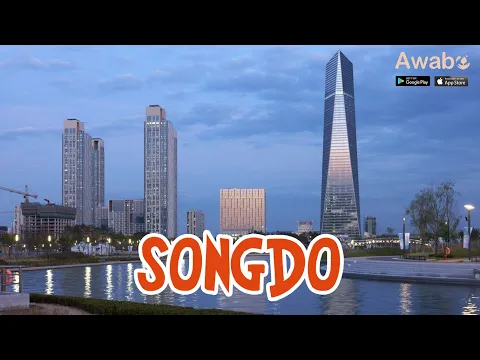
Even so, the project already serves as a urban laboratory, influencing similar initiatives in other Asian and Middle Eastern countries.
By reclaiming over 600 hectares of ocean and investing about US$ 40 billion, South Korea has demonstrated that the boundary between land and sea is no longer definitive.
Songdo is not just a city built over water; it is a real experiment of how engineering, planning, and technology can redefine the concept of urban territory.
Just as tunnels cross oceans and tracks traverse continents, Songdo proves that in the 21st century, even the sea can become a city — as long as there is enough money, engineering, and strategic vision.





A onipotência humana é recorrente e não tem limites, achando que com conhecimento e tecnologia pode domar e alterar impunemente ecossistemas naturais consolidados durante milênios. Acabei de ler sobre o Aeroporto Internacional de Kansai, no Japão, que simplesmente está afundando ! ! !
O ser humano não aprende . . .
I live in Songdo. It’s a great place to live. I see sunrises, sea line… nobody lived here before, no pain was felt here, no sorrow. After 19 years living in Seoul this place is a great change.
A Coreia do Sul ganha espaço sobre o Oceano, porém o sonho de lançar o Foguete foi para o espaço.