Portuguese
  Spanish


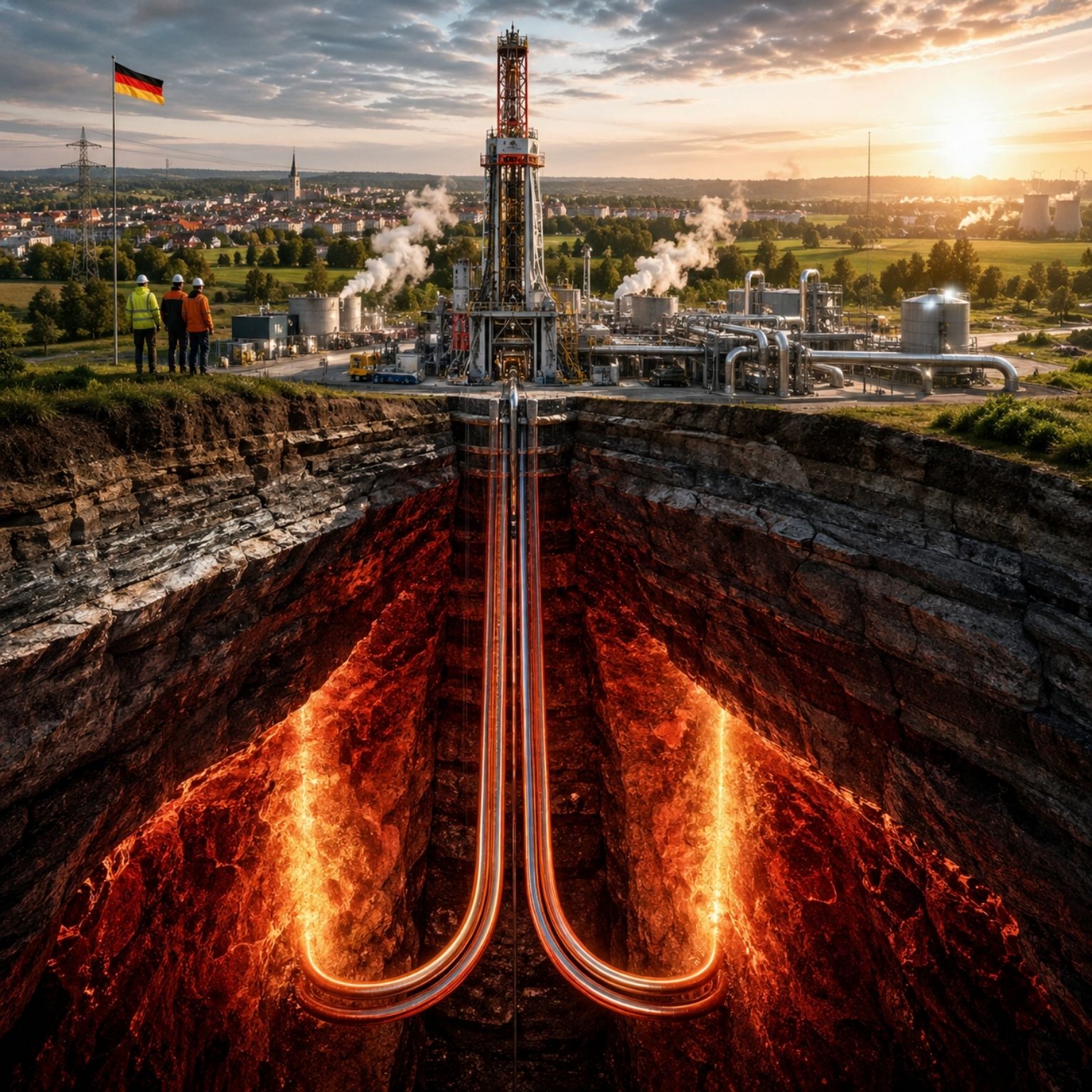

The giant radiator created underground in Geretsried transformed a previously failed geothermal field into a showcase of the new closed-loop geothermal system, by connecting two deep wells and a network of laterals that bring heat from the rocks to the surface to generate electricity continuously and in areas previously considered unsuitable for this type of project
The giant underground radiator installed in the Geretsried project in Germany has become one of the strongest examples of how advanced geothermal energy is trying to break the limits of the conventional model. In December 2025, Eavor Technologies began supplying electricity from the Eavor-Loop in Bavaria, about 40 kilometers south of Munich, marking the first successful commercial-scale application of this closed-loop system.
What makes the case so relevant is that it arises precisely where traditional geothermal energy had already failed. In 2013, the Geretsried field was the site of an unsuccessful conventional geothermal project because it lacked the reservoir properties necessary for the natural flow of hot water. Now, the same limitation has become an advantage to test a technology that does not depend on this natural circulation and uses a closed-loop to extract heat from the rocks and bring it to the surface.
What is the giant underground radiator created in Geretsried
The heart of the project is an architecture formed by two vertical wells and a network of multilateral horizontal wells that intersect at the end. According to the provided base, this mesh effectively formed a giant underground radiator, in which water circulates through the circuit and carries the heat from the reservoir to the surface.
-
Cost of Installing Subflooring in 2026: The Importance of Proper Slope to Prevent Water Damage and Costly Repairs

-
New Offshore Borehole Mining Technique Extracts Lithium and Cobalt Without Damaging Ocean Floor
-
Vale Doubles Copper Drilling in Brazil’s Carajás, Plans to Drill 120 Kilometers of Rock by 2026
-
Innovative Vertical Cistern Becomes Water Tank in Container Home Amid Pressure Issues, Offering a Compact 1,000-Liter Solution Without a Tower or Underground Tank


This model belongs to the category of advanced closed-loop geothermal systems. Instead of relying on fluid exchange with underground formations, it uses a sealed, pump-free circuit based on conduction. The goal is to enable electricity generation and continuous heat supply even in geologies that are not suitable for conventional geothermal energy.
How the Eavor-Loop works in practice
In the Geretsried system, the working fluid does not come from an underground reservoir. It is selected and added at the surface, then circulates through the closed-loop to capture heat from the Earth’s depths and is then used for electricity generation or in commercial heating and cooling applications.
This detail completely changes the logic of the project. Since the system does not depend on the natural flow of hot water underground, it expands the geographical reach of geothermal energy. Instead of being restricted to areas with naturally productive reservoirs, the technology seeks heat in formations previously considered unsuitable for commercial development.
The numbers that explain the size of the underground work
The system in Geretsried was built with two wells drilled to a total depth of 4,235 meters. They were opened 100 meters apart, crossing limestone and dolomite to a reservoir with temperatures between 150°C and 170°C.
From these wells, six pairs of 3,500-meter laterals were installed that intersect at the end, creating the closed-loop. This network was responsible for forming the giant radiator underground. From the start of the project, the parties involved knew that the scale of the work and the length of the lateral sections would require long drilling times and strong pressure on costs.
Why Geretsried became a milestone for European geothermal energy
The German project is regarded as the first successful commercial-scale application of the Eavor-Loop. This gives the case more weight than a simple technical test because it serves as a model for future geothermal developments in areas where conventional systems cannot operate.
This advancement has a direct impact on the narrative of so-called “geothermal energy anywhere.” If a failed geothermal field under traditional logic can be converted into a functional closed-loop unit, the project suggests a new front for the expansion of clean energy in previously discarded regions.
What changed in relation to the failed conventional project in 2013
The failure of the previous project in Geretsried was attributed to the absence of the reservoir properties necessary to maintain the natural flow of hot water. In a conventional system, this makes production unfeasible and compromises the entire economic logic of the enterprise.
In the Eavor-Loop, however, the lack of water in the reservoir ceased to be a problem and became precisely the reason why the field was ideal for the test. As the system uses a closed loop and a fluid controlled from the surface, it does not depend on the same geological conditions that brought down the previous project.
Drilling challenges nearly stalled the project for more than two years
Drilling the wells turned out to be much more difficult than planned. The initial schedule was for 107 days, but the actual execution extended for more than two years, from July 2023 to October 2025, due to a series of technical challenges.
The difficulties involved faults, folds, and thrusts on the slopes where the wells were being drilled, problems with shocks and vibrations in the bottom hole assembly, failures in rig components, and great complexity in controlling the trajectory in hard rock. The presence of oil and gas in one of the sections also increased the mud density and brought new difficulties for wellbore cleaning and stability.
What happened in the mud, trajectory, and telemetry operations
One of the biggest bottlenecks was the mud conditions. The accumulation of material in the drill string and on the bit reduced cutting efficiency and weight transfer, while large volumes of debris needed to be removed under difficult conditions. This caused flow erosion in bottom hole assembly components and mud pumps.
There were also problems with magnetic surveys and positioning accuracy, aggravated by the high latitude of the site and the intensity of the magnetic field. To try to solve this, the team first resorted to combinations of gyroscopic surveying and steering and inclination tools. Later, Eavor developed the Eavor-Link AMR tool, which allowed real-time magnetic communication between the bottom hole assemblies and reduced telemetry time by more than 70% in the last two pairs of laterals.
What made the drilling performance change drastically
According to the base, the turning point occurred when the team abandoned the clear drilling fluid and adopted a water-based fluid specifically designed for that purpose. The change greatly improved wellbore cleaning and reduced friction, stick-slip, and vibrations.
This change happened at the same time the drill string was switched from a tapered 5 x 5½-inch configuration to a stiffer, 5½-inch only string. The result was a direct gain in efficiency. While the first four pairs of laterals took an average of 54.5 days per section, the fifth and sixth pairs were drilled in an average of 16.5 days each, representing a 70% reduction in drilling time.
What this means for cost and economic viability
Since the closed system does not use pumps, the expectation was that operating costs would be much lower than those of conventional geothermal. This meant that the greatest economic weight of the project lay in the construction of the wells and the time required to execute them.
Therefore, every gain in drilling speed had a direct impact on the project’s viability. The reduction in time for the last pairs of laterals showed that the learning curve was decisive. In a model where underground work dominates the initial cost, drilling better, faster, and with less non-productive time can be the factor that separates a promising technology from a truly scalable solution.
Why the giant radiator could change geothermal energy in Europe
The German project suggests that closed-loop systems can open up markets in areas where traditional geothermal cannot advance. This is especially relevant in Europe, where the challenge is not only to generate clean energy but to do so in different geological contexts without relying exclusively on naturally ideal reservoirs.
By proving that the giant underground radiator worked in a field where the conventional approach failed, Geretsried is now seen as a model of what may lie ahead. The main message is clear: geothermal energy can cease to be a technology limited to a few places and start operating on a broader scale, as long as drilling and closed-loop engineering continue to evolve.
The next steps and the weight of lessons learned
According to Blaine Dow, the lessons learned from Geretsried will be applied in future Eavor-Loop implementations. This includes everything from adjustments to fluids and drill strings to the use of new telemetry tools and more efficient strategies for installing the lateral pairs.
This point is essential because the project’s success did not come easily. It came after long delays, corrected errors, and an intense learning curve. Precisely for this reason, the German case gained so much value. It was not just a proof of concept. It was a real-scale demonstration that advanced geothermal can learn, evolve, and begin to operate commercially even after severe technical obstacles.
In your view, do systems like this giant underground radiator have the potential to transform geothermal into a viable energy source in many more regions, or are the drilling challenges still too great for that?