Portuguese
  Spanish


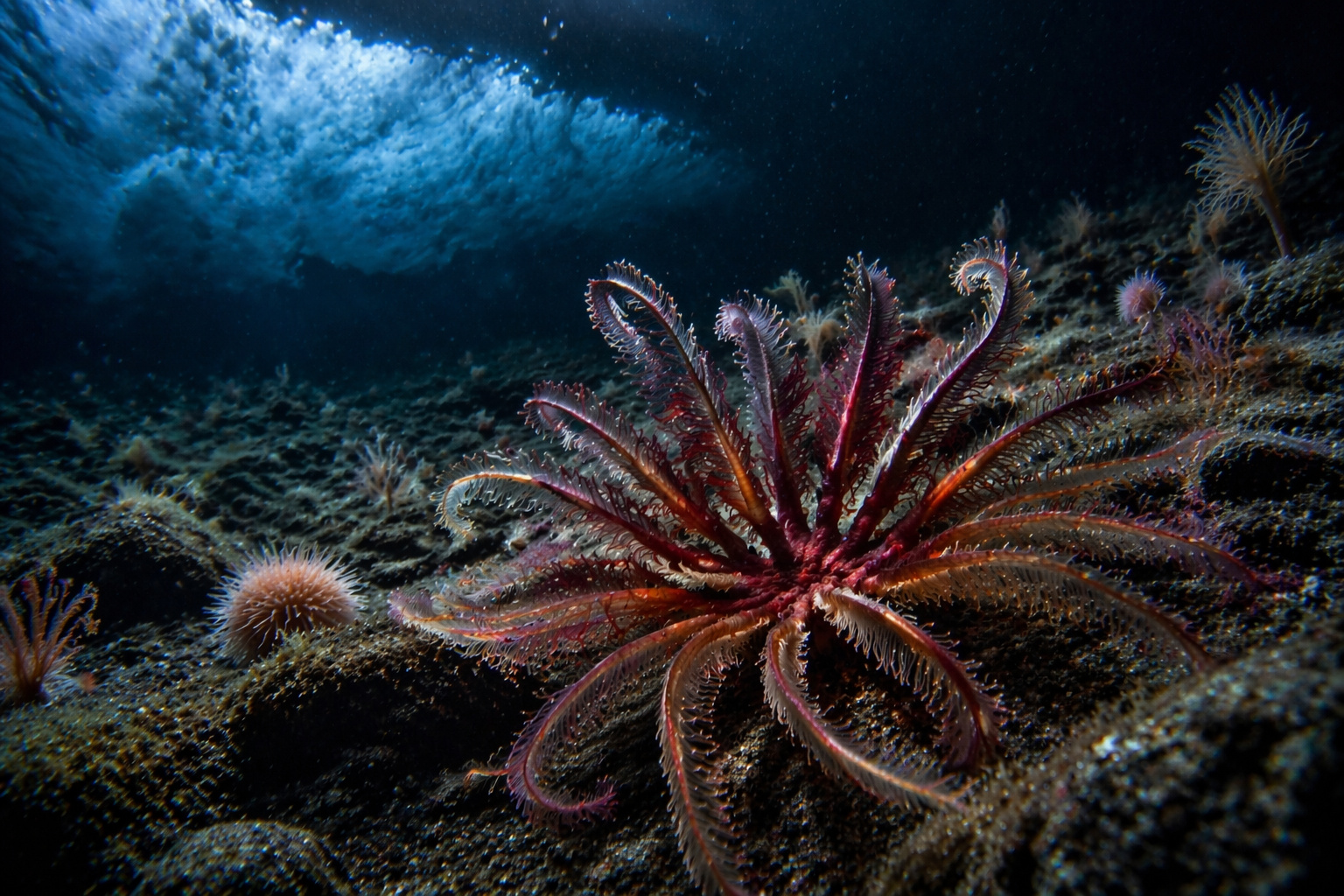

Scientific discovery registered in 2023 reveals unusual organism in ocean depths and reinforces the still little understood diversity of Antarctic marine life
A marine discovery of great scientific relevance was recorded during a long expedition in Antarctica, conducted between 2008 and 2017 by a team of marine biologists.
During this mission, researchers identified an organism with about 20 arms, whose appearance was considered unusual compared to other marine invertebrates.
Subsequently, the results were published in the Invertebrate Systematics Journal, in 2023, consolidating the finding in the scientific community.
-
NASA Rover Captures “Tired Face” on Mars, Highlighting Human Brain’s Tendency to See Faces in Rock Formations

-
Ancient Stone City in the Desert, Once Home to 30,000, Puzzles Scientists with Nabateans’ Water Mastery 2,000 Years Ago

-
Ancient Creature Thought Extinct Since Dinosaur Era Reappears, Baffling Scientists
-
India Deploys Giant Fabric Tubes Filled with Sand to Combat Coastal Erosion and Rebuild Disappearing Beaches





Furthermore, the discovery directly contributed to the advancement of research on marine biodiversity in the planet’s deep and cold regions.
Scientific investigation expands knowledge about feather stars
Initially, the goal of the expedition was to study organisms of the genus Promachocrinus fragarius, known as Antarctic feather stars.

These creatures live in deep waters of Antarctica and attract interest due to their biological and behavioral characteristics.
Therefore, researchers sought to better understand their distribution, habits, and physical structure over time.
However, during the process, new specimens were found, significantly expanding the scope of the scientific research.
Consequently, new lines of investigation emerged within the same biological group.
Unusual appearance and differentiated movement draw attention
According to the study published in 2023, feather stars exhibit distinct characteristics compared to other marine invertebrates.
Although there are similarities with organisms such as starfish and sea cucumbers, these creatures have relevant differences.
Among them, the larger size and the way they move in the water stand out, contributing to their appearance being considered unusual.
Furthermore, the swimming mode reinforces the uniqueness of these organisms in the deep ocean environment.

Habitat in extreme depths complicates research
The Antarctic feather stars are found in regions that vary between 100 and 1000 meters deep.
These conditions make research more complex due to the extreme characteristics of the marine environment.
Therefore, data collection requires prolonged expeditions and specialized equipment.
Still, these regions remain essential for understanding ocean biodiversity.
New species expand known diversity
During the study, in addition to the already known specimens, seven new species belonging to the same group were identified.
It is important to highlight that these species had not been previously described or named by science.
Thus, the work contributed to expanding knowledge about the diversity of the genus Promachocrinus.
Additionally, it reinforced the existence of organisms that had remained scientifically unclassified until then.
DNA analyses and morphology confirm classification
Over the years, some specimens had already been collected in previous expeditions.
However, their classification had not yet been definitively confirmed.
Now, based on detailed analyses, scientists have managed to validate these suspicions.
To this end, DNA tests and studies of the physical morphology of the organisms found were conducted.
Thus, it was possible to confirm their connection to the group of Antarctic feather stars.
Oceans still hide great unknown diversity
The results obtained indicate that marine biodiversity is still not fully known to science.
Moreover, the oceans continue to be environments with high potential for new discoveries.
According to the authors of the study, a more comprehensive exploration will be essential to expand this knowledge.
Thus, understanding the great variety of life in the waters of Antarctica remains a relevant scientific challenge.
In light of this, the advancement of research may reveal even more unknown species in the planet’s oceans — and, with that, deepen the understanding of marine life in the world’s most remote regions.