






 Portuguese
  Spanish
  5 min of reading
  0 comments


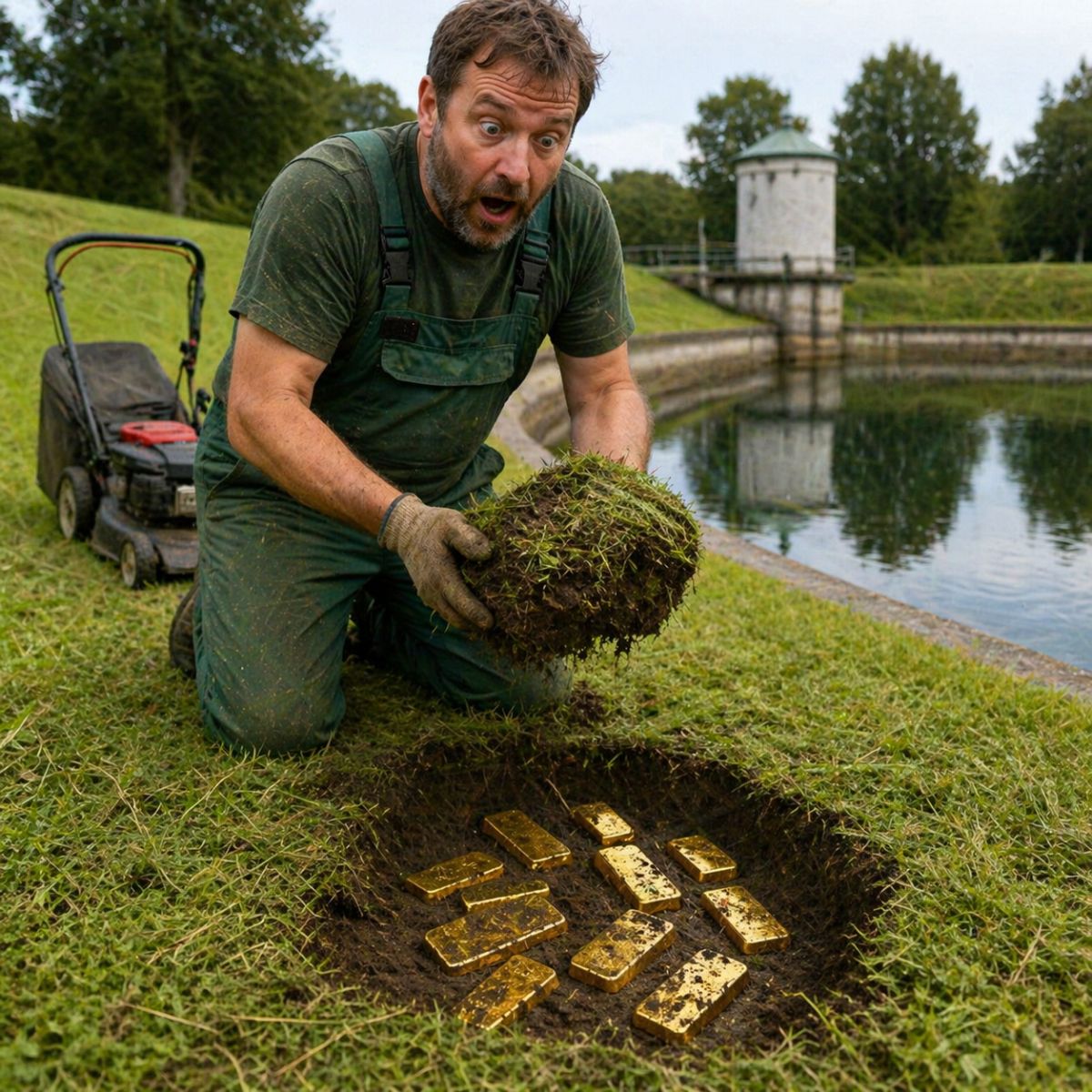
A gardener who worked as a municipal employee in Bannewitz, Germany, found 10 gold bars weighing 280 grams buried under the grass of a reservoir. The treasure, valued at 40 thousand euros or about R$ 235 thousand, remained unclaimed for six months, and now the municipality will distribute the bars among local clubs that work with children and youth.
A gardener who worked as a municipal employee in Bannewitz, Germany, made a discovery that seems straight out of an adventure movie. While mowing the grass near a reservoir, he found 10 gold bars buried just below the surface of the lawn. The find, which occurred in October 2025, weighs approximately 280 grams in total and is estimated to be worth 40 thousand euros, equivalent to about R$ 235 thousand. Since then, the case has turned into a saga involving municipal legislation, frustrated claims, and an outcome that no one expected.
According to German law, unknown owners have six months to prove ownership of found property. The deadline expired on Friday, April 17, 2026, and none of the more than ten people who came forward during this period managed to convincingly prove that the gold bars were theirs. With the legal deadline over, the municipality of Bannewitz is officially authorized to keep the treasure, and Mayor Heiko Wersig has already decided that the gold will be allocated to local clubs and associations.
How the gardener found the gold bars buried under the grass

According to information released by the portal ndmais, the discovery did not involve a metal detector or intentional searching. The gardener was performing routine maintenance of the lawn around a municipal reservoir when the blade of the mower hit something solid below the surface. Upon investigating, he found the first gold bars, small enough to be hidden just a few centimeters deep, but heavy enough to draw immediate attention.
-
Survivor of 1966 SS Daniel J. Morrell Shipwreck in Lake Huron Recounts 38-Hour Ordeal in Extreme Cold

-
The Greatest Hoax in World Cup History? The Film That Denied Brazil’s 1958 Victory and Exposed How Fake Evidence Can Seem Convincing on TV
-
Fake South Korean Online Stores Offer Shopping Thrill Without Spending Money or Receiving Products
-
The War of Jenkins’ Ear: How a Severed Ear Sparked One of the 18th Century’s Most Unusual Conflicts


The employee reported the find to the municipal authorities, who called the police to register the occurrence and start the investigation into the origin of the treasure. No one knows who buried the gold bars at that location or when it happened. The reservoir is a public space in Bannewitz, a town with about 11,000 inhabitants on the outskirts of Dresden, in Germany, and there are no records of previous reports about valuable objects buried in the region.
Why no one was able to prove that the gold bars were theirs
Over the six-month legal deadline, more than ten people presented themselves to the authorities of Bannewitz claiming to be the owners of the gold. None of them, however, were able to provide convincing proof of ownership, such as purchase receipts, certificates of authenticity with corresponding serial numbers, or any documentation linking the gold bars to a specific owner.
The difficulty in proving possession is not surprising. Gold bars are assets that often circulate outside the formal banking system, and the lack of registration complicates traceability. In Germany, the legislation is clear: if a found item is not claimed with proof within six months, ownership passes to the municipality where the object was found. The police are still investigating two final leads before the treasure is formally transferred, but the legal outcome is already practically determined.
What the municipality decided to do with the treasure of R$ 235 thousand
The mayor Heiko Wersig decided that the gold bars will be distributed among ten of the 52 local clubs and associations in Bannewitz, prioritizing entities that work with children and youth. Each selected club will receive one bar, which they can sell on their own, as selling through the municipal administration would be excessively bureaucratic.
The city council plans to decide on April 28 which entities will benefit. Wersig told the Tag24 portal that he would like to include all clubs at once, but with only ten bars available, selection will be necessary. For security reasons, the mayor does not want to keep the gold bars stored in the city hall until distribution, a precaution that is understandable given the value of the material and the attention the case has attracted in the German and international media.
What German law says about treasures found in public spaces
The legislation in Germany regarding the finding of valuable items has roots in civil law and follows clear rules. Anyone who finds a valuable object in a public space is obligated to report the find to the authorities, and the original owner has a six-month period to claim the item with documentary proof. If no one comes forward or the claims are deemed insufficient, ownership is transferred to the municipality.
The gardener who found the gold bars will not have the right to keep any of them, as the discovery was made during the exercise of his duties as a public employee. In other countries, the legislation varies: in some, the discoverer is entitled to a share of the value; in others, like in this case in Germany, the benefit goes entirely to the community. The decision to allocate the gold to youth clubs transforms a chance find into a social investment, giving the treasure a destination that its original owner likely did not plan.
The mystery that remains about who buried the gold in Bannewitz
Even with the legal deadline expired and the fate of the gold bars practically defined, the central question remains unanswered: who buried 280 grams of gold under the grass of a public reservoir in a small town in Germany? The hypotheses range from unreported inheritance and informal savings to asset protection during periods of instability, something that has historical precedent in a region that lived under the communist regime of East Germany until 1990.
The police keep the investigation open for two final leads, but without expectation of a revealing outcome. The gardener who made the discovery has returned to the routine of mowing grass in Bannewitz, probably looking at the lawn with a little more attention than before. The gold remains stored in a safe place, awaiting the final decision of the city council and the distribution that will transform the unlikely find into a concrete benefit for the community.
Have you ever found something valuable unexpectedly, or do you think the gold bars should have stayed with the gardener who discovered them? Tell us in the comments what you would do if you found buried treasure in your yard and if you agree with the decision of the Bannewitz city hall.





Be the first to react!