






 Portuguese
  Spanish


Government Starts Duplication Work on PR-412 in the Paraná Coast, with Rigid Concrete Pavement and Million-Dollar Investment, Transforming the Connection Between Matinhos and Praia de Leste Into a Modern and Safe Corridor.
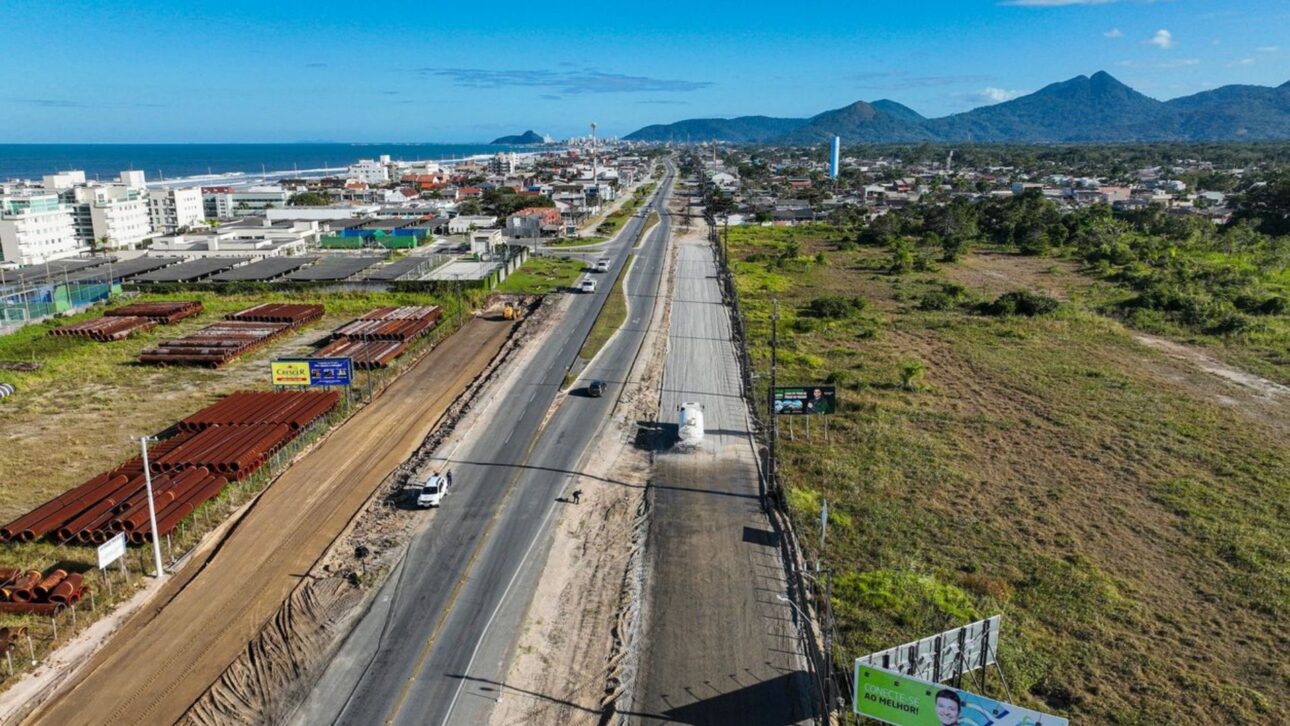
The Government of Paraná began this Saturday (August 9) the duplication of PR-412 between Matinhos and the resort of Praia de Leste, in Pontal do Paraná, on the State’s Coast.
The stretch of 14.28 kilometers will receive rigid concrete pavement, a solution that can last up to three times longer than traditional asphalt, according to norms and practices of highway engineering.
The expected investment is R$ 274 million to transform the main connection between the two cities.
-
Driver who “holds” the left lane can receive a hefty fine and 4 points on their driver’s license even if they think they are going at the correct speed for the road.

-
São Paulo Government puts R$ 343 million on the table and releases 31 km of duplication, 9.84 km of third lanes, 4 reinforced viaducts, and 8 grade-separated returns.

-
Volvo FH 2026 truck automatically reduces speed in risk areas in Brazil with GPS, activates engine brake without driver intervention, and combines safety with aerodynamics capable of saving up to 3% of diesel in some operations.

-
A viaduct over 40 years old in a city in Minas Gerais was closed due to the risk of collapse, blocked routes for months, exposed maintenance failures, and now requires a R$ 1.7 million project to prevent a collapse in the urban heart for decades.




With this investment, the State signals a transition to a concrete highway in the Paraná Coast, aligned with common standards in highways with heavy traffic.
What Changes on PR-412
Known as Máximo Jamur Highway, PR-412 will have a new central concrete lane and marginal lanes to organize local access.
The work was launched by Governor Carlos Massa Ratinho Junior.
“We are starting another major work in the Coast, which is the duplication of the highway between Matinhos and Praia de Leste, which will be a large avenue with concrete lanes, a bike lane, walkways, and LED lighting,” he stated.
The head of the Executive said that the duplication of PR-412 is part of a broader package of improvements in coastal cities.
The user will have a central high-performance lane and one-way marginal lanes.
These marginal lanes will have parking spaces, sidewalks for pedestrians, and bidirectional bike lanes, with concrete barriers separating the flows.
The expectation is to reduce conflicts between long-distance traffic and local movements, increasing safety in the urban stretch.
Works and Schedule
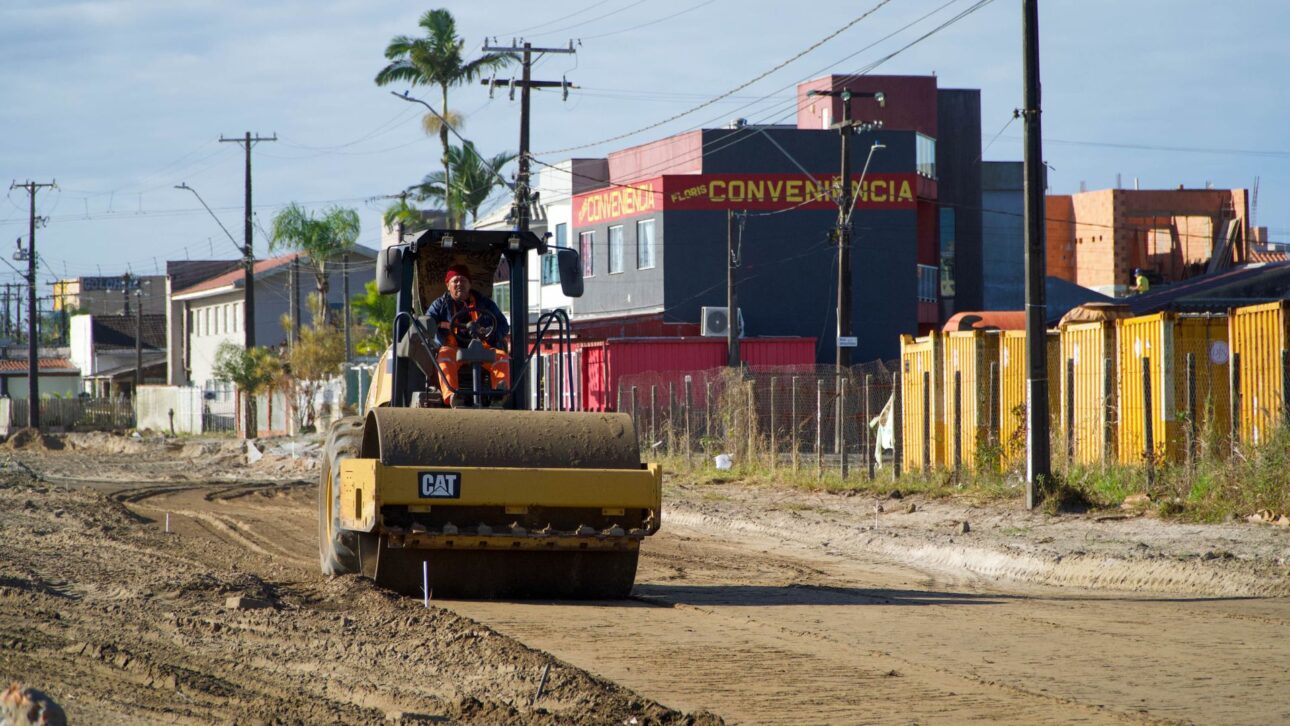
The services began with the implementation of the marginal lanes, where traffic will be diverted to free the work front on the main axis.
The execution is the responsibility of a company contracted by the Department of Highways of Paraná (DER/PR), which is also responsible for the technical supervision of the contract.
According to the state secretary for Infrastructure and Logistics, Sandro Alex, the schedule is already counting down.
“We already have machines on the lane and have started counting down the schedule, as the work has a duration of 36 months,” he said.
“We will organize traffic during the high season, to ensure mobility, accelerating to deliver it before the deadline.”
Why Concrete and Not Asphalt
The project defines rigid pavement of 21 centimeters thickness on the central lane.
This type of structure distributes vehicle loads better, tolerates temperature variations, and has longer lifespan in humid environments, such as that of the Coast.
In general, it requires less maintenance interventions over the years, which reduces traffic interruptions and recurring costs.
This choice reinforces the guideline of transforming the connection into a concrete highway in the Paraná Coast, aligned with the practice of countries that prioritize durability in corridors with high vehicle volume.
Safety and Mobility
The current lane will be widened on both sides and separated by concrete barriers in the central median.
The bidirectional bike lanes will have flow in both directions, designed to protect cyclists.
The combination of one-way marginal lanes, controlled accesses, and enhanced lighting tends to reduce head-on and side collisions, common in urban stretches of highways.
Bridges, Overpass, and Drainage
The project provides that the drainage of rainwater is to be executed under the marginal lanes.
This option avoids the relocation of already installed underground networks and accelerates the work fronts.
By mitigating flooding points, the intervention aims to preserve the pavement and ensure regular traffic during heavy rain, a recurring condition on the coastal strip.
Two bridges are planned — one over the Matinhos Canal and another over the Balneário River — and a viaduct at the intersection of PR-412 with Avenida Curitiba.
The special works eliminate at-level crossings, make movements more predictable, and facilitate those using the route between Matinhos and Praia de Leste.
The installation of public LED lighting will cover the central lane, marginal lanes, bridges, overpass, and areas for walking and biking, increasing nighttime visibility and reducing energy consumption.
Impact on Residents and Tourists
The mayor of Pontal do Paraná, Rudão Gimenez, stated that the intervention adds mobility and safety.
“The work will improve mobility in the beaches of Pontal and Matinhos, will bring safety in traffic for pedestrians and cyclists, as well as reduce flooding with drainage works,” he said.
“It will be a gain for the entire region, improving conditions for both tourists and residents.”
In the assessment of Matinhos’ mayor, Eduardo Dalmora, the initiative addresses long-standing bottlenecks.
“This work benefits the driver, summer visitor, pedestrian, cyclist, and will connect Matinhos to Pontal with more safety and mobility,” he stated.
Integration with Other Works on the Coast
The governor mentioned the Guaratuba Bridge, a long-awaited project for decades, and the requalification of the waterfronts of Matinhos and Pontal do Paraná.
According to Ratinho Junior, the bridge is 70% complete, while the Pontal waterfront recently began works and new stages are planned for Guaratuba.
In the same context, the DER/PR is conducting bidding to duplicate another stretch of PR-412, between Guaratuba and the border with Santa Catarina, and the State has partnered with the state of Santa Catarina to enable the continuation of the duplication on the Garuva side up to the border.
The goal is to provide a continuous corridor with the standard of concrete highway in the Paraná Coast, reducing interstate bottlenecks during peak season.
Photo: Jonathan Campos/AEN” class=”wp-image-252744″ srcset=”https://clickpetroleoegas.com.br/wp-content/uploads/2025/08/Imagem-CPG-redimencionada-para-google-discovery-2025-08-10T122936.343-1290×726.jpg 1290w, https://clickpetroleoegas.com.br/wp-content/uploads/2025/08/Imagem-CPG-redimencionada-para-google-discovery-2025-08-10T122936.343-768×432.jpg 768w, https://clickpetroleoegas.com.br/wp-content/uploads/2025/08/Imagem-CPG-redimencionada-para-google-discovery-2025-08-10T122936.343-1536×864.jpg 1536w, https://clickpetroleoegas.com.br/wp-content/uploads/2025/08/Imagem-CPG-redimencionada-para-google-discovery-2025-08-10T122936.343.jpg 1920w” sizes=”(max-width: 1290px) 100vw, 1290px” />
Photo: Jonathan Campos/AEN
Cost-Benefit and Maintenance
Although the initial investment in concrete is higher, durability and less need for heavy repairs dilute these costs over the life cycle of the road.
For users, less maintenance means fewer closures and more reliability.
For the public authorities, there is budget predictability to maintain the level of service.
In summer tourism, this factor weighs heavily, as interruptions during peak season affect commerce, hospitality, and logistics.
The duplication of PR-412 changes the routine of those who live and work along the Matinhos–Praia de Leste axis.
With marginal lanes, bike paths, bridges, and an overpass, the intervention reorganizes flows and reduces conflicts between local traffic and transit.
The technical choice of concrete anchors the strategy to consolidate a concrete highway in the Paraná Coast focusing on durability, security, and predictable maintenance.
The execution, according to the government, will follow monitoring by the DER/PR and special planning for the high season, including diversions through the new marginal lanes to maintain flow.
How do you evaluate the duplication of PR-412 in concrete: a correct priority for a tourist corridor or an investment that should be distributed among other urban fronts on the Coast?


