Portuguese
  Spanish


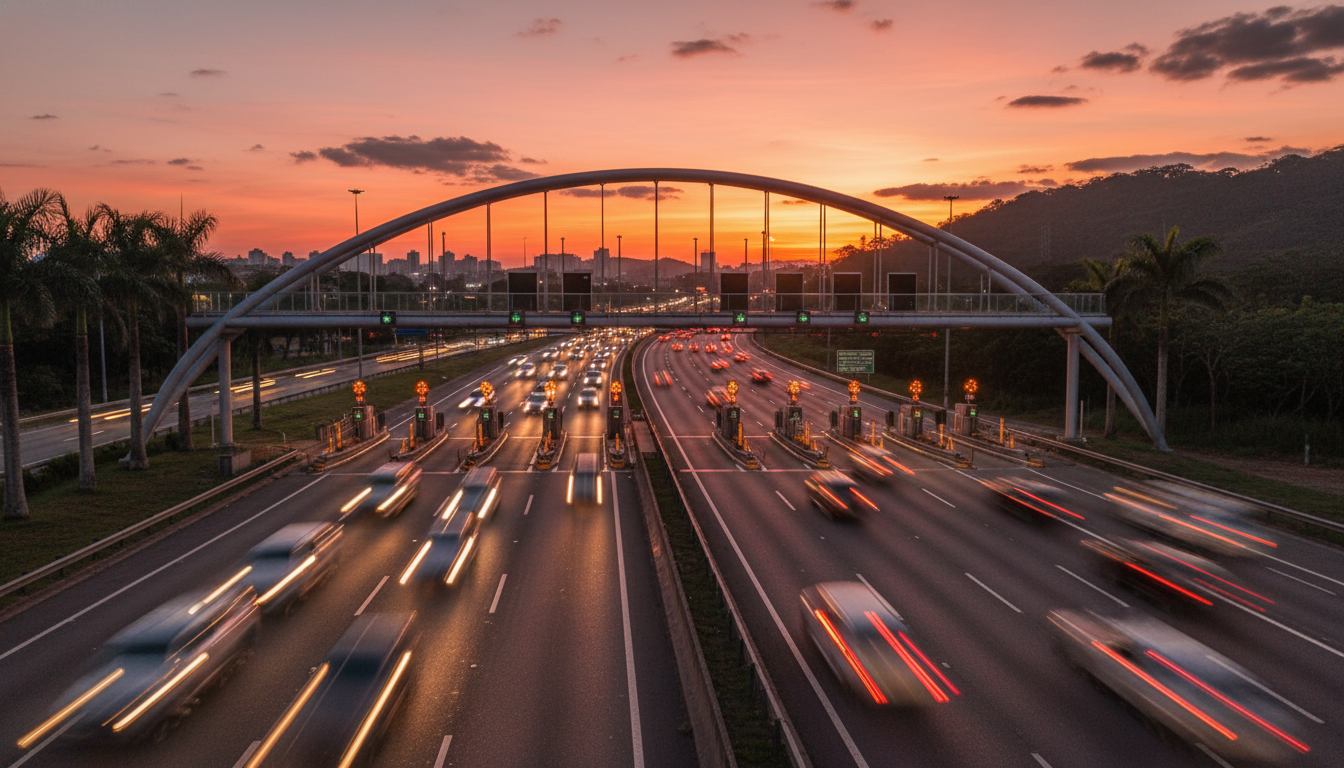

While drivers on 14 Brazilian highways discovered they had accumulated fines from Free Flow without being notified, the federal government suspended no less than 3.4 million infraction notices on April 28, 2026, and opened a 200-day deadline to pay overdue fees until November 16, 2026, according to an order signed by the Minister of Transport George Santoro as president of Contran, published by the Ministry of Transport.
The measure affects concessionaires of the 4 main groups operating tolls without barriers in Brazil: RioSP/Motiva, Nova 381 S.A, EPR Iguaçu, and Ecovias Noroeste Paulista.
The fines ranged from R$ 5 to R$ 25 per missed passage.
-
Sales of Brazil’s Cheapest Electric Car Halted Before First Deliveries: E-Motors Suspends Emova Easy Due to Import Tax Increase and Rising Freight Costs

-
Nissan Discontinues Qashqai SUV Amid Cost-Cutting, Chinese Competition, and Product Line Review

-
BYD Patents Revolutionary System Using Computer Vision to Detect Animals Under Cars Before Starting, Preventing Tragedies

-
Study Reveals Why Cars Are More Expensive to Produce and Buy in Brazil Compared to Mexico, Highlighting Taxes, Logistics, and Industrial Costs as Key Factors.




The official justification is straightforward. According to the order, the system had “difficulty accessing the necessary information for fee payment.”
Drivers did not receive SMS, email, or clear notification to pay the fee within the 30 regulatory days before the fine.
The 14 highways with Free Flow affected by the suspension
The Free Flow currently operates on 14 stretches of federal and state highways. The list covers 8 states and affects drivers from São Paulo, Rio de Janeiro, Minas Gerais, Paraná, Rondônia, and Mato Grosso.
On BR-101/RJ-SP, CCR RioSP-Motiva operates 3 gantries: Itaguaí (km 414), Mangaratiba (km 447), and Paraty (km 538). According to ANTT data, this stretch usually records more than 18 million passages per year.
In Minas Gerais, Nova 381 S.A manages 4 gantries on BR-381 between Belo Horizonte and Governador Valadares. Way-262 covers 2 points on BR-262.
EPR Sul de Minas has 1 gantry in Monte Sião (MG-459, km 12.7).
Meanwhile, in Paraná, EPR Iguaçu and EPR Paraná operate at 6 points distributed between PR-182, PR-280, BR-369, and BR-376. Ecovias Noroeste Paulista covers SP-333 at km 179 (Itápolis) and 110 (Jaboticabal).
The numbers explaining the record suspension
The rate of fine accumulation surprised the Ministry itself. According to a report by Senatran, there were 3.4 million fines between 2022 and April 2026 on just 14 highways.
According to the Ministry of Transport, the average was 858,000 fines per year. In some stretches, like BR-101/RJ-SP, the proportion reached 12% of passages converted into fines for non-payment.
The unit value of the fines ranged from R$ 195.23 (minor infraction) to R$ 293.47 (medium infraction), according to the CONTRAN table.
The values result in a potential total loss between R$ 663 million and R$ 998 million in suspended fines.
Above all, the toll fee itself, which originated each fine, varies between R$ 5 and R$ 25 depending on the stretch. The driver who missed the payment still needs to pay the original fee.
The 200-day deadline ends on November 16, 2026.

Technical reveal: how barrier-free tolling works
In the background, Free Flow combines 3 technologies to charge the fee without the driver stopping. The first is optical character recognition (OCR) of plates.
The cameras read each vehicle in motion at up to 110 km/h.
According to ANTT’s details, the second layer is LiDAR, a laser sensor that measures the vehicle’s size and classifies the category.
Five-axle trucks pay more than passenger cars in 6 different categories.
The third layer is CONTRAN-ANATEL approval. The system needs to authorize the fee within 48 hours after the passage, or it loses validity.
This deadline is the bottleneck that generated part of the 3.4 million suspended fines.
Meanwhile, the driver has 30 days after the passage to pay the fee before the fine. Payment occurs via 5 channels: gov.br/transito app, concessionaire’s website, prior automatic debit, accredited post, and linked electronic tag.
Why the system failed for 3.4 million
The central reason for the systemic failure was the difficulty accessing billing information. According to Contran’s own order, SMS and email notifications did not reach a significant portion of fined drivers.
According to G1, 3 combined technical problems explain the result. First, outdated registrations at the DETRAN of the 27 states.
Second, Renach base with old addresses. Third, lack of integration between concessionaires and the federal system.
Meanwhile, the gov.br/trânsito app did not yet have a unified interface for Free Flow at the time of the passages. The user needed to access each concessionaire’s website separately.
The integrated version of the app has been in development since 2024 and is expected to go live by December 2026.
Above all, the Federal Court received more than 47,000 writs of mandamus in 2025 against Free Flow fines. In February 2026, the Federal Regional Court of the 2nd Region granted a collective injunction suspending 12,000 fines in Rio de Janeiro.
The judicial decision was one of the triggers for Contran’s administrative measure.

Human reveal: the case of driver Marcos Andrade in Rio
The human face of the problem appeared in several individual cases. According to a report by G1 Rio, Rio driver Marcos Andrade discovered in 2025 that he owed R$ 23,840 in accumulated fines from BR-101/RJ-SP.
He crossed the Mangaratiba gantry 3 times a week for work.
Andrade’s case is not isolated. Reports from Estadão and Folha de São Paulo documented, in February 2026, 12 professional drivers with fines above R$ 10,000 each.
In 8 of the 12 cases, the driver had not received any prior notification.
Meanwhile, drivers of apps like Uber and 99 were especially affected. The category frequently crosses gantries and has unstable registration at the DETRAN due to frequent address changes.
On the other hand, the National Union of Professional Drivers requested in March 2026 that Contran completely suspend the fines until the unified interface is ready.
The April 28 order partially met the request with a limited deadline.
How international models work
The Brazilian Free Flow mirrors systems already operating in 4 developed countries. In the USA, E-ZPass covers 19 states in the Northeast and Midwest since 1989 with mandatory electronic tags.
According to the Federal Highway Administration, the system has 22 million active users. The successful collection rate is 99.7%, compared to about 88% of Brazil’s early experiences with Free Flow.
In France, the Liber-t system has been operating with tags since 1999 and covers 9,000 km of highways. In Italy, Telepass reaches 13 million subscribers.
In Portugal, Via Verde operates 100% of tolled bridges and highways.
Meanwhile, none of the 4 countries has the Brazilian equivalent of payment without a prior tag. The flexibility of Brazil’s Free Flow, where the driver pays up to 30 days after the passage even without a tag, is greater, but the 99.7% efficiency charged by E-ZPass shows the path for improvement.

Future reveal: the next phase with integrated app in December
The next step planned by Senatran is the launch of the integrated Free Flow interface in the gov.br/trânsito app by December 2026.
The final version will allow payment to all concessionaires on a single screen with automatic vehicle registration.
Meanwhile, the ministry is preparing a regulation review. The proposal includes an automatic 60-day period between passage and fine, instead of the current 30.
Concessionaires will have 48 hours to notify via 3 different channels: SMS, email, and app push notification.
According to an analysis by Estadão, the next round of concessions includes 8 new stretches with mandatory Free Flow. The schedule covers BR-040, BR-153, BR-262, and extended BR-381.
It is worth remembering the advancement of centralized digital platforms in other traffic fronts.
- Suspended fines: 3.4 million on 14 highways
- Deadline to regularize: 200 days
- Deadline date: November 16, 2026
- Unit value: R$ 195.23 to R$ 293.47 per fine
- Total potential in fines: R$ 663 million to R$ 998 million
- Toll fee: R$ 5 to R$ 25 per passage
- Signatory: Minister George Santoro
- Coverage: 8 states (RJ, SP, MG, PR, RO, RS, MT, SC)

The points still pending regulation
Despite the order, 3 fronts still depend on complementary regulation. The integrated interface of the gov.br/trânsito app has a schedule until December 2026 but may be delayed.
On the other hand, the next round of concessions needs to define uniform deadlines for all concessionaires. Finally, integration with Renach bases and the 27 state DETRANs remains a critical point.
The outcome of this harmonization defines the pace of phase 2 of Free Flow in Brazil.