






 Portuguese
  Spanish
  8 min of reading
  0 comments


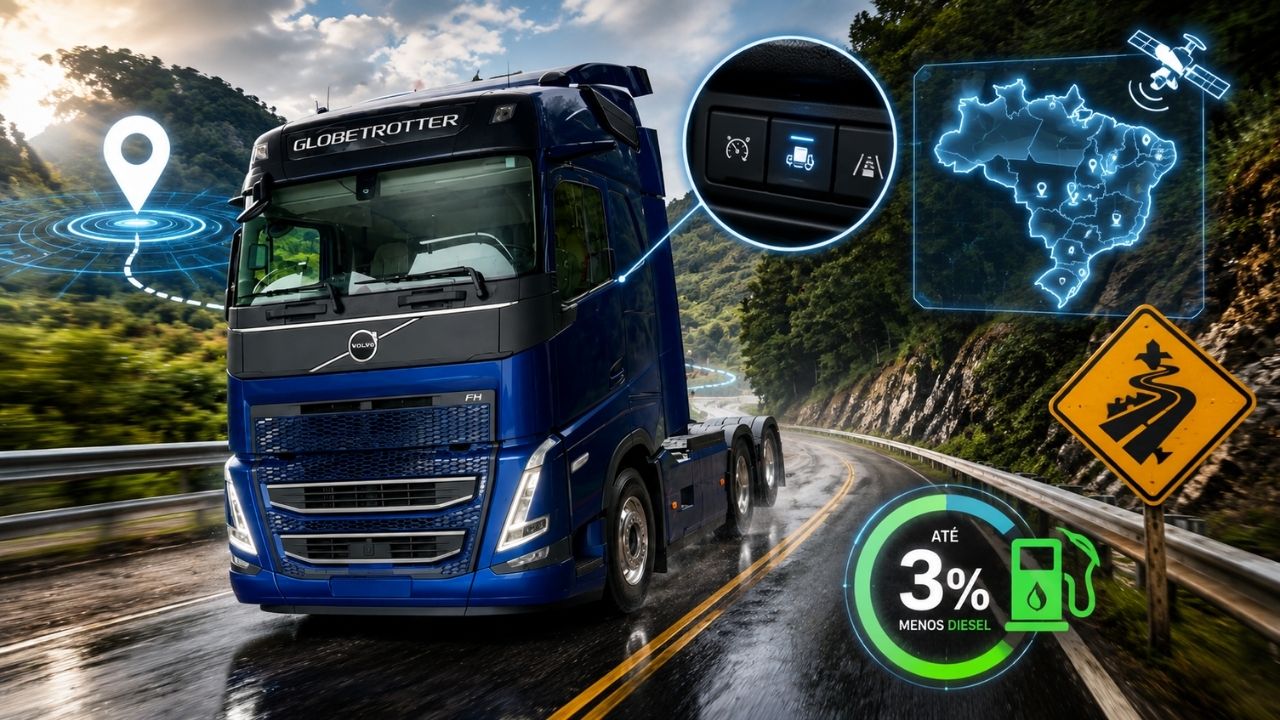
The Volvo FH 2026 truck debuts in Brazil with Safety Zones, a service that uses GPS to limit speed and activate engine brake in zones programmed by the fleet. Separately, I-Torque promises up to 3% fuel savings in certain operations, while aerodynamic adjustments help reduce drag in transportation.
The Volvo FH 2026 truck now features in Brazil a technology capable of automatically reducing its speed when entering areas previously classified as critical by the carrier. Launched by Volvo in May 2026, Safety Zones uses GPS connectivity and the Volvo Connect platform to control limits in locations such as curves, yards, terminals, and risk sections.
As shown in a video published by the channel Planeta Caminhão, the innovation does not mean that the vehicle chooses on its own where it should decelerate. The zones are programmed by the fleet manager, who determines on the digital map the area and the maximum allowed speed. Upon reaching this perimeter, the truck alerts the driver, limits acceleration, and automatically activates the engine brake to help respect the configured limit.
Truck starts to recognize areas where speed needs to be lower

The Safety Zones works through virtual fences created on the operation map. The carrier can select a specific section of the route and define what the maximum allowed speed will be for the vehicles linked to the system, including the Volvo FH 2026.
-
Apple and Tesla on Alert After Cyberattack on Indian Supplier Exposes Over 200,000 Confidential Files, Industrial Projects, Employee Data, and Potential Trade Secrets on the Dark Web

-
In the Atacama Desert, a Tropical Oasis with Pool and Palm Trees Hosts Astronomers Studying the Universe

-
São Paulo Unveils 500 Electric Buses with $1.3 Billion Investment, Aiming to Cut 20 Million Liters of Diesel Annually and Showcase Clean Mobility

-
Robot Works 900 Hours to Build World’s Tallest 3D-Printed Concrete Tower, 30 Meters High, in Swiss Village of 12 Residents



In practice, a company can configure different limits for a curve with rollover risk, a loading area, a port terminal, a mining site, or the yard of a logistics center. When the truck enters that space, the system identifies its position by GPS and starts to act according to the registered programming.
Technology transforms an operational rule into an automatic vehicle intervention. Instead of relying solely on signage, training, or driver reaction, the fleet now has an electronic resource that helps prevent speeding in areas considered sensitive.
Engine brake is activated without manual driver command
When the Volvo FH 2026 enters a zone configured with a speed lower than that at which it is traveling, the Safety Zones can automatically activate the engine brake. At the same time, acceleration is limited to prevent the vehicle from continuing to increase speed above the defined parameter.
The driver receives an indication on the dashboard that they have entered a controlled area and what limit must be respected in that section. The intervention acts as a driving aid, especially in operations where the combination of load weight, slope, curves, or heavy traffic increases risks.
It is important to distinguish this operation from an autonomous emergency braking. The feature disclosed by Volvo acts with engine braking and acceleration limitation within pre-programmed zones. The system does not replace the driver’s responsibility but reduces the margin for a truck to pass through a critical area at an inappropriate speed.
Curves, ports, and mining areas are among the planned applications

Volvo presents Safety Zones as a tool aimed at operations where controlling speed is essential to reduce risks. Among the environments cited by the manufacturer are port terminals, logistics centers, mining areas, and spaces with heavy vehicle traffic.
These locations gather conditions that can increase the likelihood of accidents: tight curves, ramps, intersections, uneven surfaces, circulation of people, and bulky loads. In a heavy transport operation, a speed error can result in overturning, collision, or loss of control of the vehicle.
The manager can also create more than one zone for the same vehicle along a route. Thus, the truck can receive progressive limits before reaching a more critical section, gradually reducing speed instead of relying on a single intervention at the curve’s entrance.
The most relevant application is not in controlling speed on any road, but in anticipating points where the operation already knows the risk is higher.
Service arrives in Brazil by subscription and depends on Volvo Connect

In Brazil, Safety Zones is available by subscription for 2026 models of the Volvo FH, Volvo FM, and Volvo FMX lines. The configuration is done in Volvo Connect, a digital platform used by the brand for connectivity and operation management services.
Through the system, the company defines the geographical areas, the applicable limits for each truck, and, when necessary, restrictions by days or times. This flexibility allows the rule to vary according to the local routine, such as periods of higher traffic, internal operation, or circulation of specific loads.
The tool also offers the manager greater control over how the fleet behaves in designated locations. The truck no longer relies solely on a verbal safety recommendation and starts to obey parameters digitally inserted by the operation itself.
For transport companies, the feature can have special significance in activities with high exposure to accidents, as an occurrence involving a heavy vehicle can affect the driver, cargo, equipment, third parties, and the functioning of an entire logistics chain.
Volvo FH 2026 combines connected safety and new consumption strategy
Safety Zones arrives at a time when the Volvo FH 2026 also received changes aimed at operational efficiency. Among them is I-Torque, a technology that continuously manages engine torque with the support of artificial intelligence, considering speed, topography, and transported weight.
According to Volvo, I-Torque can offer fuel savings of up to 3% compared to the same model without the technology, especially in larger compositions and more demanding routes. The solution is available for versions with 420, 460, 500, and 540 horsepower engines.
This gain does not directly result from the system that limits speed in risk areas. It is another function of the 2026 line, aimed at more efficiently utilizing the power delivered by the engine during the journey. While Safety Zones acts on the safety of designated stretches, I-Torque seeks to reduce consumption throughout the operation.
The combination of these technologies highlights a change in the role of the heavy truck: in addition to transporting cargo, it starts to interpret route data, adjust performance, and automatically intervene in situations defined by the company.
Aerodynamics reduce air resistance and complement efficiency

The Volvo FH 2026 also uses design features aimed at reducing aerodynamic drag. Among them are adjustments in cabin gaps, external mirror systems by cameras, and solutions designed to improve air passage around the vehicle.
In a long-distance truck, air resistance directly affects consumption, especially at highway speeds and in compositions with tall implements. The more turbulence occurs between the tractor unit, cabin, and trailer, the greater the effort required from the set to maintain movement.
The camera mirrors reduce the presence of external structures exposed to airflow and also enhance visibility in certain conditions. Meanwhile, more precise closing of gaps and openings seeks to reduce aerodynamic losses during movement.
Volvo associates these elements with fuel savings, but the official percentage of up to 3% announced for the 2026 line is linked to I-Torque, not exclusively to aerodynamics.
Cameras replace mirrors and help the driver observe the trailer

Besides the aerodynamic effect, the camera system offers functions aimed at driving. The solution enhances side and rear visibility of the truck, even in low-light conditions, facilitating the monitoring of the implement during maneuvers and nighttime movements.
During turns, visual monitoring of the trailer is a critical point for articulated vehicle drivers. The system can keep the observation field directed to the rear part of the set, reducing hard-to-see areas that arise when the tractor and implement change angle.
In large-scale operations, visibility and speed control act as complementary layers of safety. A truck that sees better around and automatically reduces speed in programmed areas enhances the support available to the driver, without taking away the operation’s control from them.
Technology seeks to tackle accidents associated with inappropriate speed
Incompatible speed with certain sections is one of the factors that can increase the risk of truck accidents, especially in curves, descents, industrial accesses, and restricted traffic areas. Heavy vehicles carry a large mass and may require a greater distance to safely reduce speed.
With Safety Zones, the carrier can transform its operational experience into digital parameters. If a curve is already known for requiring slower passage, the company can predefine a specific limit for that region, causing the system to act every time a configured vehicle approaches the point.
Volvo reported that similar technology was already used in buses and that, in areas where the feature was activated, there was a reduction in accidents. For trucks, the application is now starting in the Brazilian market with a focus on controlled operations and routes that require special attention.
The proposal is to prevent a known risk point from continuing to rely solely on the driver’s memory, experience, or instant decision.
Feature does not make the truck autonomous, but expands fleet control


Despite automatically acting on speed and engine brake, Safety Zones does not transform the Volvo FH 2026 into an autonomous truck. The definition of zones depends on the company responsible for the fleet, and the driver continues to operate the vehicle throughout the route.
What changes is the system’s ability to intervene in previously delimited areas. Instead of just informing a limit or later recording an excess, the vehicle acts during the passage through the configured location, restricting acceleration and assisting in deceleration.
This difference can be relevant for companies operating in closed environments, industrial routes, or routes known for recurring risks. The truck remains under human control but receives an electronic barrier against speeds incompatible with critical points chosen by the operation.
Heavy truck enters a new phase of safety and economy in Brazil
The Volvo FH 2026 arrives in the Brazilian market with two fronts that help explain the technological transformation of road transport: connected speed control in risk areas and intelligent performance management to save fuel.
On one hand, Safety Zones allows companies to set limits on the map and have the truck automatically activate the engine brake when entering sensitive locations. On the other, I-Torque promises fuel savings of up to 3% in specific conditions, while aerodynamic improvements complement the quest for efficiency.
The combination is especially interesting for fleets that need to reduce accidents, control costs, and maintain productivity in heavy operations. In your opinion, do technologies that automatically limit speed make transportation safer, or do they still depend too much on how each company configures its routes? Comment.


-

-

2 people reacted to this.