Portuguese
  Spanish


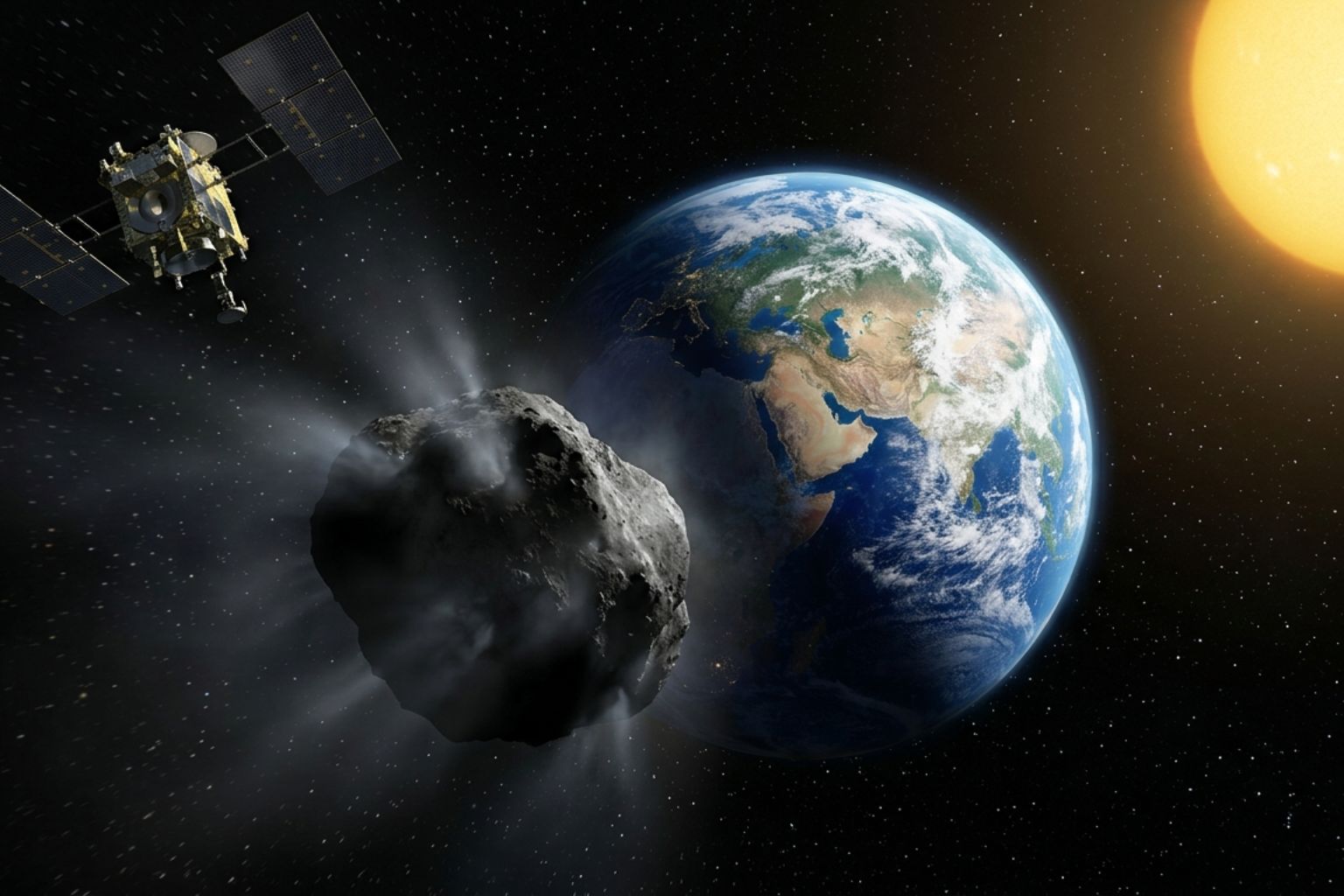


Mysterious objects challenge traditional classifications by exhibiting dynamic comet behavior without visible signs of activity, revealing a new class in the Solar System that intrigues scientists and expands contemporary astronomical understanding.
In December 2024, a study published in the Proceedings of the National Academy of Sciences (PNAS) and led by astrophysicist Darryl Seligman from Michigan State University, officially consolidated the existence of a new class of objects in the Solar System that directly challenges traditional classifications: the so-called dark comets. The research identified seven new objects with anomalous behavior, raising the known total to 14 bodies, all sharing a common characteristic that has intrigued astronomers for decades: they move like comets but do not exhibit a tail, coma, or any visible signs of activity.
The phenomenon, first observed back in 2003 with the object 2003 RM, gained global attention after the unusual behavior of ʻOumuamua in 2017. Both exhibited unexplained acceleration not attributable to gravity, suggesting the existence of some kind of additional force acting upon them. The most accepted hypothesis today is that these objects release gases — likely water — in an extremely subtle manner, without producing the classic bright tail of traditional comets.
Dark comets: what are these objects that challenge the classification of the Solar System
Dark comets represent a hybrid category between asteroids and comets. Visually, they behave like asteroids: they are dark, do not have a tail, and do not exhibit visible activity. However, their trajectories reveal something different.
-
Scientists Develop Method to Store Wind and Solar Energy by Liquefying Air for On-Demand Power Generation

-
Brazilian Engineer Who Grew Up Without Electricity Develops Software, Expands AltoQi to 67,000 Clients, Aiming for $21 Million by Digitizing Brazil’s Construction Industry

-
Spain Launches World’s Largest Floating Dry Dock: 56-Meter Giant Produces Massive Concrete Structures in A Coruña Using Technology Proven in Brazil

-
AI-powered toys that talk, recognize faces, and collect data face scrutiny from Brazilian government over children’s privacy concerns





Astronomers have observed that these objects experience small additional accelerations as they approach the Sun, something typical of comets that release gases upon heating. This release generates an effect similar to a “push,” slightly altering their orbit.
The difference is that, in dark comets, this process occurs without detectable visual signs, making them practically invisible to traditional identification methods. This behavior has led scientists to conclude that these objects likely contain ice within, but release material in a much more discreet manner than classic comets.
The discovery of 14 objects and the division into two distinct populations
The study published in 2024 revealed that dark comets are not an isolated phenomenon, but rather a significant population within the Solar System. Researchers identified two main categories.
The first is composed of larger objects, located in more external regions, with orbits similar to those of the Jupiter family comets. These bodies have more elongated trajectories and dynamic characteristics closer to traditional comets.
The second category includes smaller objects, located in the inner Solar System, with nearly circular orbits and often close to Earth’s orbit. This second population is particularly relevant because it orbits in regions where Earth formed, raising direct hypotheses about its role in the origin of the planet’s water.
Tail-less acceleration and the mystery of invisible water
The central point that defines dark comets is the so-called non-gravitational acceleration. This phenomenon occurs when an object undergoes a change in velocity that cannot be explained solely by the gravitational attraction of planets.
In traditional comets, this acceleration is caused by the sublimation of ice — the process by which ice transforms directly into gas when heated by the Sun. This gas is expelled and generates a reaction force, altering the body’s trajectory.
In dark comets, scientists believe that the same process occurs, but in a much more subtle way. The most accepted hypothesis is that these objects release water or other volatiles without producing enough dust to form a visible tail, making them practically invisible in conventional observations.
What this changes in the theory about the origin of water on Earth
One of the most important implications of the discovery is related to the origin of water on Earth. For decades, scientists debated whether the oceans came from distant comets or water-rich asteroids. Dark comets introduce a new possibility: small, discreet, and abundant objects in the inner Solar System may have been the main carriers of water to primitive Earth.
As these bodies orbit regions close to the planet, they would have a higher likelihood of collision throughout early geological history. If the isotopic composition of the water from these objects is similar to that of Earth’s oceans, they may represent the missing piece in this scientific puzzle.
Relation to ʻOumuamua and the origin of the concept
The interest in this type of object gained momentum after the passage of ʻOumuamua in 2017, the first interstellar object detected in the Solar System.
It exhibited non-gravitational acceleration without showing a visible tail, which initially generated various hypotheses, including exotic explanations. Later studies suggested that the phenomenon could be explained by the release of hydrogen or other gases.
This behavior helped consolidate the idea that objects can exhibit cometary activity without obvious visual signs, paving the way for the identification of dark comets.
Hayabusa2 mission will investigate one of these objects in 2031
The next stage of this discovery is already underway. The Hayabusa2 probe, from JAXA, which previously collected samples from the asteroid Ryugu, is on an extended mission to study one of these objects. The target is the body 1998 KY26, considered a candidate for a dark inner comet. The probe is expected to reach the object around 2031, allowing for direct observations of its surface.
This mission could provide unprecedented data on the composition, structure, and behavior of these bodies. It will be the first time humanity observes a dark comet up close, which could confirm or refute fundamental hypotheses about its nature.
A new type of object may be hidden in large numbers in the Solar System
The identification of 14 objects is just the beginning. Scientists believe that many other dark comets have yet to be detected, precisely because of their discreet nature.
Since they do not have tails, they go unnoticed in traditional surveys focused on visible activity. This means that the Solar System may contain a significant population of these bodies. This possibility directly alters the understanding of the distribution of water and organic matter in the Solar System, as well as influencing planetary formation models.
What dark comets reveal about what we still cannot see
The discovery of this new class of objects reinforces a fundamental limitation of astronomy: much of the universe remains invisible to traditional observation methods.
Just like dark matter, dark comets represent an example of how important phenomena can exist without being detected for long periods. They show that the Solar System still holds structures and processes that are only beginning to be revealed with new technologies and scientific approaches.
And you? Did you imagine that practically invisible objects may have been responsible for bringing the water that forms the oceans of Earth?