





 Portuguese
  English
  Spanish
  2 min of reading
  0 comments


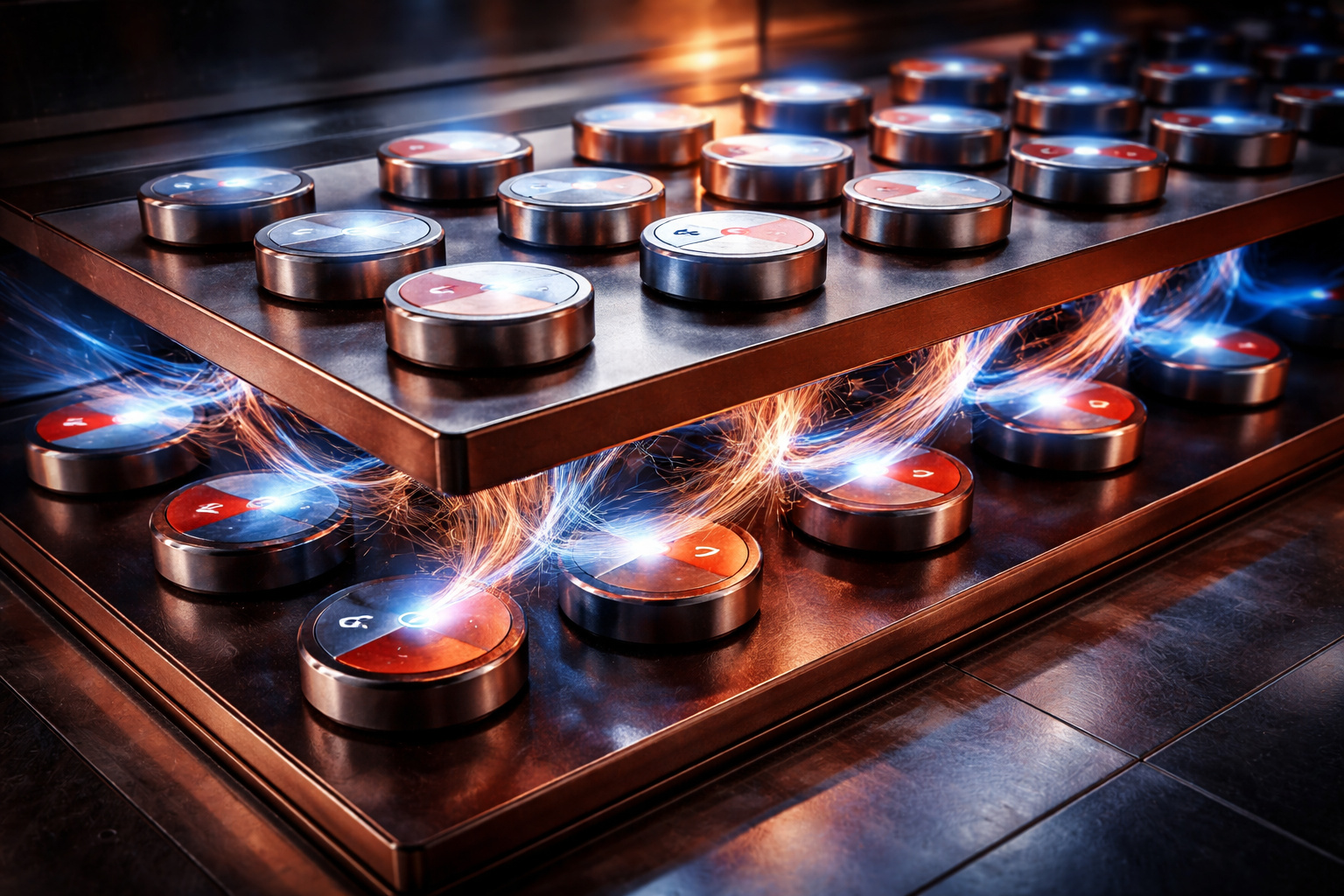
The phenomenon demonstrates that friction can arise without physical contact, contradicting principles established since 1699 and expanding technological possibilities
A recent scientific discovery revealed a behavior that both intrigues and redefines fundamental concepts of classical physics.
Researchers identified a form of friction that arises without direct mechanical contact, which therefore contradicts the traditional law of Guillaume Amontons, formulated in 1699.
In this context, the study conducted by Hongri Gu and his team at the University of Constance in Germany demonstrated that resistance to motion can be generated exclusively by magnetic interactions.
Thus, this result reorganizes the classical understanding of friction, which has always been associated with physical contact between surfaces.
Limitations of the classical law of friction
The law of Amontons states that friction is proportional to the applied load and independent of the contact area.
Moreover, this formulation is based on the idea that surfaces in contact exhibit microscopic deformations that increase resistance to motion.
For example, when pushing objects with different weights, it is observed that the effort required varies according to the applied load.
However, this explanation does not account for situations where deep internal reorganizations occur in materials.
Thus, especially in magnetic systems, motion can alter the very internal structure, which is not predicted by the classical model.
Experiment reveals friction without physical contact
In light of this theoretical gap, scientists developed an experiment with two magnetic layers.
While the upper layer had magnets free to rotate, the lower layer remained fixed.
Thus, even without direct contact, measurable friction was generated due to the magnetic coupling between the layers.
Additionally, by varying the distance between them, the researchers were able to adjust the effective load of the system.
Consequently, it became possible to observe how the magnetic configuration evolved during the relative motion between the layers.
-
Meltwater lakes in Greenland are darkening the ice surface, absorbing more solar energy and accelerating a mass loss that climate models may still underestimate.

-
Bacteria that live for 200 years inside concrete and wake up only when a crack appears are already being used to build bridges in the Netherlands, but Brazil does not yet have a single beam made with this self-repairing technology.

-
Forget salt on the roads: researchers test asphalt with passive geothermal energy in Spain, capable of heating the road from below, reducing black ice, and using IoT sensors without relying on pumps, external electricity, or chemicals in the European winter.

-
Research with DNA extracted from feces showed that the elephants known as “ghosts” in the highlands of eastern Angola form a distinct genetic lineage, with closer proximity to populations from Namibia.




Unexpected behavior expands understanding of the phenomenon
The results showed behavior that initially seems contradictory.
Friction was observed to be weak both at very small distances and at larger separations between the layers.
However, at intermediate distances, competing interactions emerged between the magnetic systems.
While the upper layer favored an antiparallel alignment, the lower one imposed a parallel alignment.
This incompatibility generated a dynamic instability in the system.
As a consequence, the magnets began to alternate between distinct states with a delay, a phenomenon known as hysteresis.







Be the first to react!