Portuguese
  Spanish


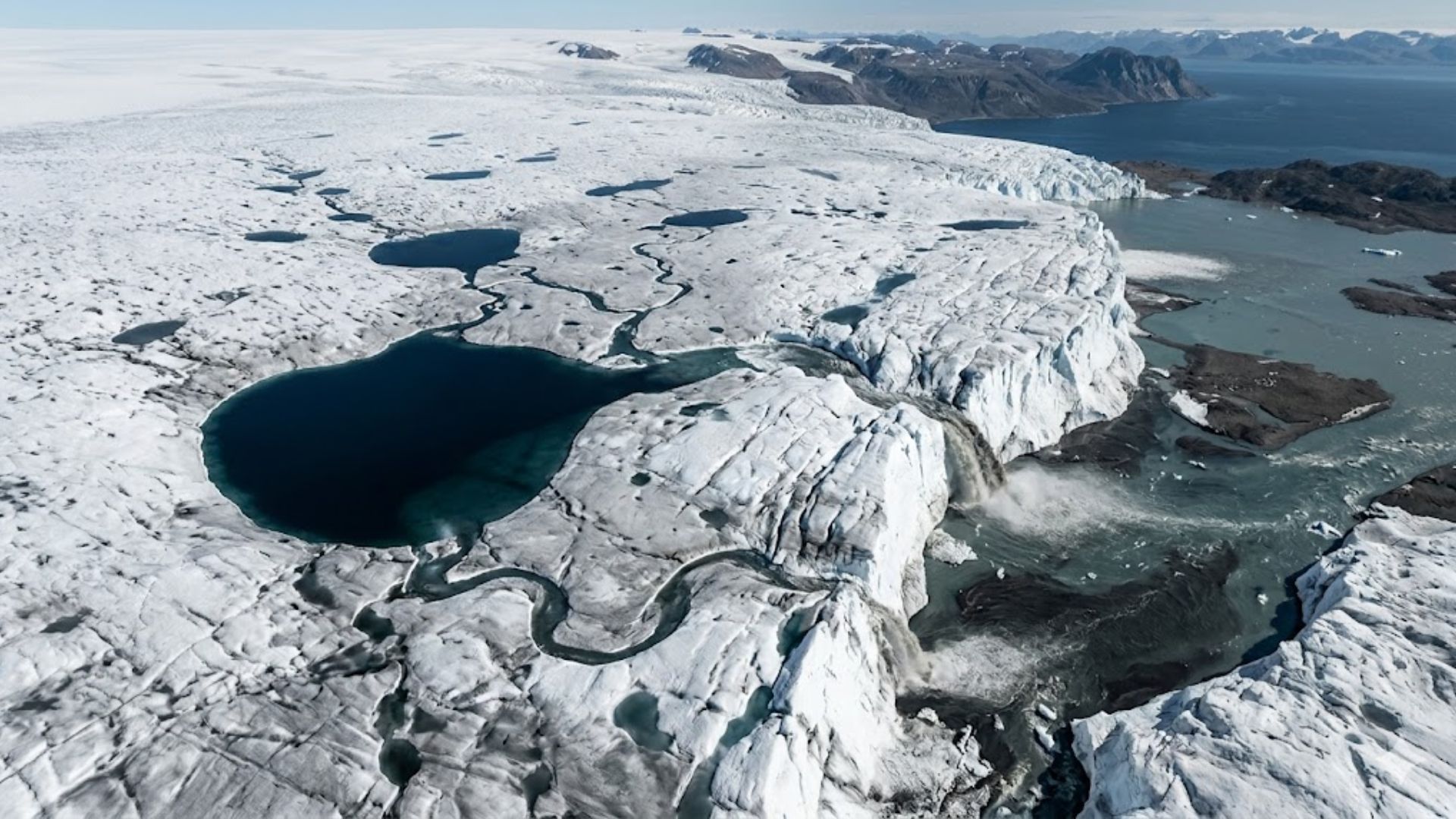


Study shows that meltwater ponds and rivers in Greenland reduce albedo, increase heat absorption, and may accelerate ice loss.
A study published in 2025 in Nature Communications showed that ponds, rivers, and small accumulations of meltwater on the Greenland ice sheet have a greater effect than previously thought. According to the authors, this water reduces the albedo, meaning the surface’s ability to reflect sunlight, increasing the energy available to melt even more ice. The most concerning point is that part of this effect is still poorly represented in the models used to project Greenland’s contribution to sea level rise. Simply put, the more ice melts, the more liquid water appears on the surface; the more water appears, the more heat is absorbed; and the more heat enters the system, the more ice can melt.
Meltwater reduces albedo and turns white ice into a surface that absorbs more heat
Albedo is a measure of reflectivity. Light surfaces, like fresh snow and white ice, reflect a large portion of solar radiation; darker surfaces, like liquid water, old ice, impurities, and sediments, absorb more energy.


In Greenland, this physical detail is decisive. When the surface is covered by meltwater ponds and channels, it reflects less light and absorbs more shortwave radiation, creating a direct reinforcement to surface melting.
-
EcoFlow’s Portable Fridge Offers 43 Hours Off-Grid, Reaches -25°C, App-Controlled, Solar-Powered for Camping and RV Adventures

-
Vietnamese Inventor Overcomes Debt and Develops Agricultural Robot Sold in 15 Countries
-
3,000 Sheep Maintain 900 MW Solar Farm Transforming Texas Fields into Energy for Data Centers

-
Distant Galaxy Shaped Like a Giant Jellyfish Sheds Gas, Forming New Stars as It Moves Through Hot Cosmic Gas


The study states that this process, called melt-albedo feedback, makes the ice sheet especially sensitive to rising air temperatures. This means that small increases in heat can generate larger responses when the surface begins to darken.
Small ponds and narrow channels may have been overlooked by medium-resolution satellites
The strongest finding of the study is in the size of the water formations. Drone images showed that, in the upper ablation zone, there are thousands of small channels and ponds with less than 100 m² that together represent more than 50% of the total meltwater area observed in that sector.
This data is important because many satellite-made maps cannot capture these smaller details well. When image resolution is medium, small watercourses and narrow puddles may disappear from the count, even when they have a relevant radiative effect.
According to the authors, small formations with less than 1,000 m² account for 63.6% of the total accumulated water area in one of the analyzed sections. Therefore, the actual radiative effect of these puddles can be three to four times greater than estimated by approaches based only on medium-resolution satellites.
The study combined satellites, drones, and atmospheric reanalysis to measure the effect of water on ice
The team used surface water maps obtained by satellite and albedo data to assess how the presence of liquid water alters the reflectivity of the ice sheet. Then, they incorporated downward solar radiation and air temperature to estimate how much extra energy becomes available for melting.
To verify what the satellites could not see, the researchers also used drone images with a resolution of 30 centimeters per pixel, covering almost 300 km² of Greenland’s ice sheet. This step allowed them to identify channels, puddles, and small features invisible in coarser surveys.

This combination shows why the topic is technically strong. It is not just about observing blue spots on the ice, but measuring how these spots change the surface energy balance and can alter the amount of water that flows into the ocean.
Greenland already accounts for a significant part of global sea level rise
Greenland’s ice sheet has been losing mass since the 1990s. According to the study, it accounted for about 20% of the global sea level rise between 2006 and 2018, with the loss mainly driven by increased surface melting and water runoff into the ocean.
This context increases the importance of the new mechanism. If climate models fail to correctly include the extra energy absorption caused by meltwater puddles, they may underestimate future meltwater production and, consequently, Greenland’s contribution to sea level rise.
The research does not claim that Greenland will collapse immediately. The warning is more specific: a physical process already observed on the ice surface may be underestimated precisely where projections need more accuracy.
July 2025 showed how albedo can quickly drop during heat waves
Data from the National Snow and Ice Data Center show that in mid-July 2025, a heat wave over Greenland caused a rapid drop in the average reflectivity of the ice sheet. The albedo went from values close to record highs to values close to record lows in the 2017 to 2024 dataset.

The NSIDC explains that the surface can darken when strong melting exposes older ice, aged snow, or activates biological processes. When this happens, the ice absorbs more energy and becomes more vulnerable to new melting episodes.
This behavior helps to understand why the study on melt ponds is relevant. The problem is not just the air temperature on a hot day, but the surface’s ability to change state and start absorbing more heat once melting begins.
Climate models may still leave out part of this melting accelerator
Nature Communications states that coupled climate and ice sheet models do not explicitly accumulate meltwater on the surface. Therefore, they do not fully represent the additional shortwave energy absorption caused by ponds, rivers, and other liquid accumulations on the ice.
This point is central to the issue. If liquid water on the surface is not well included, the model may calculate a more reflective Greenland than it actually becomes during intense melting periods. This reduces the accuracy of future melting projections.
The authors argue that the process should be incorporated into projections because glacio-hydrological models capable of routing and accumulating water on the ice sheet already exist. The limitation, therefore, is not conceptual but in integrating this effect into climate forecasting systems.
The danger lies in the simplicity of the mechanism: white ice turns into dark water and absorbs more Sun
The strength of this issue lies in the fact that the process is visually simple and scientifically important. A white surface reflects; a surface covered by water absorbs. When this cycle spreads over regions of the ice sheet, the result can be a silent reinforcement of melting.
The study does not turn every puddle in Greenland into an isolated catastrophe, but it shows that thousands of small features combined can alter the energy balance of the ice sheet. What seemed like a surface detail can function as a hidden climate accelerator in plain sight of satellites.
The question now is how much of this effect will be incorporated into climate models in the coming years, because the answer may change the way scientists estimate the future speed of Greenland’s ice loss and its contribution to sea level.