






 Portuguese
  Spanish


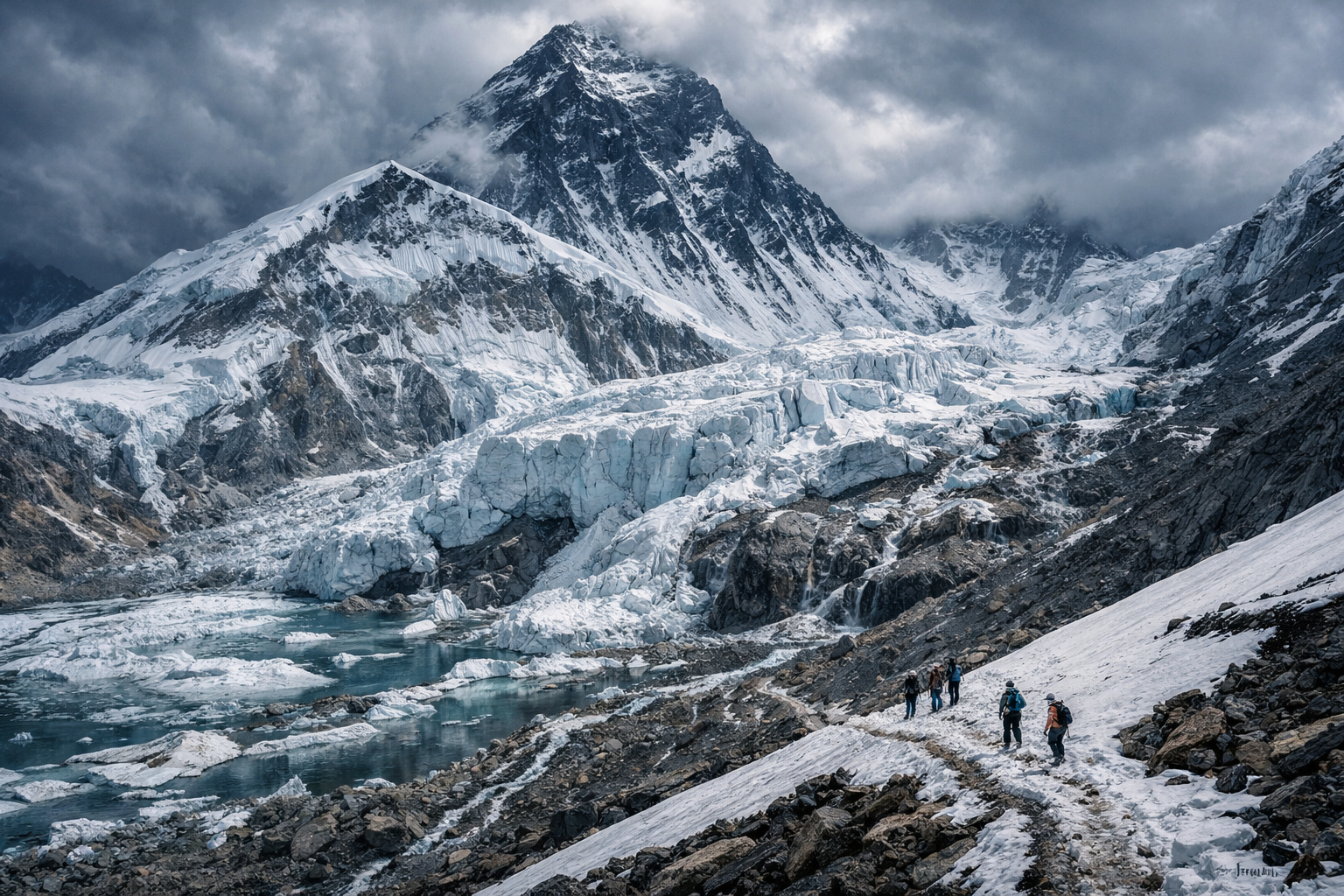


Recent Revelations In The Highest Region Of The Planet Expose Environmental Risks, Reappearance Of Bodies, Historical Mysteries And The Accelerated Effects Of Climate Change At Altitudes Above 8,000 Meters
The Mount Everest, considered the highest point on the planet, has always symbolized overcoming obstacles, courage and the maximum limit of human endurance. However, in recent years, a new discovery on Mount Everest has raised concerns among scientists, environmentalists and mountaineers around the world. What was once seen only as an extreme sports challenge has now become a global alert about climate change, environmental degradation and rising risks on the highest mountain on Earth.
In addition, the advance of global warming combined with overcrowding and excessive commercialization of expeditions has turned Everest into a true natural laboratory of extreme impacts. As revealed in recent content, the effects of these transformations are becoming increasingly visible—and alarming.
The information was released by the channel “Fatos Desconhecidos,” which has over 22.8 million subscribers and has surpassed 164,000 views on the video discussing the scientific discovery related to Mount Everest. According to the channel, the data presented includes geological and environmental analyses as well as direct evidence of the accelerated changes in the region, reinforcing the seriousness of the current scenario.
-
Brazilian Airport to Receive $2.8 Million Investment, Completion Expected Within a Year

-
UN Warns of AI’s Environmental Impact and Calls for Greater Corporate Transparency

-
Former Atacadão Employee Turns Online Cake-Baking Lessons into a Confectionery Brand with Factory, Store, Delivery, and Nearly $400,000 in Revenue
-
Brazilian Startup Sells Nearly 9 Million Surprise Bags of Near-Expiry Food, Prevents Thousands of Tons of Waste, Aiming for $42 Million Revenue by 2026




Mount Everest As An Open-Air Cemetery In The Death Zone
Above 8,000 meters in altitude, in the so-called Death Zone, the human body begins to fail rapidly. Severe oxygen scarcity, extreme cold and physical exhaustion make any prolonged stay extremely dangerous. Consequently, rescue operations become almost impossible without putting new lives at risk.
For this reason, many climbers who died on Mount Everest remain exactly where they fell. However, with the progressive melting of glaciers—one of the direct effects of global warming—bodies that were once preserved under thick layers of ice are reappearing. This new discovery on Mount Everest not only exposes a shocking reality but also forces authorities to organize increasingly risky cleanup missions.
In addition to the exposure of bodies, the melting ice also reveals old debris, abandoned oxygen tanks, and remnants accumulated over decades of climbing. Thus, the environmental impact becomes evident, showing that the top of the world also suffers from uncontrolled human action.
Among the most emblematic cases is that of “Green Boots,” the nickname given to a climber whose body remained in a cave for years, serving as a visual reference point for those climbing the mountain. Another notable episode is that of Francys Arsentiev, known as “Sleeping Beauty,” who died of hypothermia and exhaustion after attempting to descend without supplemental oxygen. For years, her body was exposed, becoming a symbol of the extreme human cost of the quest for the summit.
Historical Mysteries, Overcrowding And Rising Risks On The Highest Mountain On The Planet
In addition to recent environmental discoveries, Mount Everest also holds historical enigmas that remain without definitive answers. One of the greatest mysteries involves George Mallory and Andrew Irvine, who attempted to reach the summit in 1924. The question remains today: did they reach the top before dying?
Parts of their bodies were found decades later, but no conclusive evidence confirmed the achievement. This enigma continues to fuel debates in mountaineering and reinforces the mountain’s relentless character, where even history remains frozen in uncertainty.
Meanwhile, another factor that has made Mount Everest even more dangerous is overcrowding. Human traffic jams form in lethal areas, where each minute without adequate oxygen can be fatal. The excessive commercialization of expeditions allows unprepared individuals to progress into critical zones, significantly increasing the risk of tragedies.
The direct impacts include:
- Melting ice: exposure of bodies and old debris
- Overcrowding: human congestion in deadly sections
- Excessive commercialization: presence of climbers without proper preparation
- Environmental impact: accumulated waste, abandoned tanks, and glacial contamination
As a consequence, human bodies remain integrated into the landscape, oxygen tanks accumulate on the slopes, and human waste contaminates the ice. Furthermore, each rescue operation puts more lives at risk, exacerbating the problem.
Mount Everest has ceased to be merely a natural challenge and has become a mirror of human ambition. The mountain remains imposing, yet shows visible marks of intense exploitation, environmental neglect, and decisions driven more by status than by real preparation.
Recent discoveries are alarming not only for what they reveal beneath the ice but especially for what they expose about our relationship with nature. Everest remains the top of the world; however, it also solidifies as a severe warning that not every limit should be pushed at any cost.
Source: O Antagonista







Bom, em primeiro lugar eu não vi nenhuma nova descoberta. Tudo que tem aqui já é discutido há décadas. Depois, o alerta sobre os riscos da escalada são públicos e notórios. Gasta dinheiro e se arrisca quem quer e pode, porque não é barato. Reles mortais como eu dificilmente irão ao Nepal, muito menos tentarão escalar o monte. Finalmente, basta uma tempestade que o gelo volta todo novamente. A altitude minimaliza alterações climáticas significativas que outras regiões sofrem. Regiões de montanhas como a cordilheira dos Andes, os Alpes suíços e o Himalaia tem um microclima próprio. Suas variações são muito mais relacionadas a eventos locais do que a tendências globais. Resumindo: click bait.
Alpinismo é uma modalidade para is inguinorantes e aos que não tem o que fazer…..Tantos outros esportes menos perigoso e Estes ensistem em desafiar a vida….Desculpem mais não tenho sentimentos nenhum aos que escolhem o desconhecido. A Bíblia diz, Deus é Amor e justiça, Deus te permite livramentos mais não tentaras o teu Deus.
Quem procura, acha!!!!
O Monte está lá bem caladinho e não pede para ser visitado muito menos ser distruido.
Sérgio, nossa “como você ajudou” com esse comentário discriminatório, muita gente se aproximará de Deus por causa disso. Se não vai ajuntar, pelo menos não espalhe.