






 Portuguese
  Spanish
  4 min of reading
  1 comment


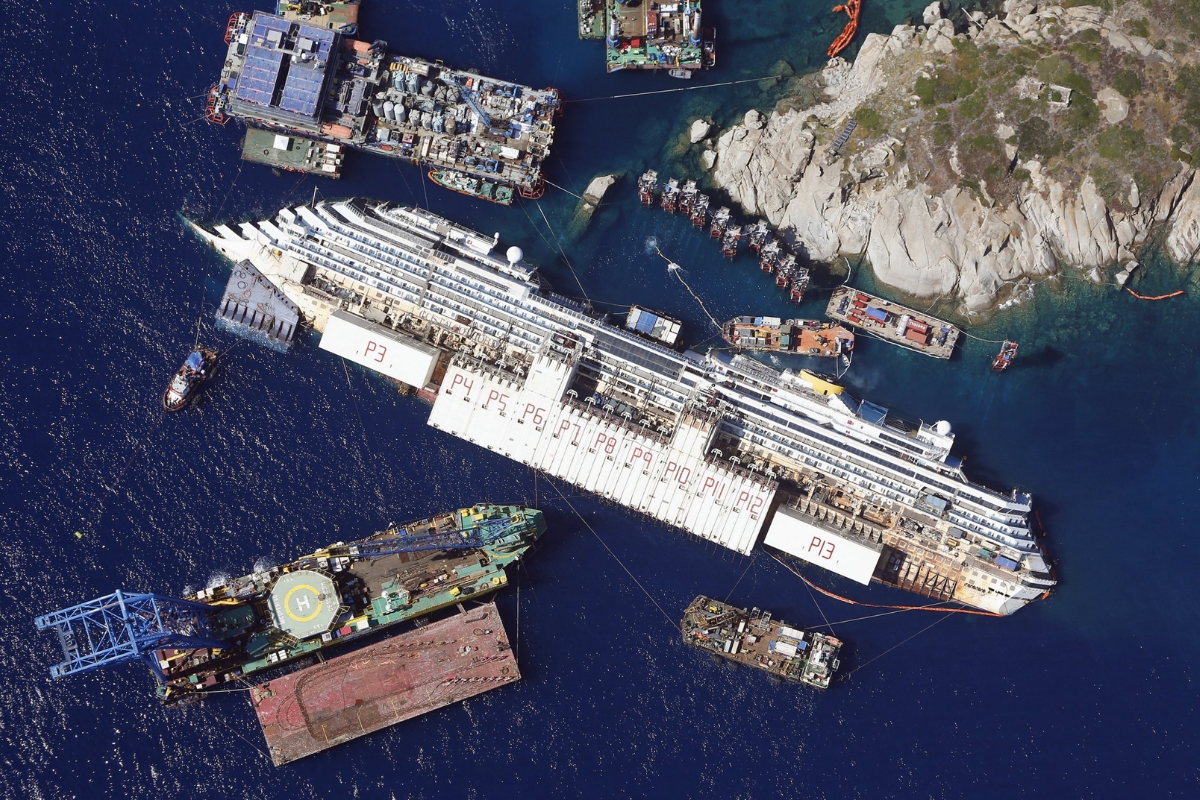


The Salvage of Costa Concordia Became the Largest Maritime Operation in History: Over US$ 1 Billion, Unprecedented Technologies, and a Gigantic Maneuver to Raise a 114,000-Ton Ship That Threatened the Mediterranean
The sinking of the Costa Concordia still evokes a strange silence when it comes up in discussions of maritime engineering. Not only due to the human impact, with 32 lives lost, but also because of the surreal scale of everything that followed. Never before had an attempt been made to salvage a vessel of that size, tilted on the Italian coast, stuck on the rocks and posing a massive environmental risk.
What began as a tragedy evolved into the largest and most expensive maritime salvage operation ever undertaken, a technical milestone that cost between 1 and 2 billion dollars and involved specialists from around the world.
The story behind this process is as impressive as the ship itself. The Costa Concordia, weighing over 114,000 tons, measuring 290 meters long and 17 decks high, ended up becoming an outdoor laboratory where engineers, divers, and salvage experts tested limits that had only existed in theory until then.
-
Survivor of 1966 SS Daniel J. Morrell Shipwreck in Lake Huron Recounts 38-Hour Ordeal in Extreme Cold

-
The Greatest Hoax in World Cup History? The Film That Denied Brazil’s 1958 Victory and Exposed How Fake Evidence Can Seem Convincing on TV
-
Fake South Korean Online Stores Offer Shopping Thrill Without Spending Money or Receiving Products
-
The War of Jenkins’ Ear: How a Severed Ear Sparked One of the 18th Century’s Most Unusual Conflicts


And in the midst of all this, Italy needed to race against time to prevent tons of fuel from leaking into one of the most environmentally sensitive areas of the Mediterranean.
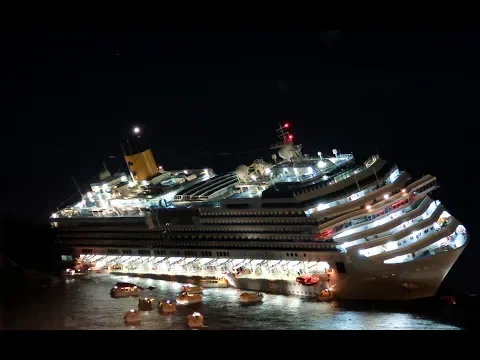

The Decisive Moment: Stabilizing a Giant About to Collapse in the Sea
When the Costa Concordia ran aground on the night of January 13, it lay on a reef like a building toppled on the beach. With water flooding the decks, the broken hull, and the precarious position making each movement of the tides increase the risk of the ship slipping into a 70-meter deep underwater abyss.
The first days were a race against time. The Italian government prioritized the immediate removal of fuel, an operation known as “defueling,” which required breaching deformed tanks, controlling leaks, and pumping oil under dangerous conditions. The Dutch company Smit Salvage led this stage, which took nearly two months.
After that came the challenge that turned the case into a global phenomenon: how to raise a 114,000-ton ship that was overturned and partially crushed against the rocks? The answer came from South African engineer Nick Sloane, an expert in extreme salvages, who described the scenario as “the Catharsis of the Century of maritime engineering.” He coordinated the proposal from Titan Salvage with the Italian company Micoperi, which would eventually be approved by the government.

The Maneuver That Became a Symbol: The “Parbuckling” That Up Righted the Ship
The boldest solution became known as “parbuckling,” a classic technique for righting vessels, but never attempted on anything even remotely resembling the size of the Concordia. The plan involved constructing enormous underwater platforms, anchored by pillars driven into the rocky seabed. Then, large hydraulic cables and steel cylinders would be installed to pull the ship back into an upright position.
The maneuver began on September 16, 2013, and lasted about 19 hours, broadcast live to the entire world. The hull creaked, the structure cracked, and inch by inch, the Costa Concordia turned until it finally stood upright on the platforms. The image of the moment when the ship “straightens up” remains a reference in maritime engineering to this day.
Meanwhile, the budget was exploding. Each new phase required equipment that did not exist, which needed to be built specifically for the operation. Giant floaters were manufactured and attached to the side of the ship to enable refloating. This part alone added hundreds of millions of dollars to the final cost.
In July 2014, the Costa Concordia finally floated again. On the 23rd of that month, tugboats began the slow journey to the port of Genoa, where the dismantling took years.
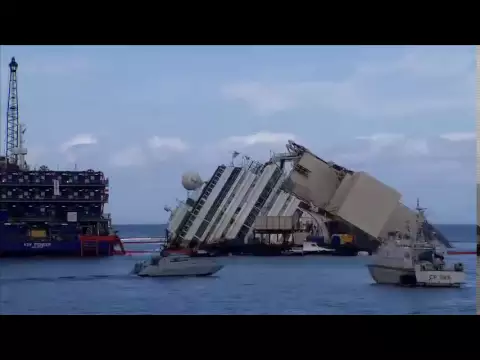
Why Was the Salvage So Expensive? Technology, Environmental Risk, and Custom Engineering
No ship of such size had ever been salvaged before. This meant that practically no pre-fabricated solutions existed to deal with a disaster of that magnitude. Everything had to be custom-built: platforms, floaters, hydraulic cylinders, cable systems, simulation software, sensors, and support structures.
Moreover, any mistake could result in an environmental and financial disaster. Italy was concerned that the hull could slip, break completely, and release toxic waste into the marine area. To prevent this, the operation maintained 24-hour monitoring, with hundreds of specialists working simultaneously.
The total cost is difficult to calculate precisely, but Italian authorities and international sources estimate that the entire operation — including stabilization, fuel removal, parbuckling, refloating, towing, dismantling, and compensation — ranged between 1.2 and 2 billion dollars. Reuters, for example, reported in 2014 that the total expense exceeded 1.5 billion euros.
The operation left an impressive technical legacy. It has become a case study in universities, seminars, and naval engineering programs, and established Nick Sloane as one of the world’s leading experts in complex salvages.
The removal of the Costa Concordia was not just a salvage. It was a demonstration of how engineers, divers, and scientists can confront an unprecedented problem and create, from scratch, solutions capable of moving a structure equivalent to a skyscraper lying in the sea.





Vada a bordo, cazzo…