Portuguese
  Spanish


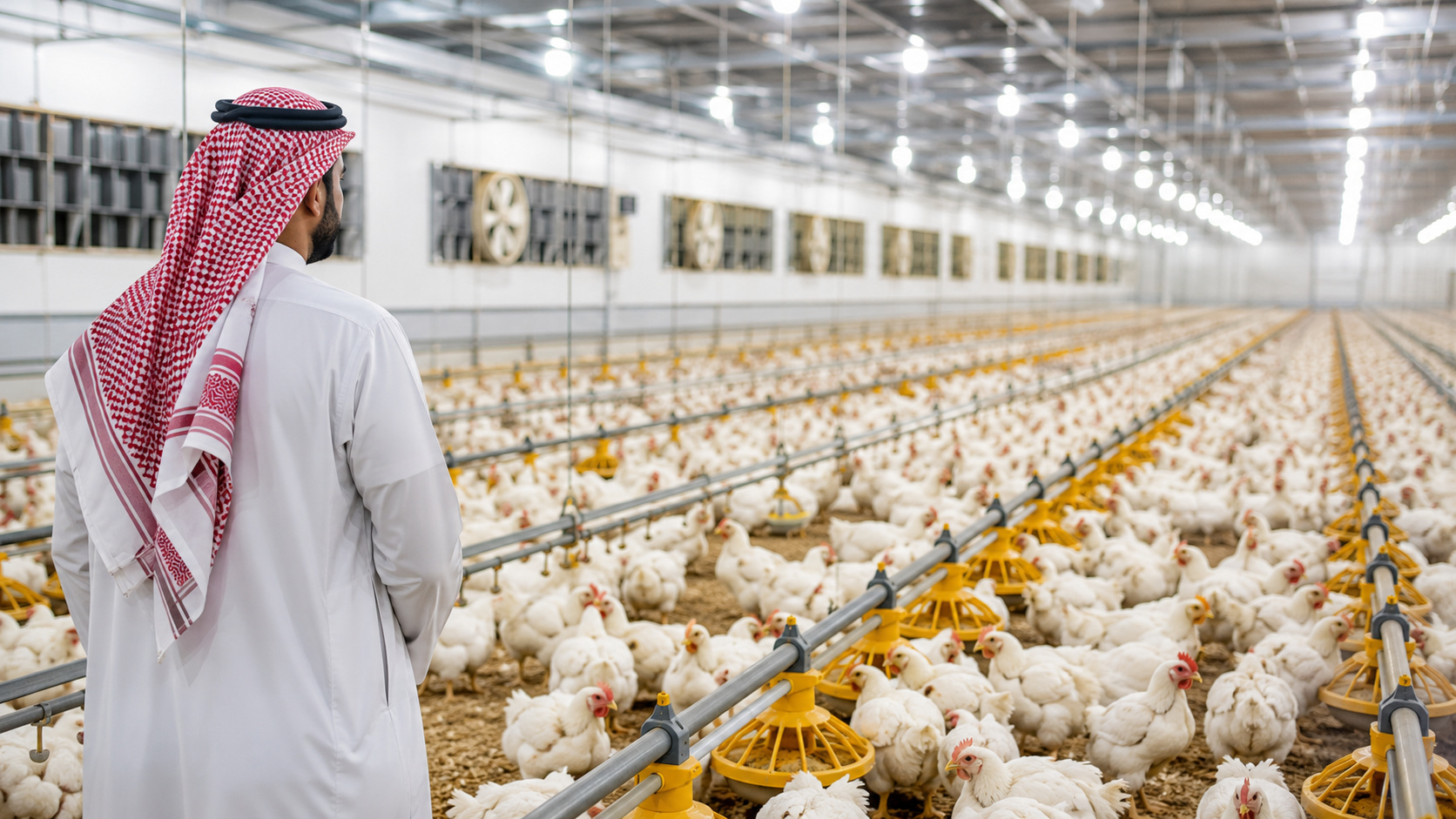

Saudi Arabia expands its own chicken production, aims for self-sufficiency of up to 90%, and may reduce dependence on Brazilian imports in the coming years.
Saudi Arabia has become one of the most important markets for Brazilian chicken in recent decades. In 2025, the country was the third-largest destination for national chicken meat exports, importing about 397 thousand tons, behind only the United Arab Emirates and China. The Saudi market generates billions of reais for companies like BRF, JBS/Seara, and other Brazilian exporters specialized in halal products.
But while it continues to buy large volumes from Brazil, the Arab kingdom is executing an ambitious plan that could profoundly change this scenario. Within the Vision 2030 strategy, the Saudi government is investing billions of dollars to increase domestic poultry production, reduce dependence on external suppliers, and transform the country into a regional poultry powerhouse.
Vision 2030 plan aims to bring desert chicken production to self-sufficiency of up to 90%
Food security has become one of the central priorities of the Vision 2030, a program created to reduce Saudi Arabia’s economic dependence on oil and strengthen strategic sectors. Among them, food production occupies a prominent position.
-
India’s Sugar Export Cuts and Ethanol Shift Amid El Niño Threat Could Impact Global Prices and Stocks

-
Quarantine Pest Threatening Palm Trees Puts Brazilian Authorities on Alert, Prompts Monitoring at University of Taubaté and Potential Control Measures Across São Paulo
-
Global Alert: Report Finds 159 Pesticides in Coffee Beans Sold in Europe, Posing Serious Risks to Millions of Farm Workers
-
Low-Demand Brazilian Beef Offal Gains Popularity Abroad: Indonesia Purchases $19.5 Million, Boosting Revenue and Reducing Waste



In the specific case of chicken, the goals are aggressive. Saudi authorities and industry entities claim that the country has already reached self-sufficiency levels between 70% and 80% and is working to reach up to 90% of the domestic market by the end of the decade, significantly reducing the need for imports.
This advancement was driven by government subsidies, tax incentives, financing for farms, technological modernization, and billion-dollar investments throughout the production chain.
Brazil still dominates halal supply, but Saudi dependence begins to decrease
Despite the expansion of local production, Saudi Arabia continues to rely on external suppliers to complement domestic demand. Brazil remains one of the country’s main partners thanks to halal certification and large-scale production capacity.


The numbers show that this relationship remains strong. Data released by ABPA indicate that Saudi purchases grew in 2025, reaching approximately 397 thousand tons of Brazilian chicken meat.
In April 2026, Saudi imports of chicken from Brazil continued to advance, with an increase of 5.2% compared to the same period of the previous year.
The challenge for Brazilian exporters is not in the present, but on the horizon of the coming years. The greater the Saudi production capacity, the less the need for imports to supply the country’s supermarkets, restaurants, and food chains tends to be.
JBS and BRF are already adapting to the new scenario created by the Saudi government
The major Brazilian companies quickly noticed the kingdom’s strategy shift. Instead of relying solely on exports, national groups began to invest directly in local operations.
In January 2026, JBS announced a partnership to produce chicken locally under the Seara brand, aligning with the Saudi policy of strengthening domestic production.
Similar moves have been occurring throughout the Gulf region. The goal is to remain within the market even if the share of imports decreases over time. For many companies, producing within Saudi Arabia may become as important as exporting from Brazil.
Recent restrictions show that the Saudi market can also use trade barriers
In addition to the growth of local production, another factor observed by the sector is the increase in control over imports.
In 2026, Saudi authorities suspended the licensing of 11 Brazilian plants exporting chicken meat, a measure that surprised the Brazilian government and the production sector. Although the country’s purchases remain high, the episode showed that market access can undergo rapid changes for regulatory, commercial, or sanitary reasons.

In another recent instance, restrictions related to avian flu also temporarily affected the trade flow between the two countries, highlighting the strategic importance of this market for the national agribusiness.
Multi-billion market remains attractive, but the long-term scenario has changed
Saudi Arabia is still far from completely abandoning chicken imports. Population growth, increased consumption, and demand from the food sector continue to support high purchases from abroad.
Even so, the strategic direction is clear: produce more and more within its own borders. What was once one of the most dependent markets on imported chicken is now working to become one of the most self-sufficient in the Middle East.
For Brazil, the issue is no longer just about selling more chicken but becomes another: how to maintain space in a market that continues to buy hundreds of thousands of tons today, but intends to rely less and less on foreign suppliers tomorrow?