






 Portuguese
  Spanish
  5 min of reading
  0 comments


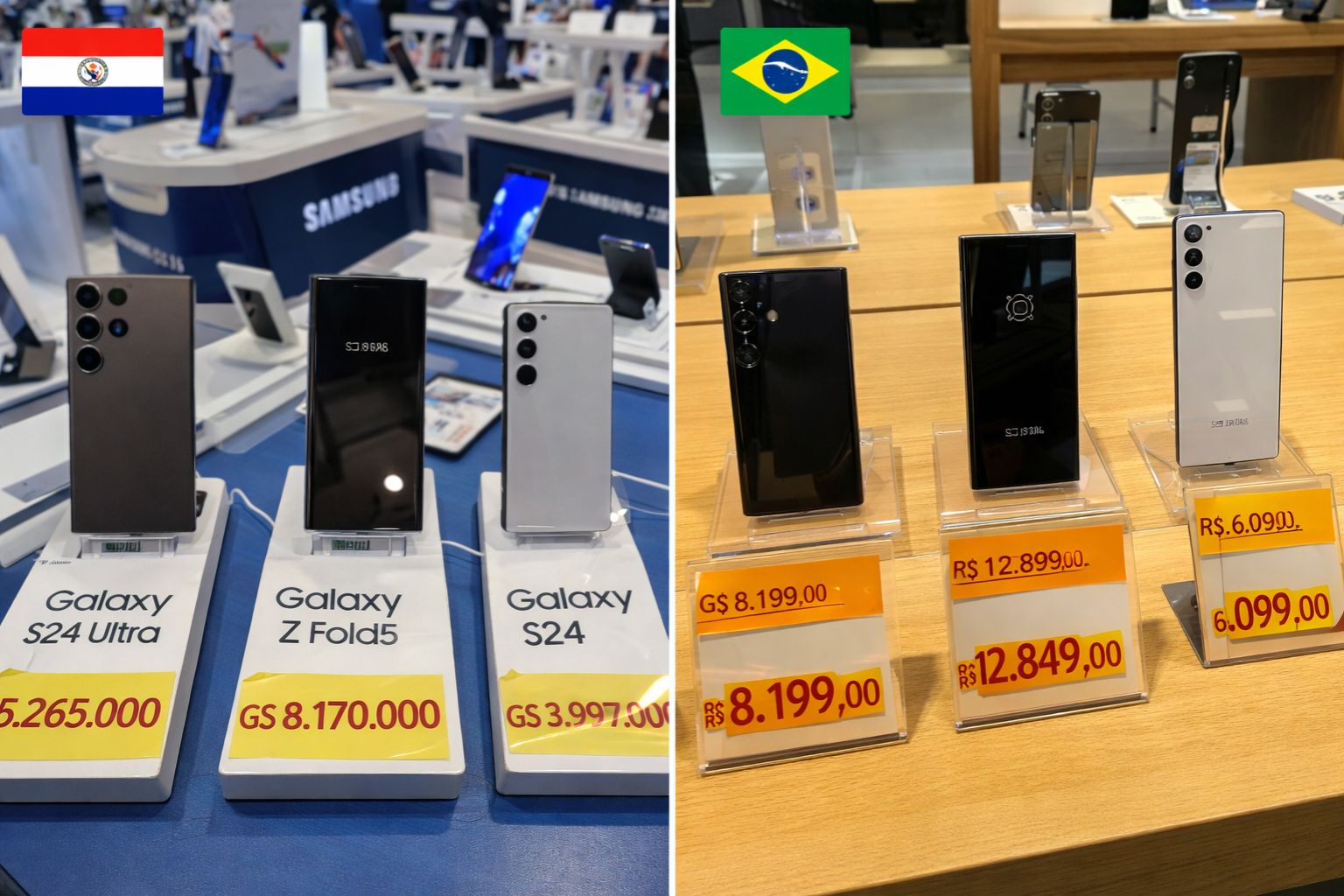
Samsung phones cost 36% less in Paraguay compared to Brazil, with the Galaxy S26 Ultra priced at R$ 6,590 against R$ 10,349 in the national market. However, store fees between 5% and 10%, IOF of 3.5%, travel costs, and warranty restrictions can reduce or eliminate the advantage depending on the model.
Buying a Samsung phone in Paraguay may seem like an irresistible deal when looking only at the display prices. A recent survey compared prices of Samsung smartphones in both countries and found significant differences: the Galaxy S26 Ultra with 256 GB costs about US$ 1,125 in Paraguay, equivalent to R$ 6,590 with taxes included, while in Brazil the same model is priced at R$ 10,349, a savings of up to 36%. The Galaxy S26 Plus also shows a significant advantage, priced at R$ 5,588 in Paraguay compared to R$ 8,279 in Brazil. The numbers are tempting, but relying solely on them is the first mistake many people make before crossing the border.
The problem begins when adding costs that do not appear on the tag. Stores in Paraguay usually charge between 5% and 10% more for payments made with credit or debit cards, in addition to the IOF of 3.5% that applies to any international purchase made with a Brazilian card. Ground or air travel, accommodation, food, and internal transportation in Paraguay all factor into the final cost, and depending on the model of phone one intends to buy, these costs can consume all the savings that seemed guaranteed. Before packing, it is necessary to do the complete math.
How much does each Samsung model really cost in Paraguay with taxes included
According to information from the portal Canal Tech, the prices of Samsung phones in Paraguay are quoted in US dollars, and the first conversion already includes costs. The Galaxy A07 with 128 GB costs US$ 104 in Paraguay, which with store fees and IOF amounts to US$ 118, or R$ 537, compared to R$ 729 in Brazil for the 256 GB version. The Galaxy A36 with 128 GB costs US$ 236, reaching R$ 1,379 with fees, while in Brazil the price is R$ 1,499. The savings on entry-level models exist, but are modest when considering travel costs.
-
Land Rover to Halt Production in July, Putting 371 Jobs at Risk, as Chinese Automaker Negotiates to Convert Factory to 100,000 Vehicles Annually by 2027

-
Mexican Pest Threatens U.S. Cattle Herds at Historic Lows, Potentially Boosting Brazilian Beef Exports as Burger Prices Soar

-
Brazilian Freight Bill Progresses in Congress with $5,000 Minimum Wage, 70% Advance Payment, and Fines Up to $1 Million, as Agriculture and Industry Warn of Rising Costs and Legal Uncertainty

-
High Interest Rates and Record Defaults Lead to Surge in Vehicle Repossessions and Crowded Car Auctions in Brazil by 2026


In premium models, the difference becomes more pronounced. The Galaxy S26 with 256 GB is priced at R$ 4,539 in Paraguay against R$ 6,749 in Brazil. The Galaxy S26 Plus is priced at R$ 5,588 against R$ 8,279. The Galaxy Z Flip 7 with 512 GB is listed at R$ 3,976 in Paraguay against R$ 5,999 in Brazil. The exception is the Galaxy Z Fold 7, which costs R$ 9,487 in Paraguay, more expensive than the R$ 8,099 charged in Brazil, a case where crossing the border to buy would result in a loss.
What you need to know about payment before buying in Paraguay
The payment method radically changes the final cost of the cell phone purchased in Paraguay. The most common and advantageous is to pay in cash US dollars, avoiding card fees and the IOF, but this requires buying dollars in advance at Brazilian exchange houses, which charge their own fees and practice rates above the commercial exchange. The cost of this conversion needs to be taken into account.
For those who use credit or debit cards in Paraguay, the bill becomes significantly higher: stores add between 5% and 10% to the cash price, and the 3.5% IOF automatically applies to international purchases. In the worst-case scenario, these combined increases can represent up to 13.5% more on the original price of the cell phone, eroding much of the advantage that Paraguay offers. Pix is accepted in some establishments, but the administrative fees vary according to each store’s policy and do not guarantee savings compared to cash dollars.
The customs rules that can turn savings into losses in Paraguay
Brazilian legislation allows a cell phone purchased in Paraguay to be treated as a personal use item, exempt from import tax, as long as it is out of the packaging, in use, and is the only one of its kind carried by the person. However, if the device does not qualify as personal use, the exemption quotas come into effect: US$ 500 for land travel and US$ 1,000 for those returning by plane from Asunción.

The impact of taxation is significant. If the cell phone purchased in Paraguay costs US$ 1,000 and the land quota is US$ 500, the excess US$ 500 is taxed at 50%, adding US$ 250 to the final cost, which becomes US$ 1,250. In this scenario, a Galaxy S26 Plus that seemed to cost R$ 5,588 can easily approach R$ 8,000 after taxation, nullifying almost all the advantage over the Brazilian price. Checking the device and the IMEI code before leaving the store and obtaining the invoice are essential measures to avoid problems with inspections.
The warranty issue that nobody tells you before buying in Paraguay
One aspect that often goes unnoticed is that Samsung limits the warranty to the country where the cell phone was originally sold. This means that a device purchased in Paraguay will not have free technical assistance from Samsung in Brazil, and any manufacturing defect will need to be resolved at your own expense, either by sending the device back to Paraguay or paying for private repair in Brazil.
For those who live near the border, such as in Foz do Iguaçu, the warranty issue is less problematic because access to Ciudad del Este is relatively simple. But for those living in São Paulo, Rio de Janeiro, or any distant capital, saving R$ 2,000 or R$ 3,000 on a purchase can become an expensive problem if the phone has defects in the first months of use. The cost-benefit analysis of buying in Paraguay needs to consider not only the price of the device but the financial risk of being without warranty coverage in Brazilian territory.
When it is really worth buying Samsung in Paraguay
The answer depends on three factors: the model of the phone, the proximity to the border, and the payment method. For those living in border cities who can go to Paraguay without significant travel costs, buying premium models like the Galaxy S26 Ultra or the Galaxy S26 Plus results in real savings that can exceed R$ 3,000 even after all fees. In these cases, the deal is clearly advantageous.
For those who need to travel by plane or bus with ticket costs above R$ 500, the equation changes. Adding up ticket, accommodation, food, currency exchange, store fees, and IOF, the real savings on mid-range models can be reduced to less than R$ 200, making the trip financially unjustifiable unless multiple items are purchased or other shopping objectives are combined. The rule is simple: the more expensive the Samsung model, the more Paraguay pays off. For entry-level models, the difference rarely justifies the travel.
Samsung phones cost up to 36% less in Paraguay, but fees, IOF, and travel costs can consume the savings. Have you ever bought a phone in Paraguay? Was it worth it? What didn’t they tell you before the trip? Share your experience in the comments.





-

1 person reacted to this.