Portuguese
  Spanish


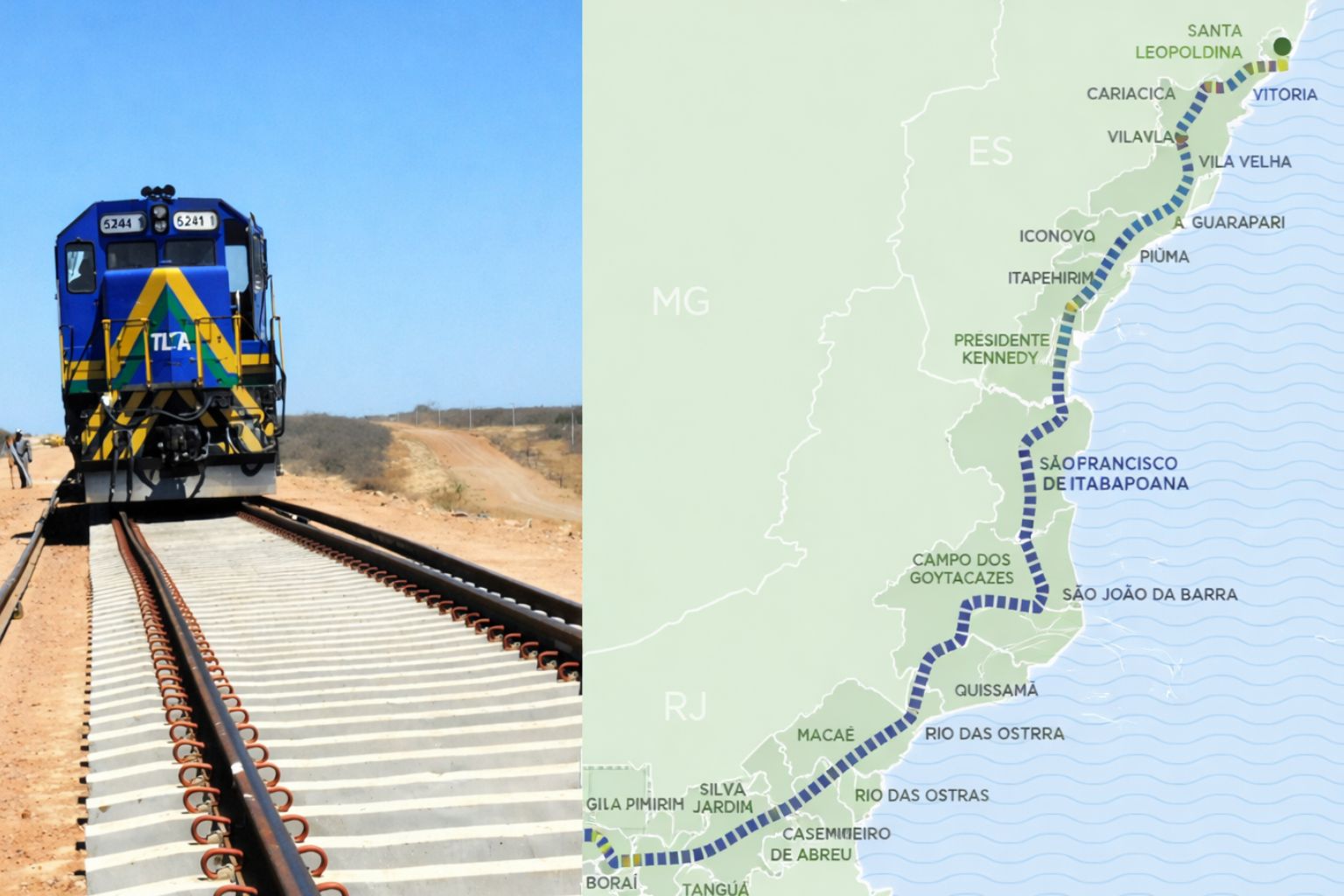

The mega railway EF-118 will connect Espírito Santo to Rio de Janeiro with 575 km and an estimated investment of R$ 6.6 billion. The line will cross 24 municipalities between Santa Leopoldina and Nova Iguaçu, with a capacity of 24 million tons per year. The project awaits approval from the TCU for the publication of the tender in 2026.
A mega railway of 575 kilometers has just taken a decisive step to come to fruition and could reshape the logistics map of Southeast Brazil. The EF-118 project, also known as the Southeast Railway Ring, was approved by the Ministry of Transport in December 2025 and has an estimated investment of R$ 6.6 billion. The mega railway will cross 24 municipalities between Santa Leopoldina, in Espírito Santo, and Nova Iguaçu, in Rio de Janeiro, connecting capitals, agricultural regions, industrial hubs, mining complexes, and export ports in a single integrated railway network. The project is still awaiting evaluation from the Federal Court of Accounts (TCU) for the publication of the tender, expected in 2026.
The scale of the project justifies the label of mega railway. With the capacity to transport up to 24 million tons per year, the line promises to revolutionize the flow of iron ore, grains, and fertilizers from the interior of Espírito Santo to the Port of Açu, in Rio de Janeiro, one of the largest industrial port complexes in the country. The main section covers 246 km between Santa Leopoldina (ES) and São João da Barra (RJ), with the possibility of expansion of another 325 km to Nova Iguaçu (RJ) utilizing pre-existing segments of the EF-103 railway. If everything goes according to schedule, operations will begin between 2033 and 2035.
What is the complete route of the mega railway in Southeast Brazil
The mega railway project is divided into two main sections that together total the announced 575 kilometers. The first is the main section, with 246 km between Santa Leopoldina, in Espírito Santo, and São João da Barra, in Rio de Janeiro, the city that houses the Port of Açu. This is the heart of the project and what enables the direct connection between the producing regions and the destination port complex.
-
28-meter, 156-ton titans traveled 20,000 km from China to the port of Santa Catarina: Portonave received 7 fully electric megacranes, part of a R$ 210 million package, to double container handling.

-
They exchanged the idea of a large house for a 35 m² warehouse, spent US$ 12,000 on the structure, and created a tiny house in Colorado with space to live and work.

-
A newly opened terminal in the middle of the Amazon has begun transporting soy and corn through Amapá, eyeing the queue of ships that is congesting the ports in the South.

-
Goodbye to old tiles: renovation technique without construction transforms bathrooms in a few hours, eliminates debris, and reduces costs with coverings using special paints, high-resistance adhesives, and modern finishes that completely renew the space.



The second section provides for an additional expansion of 325 km to Nova Iguaçu, in Rio de Janeiro, utilizing pre-existing segments of the EF-103 railway. This extension significantly increases the reach of the mega railway by connecting it to another railway network already in operation, creating an integrated logistics ring that can serve a much larger area than the municipalities directly crossed by the tracks. The passage through 24 municipalities generates local economic impacts ranging from expropriations and jobs in construction to the possibility of installing intermediate terminals at strategic points.
Why the mega railway can transform the logistics of the Southeast

The logic behind the construction of the mega railway is simple to explain and complex to implement. Rail transport is significantly cheaper and more efficient than road transport for heavy and long-distance cargo, but Brazil has historically invested little in its railway network, leaving agricultural, mineral, and industrial products dependent on trucks that congest highways and increase export costs. The EF-118 fits precisely into this gap.
By connecting the interior of Espírito Santo to the Port of Açu, the mega railway drastically reduces the costs of transporting iron ore, grains, and fertilizers that currently reach the ports by road or by less efficient railway networks. The Port of Açu, with this logistical reinforcement, aims to establish itself as the “new route of agribusiness,” a status that is only viable if there is railway infrastructure compatible with the volumes produced by agribusiness and mining. The mega railway is, therefore, a necessary condition for the entire port complex to operate at its maximum potential.
What is needed for the mega railway to become a reality
According to information from the ndmais portal, the approval from the Ministry of Transport in December 2025 was a decisive step, but it is not the last. The project is now awaiting evaluation from the Federal Court of Accounts (TCU), which needs to validate the terms of the concession before the bidding notice can be published in 2026. The TCU analyzes details such as the value of the grant, contractual guarantees, deadlines, and operational conditions, and this phase can add months to the schedule depending on the adjustments requested.
After the TCU’s approval and the publication of the bidding notice, there will still be the auction, the signing of the concession contract, the complete environmental licensing, and the actual start of construction. The optimistic schedule places the start of mega railway operations between 2033 and 2035, which means almost a decade between approval and operation. For a country that urgently needs to modernize its logistical infrastructure, this timeframe may seem long, but it is compatible with the complexity of a project that involves 575 km of tracks, 24 municipalities, and multiple state and federal jurisdictions.
How the mega railway integrates with Brazil’s existing logistics network
One of the project’s differentiators is that the mega railway does not emerge in isolation. The project has the potential for integration with the existing Brazilian railway network and coordination with other port complexes in the region, such as the ports of Ubu and Central, both in Espírito Santo, in addition to the Port of Açu in Rio de Janeiro. This interoperability transforms the EF-118 into an element of a larger system, not just an isolated line that serves only its terminal points.
The capacity to transport 24 million tons per year positions the mega-railway as one of the main logistical arteries of the Southeast. To give perspective, this volume is equivalent to the load of approximately 600 thousand trucks taken off the roads each year, reducing congestion on highways such as BR-101, decreasing greenhouse gas emissions associated with road transport, and increasing road safety by reducing heavy vehicle traffic. The integration with other networks allows products coming from Mato Grosso, Minas Gerais, or Goiás to reach the Port of Açu by rail, without ever needing to get on a truck for long distances.
The impact of the mega-railway on Brazilian agriculture and mining
For agriculture, the mega-railway represents a strategic gain. Brazil is one of the world’s largest grain producers, but loses competitiveness in the international market due to logistical costs that exceed those of competitors like the United States and Argentina. The EF-118 reduces this disadvantage by offering a direct rail route between producing areas and a port capable of receiving large vessels.
The mining sector also benefits from the project. Iron ore and fertilizers are commodities that depend on long-distance transport in large volumes, and the rail mode is technically the most suitable for these loads. Companies that today need to transport ore via costly highways or wait for slots on congested railways now have a new alternative with the mega-railway, which can reactivate extraction projects that were unfeasible due to logistical costs. The regional economic development of the 24 municipalities crossed by the line is another expected consequence.
A mega-railway of 575 km can transform the logistics of the Southeast by connecting Espírito Santo to Rio de Janeiro. Do you think this project will come to fruition by 2035? Does Brazil need more railways like this? Leave your opinion in the comments.