






 Portuguese
  Spanish


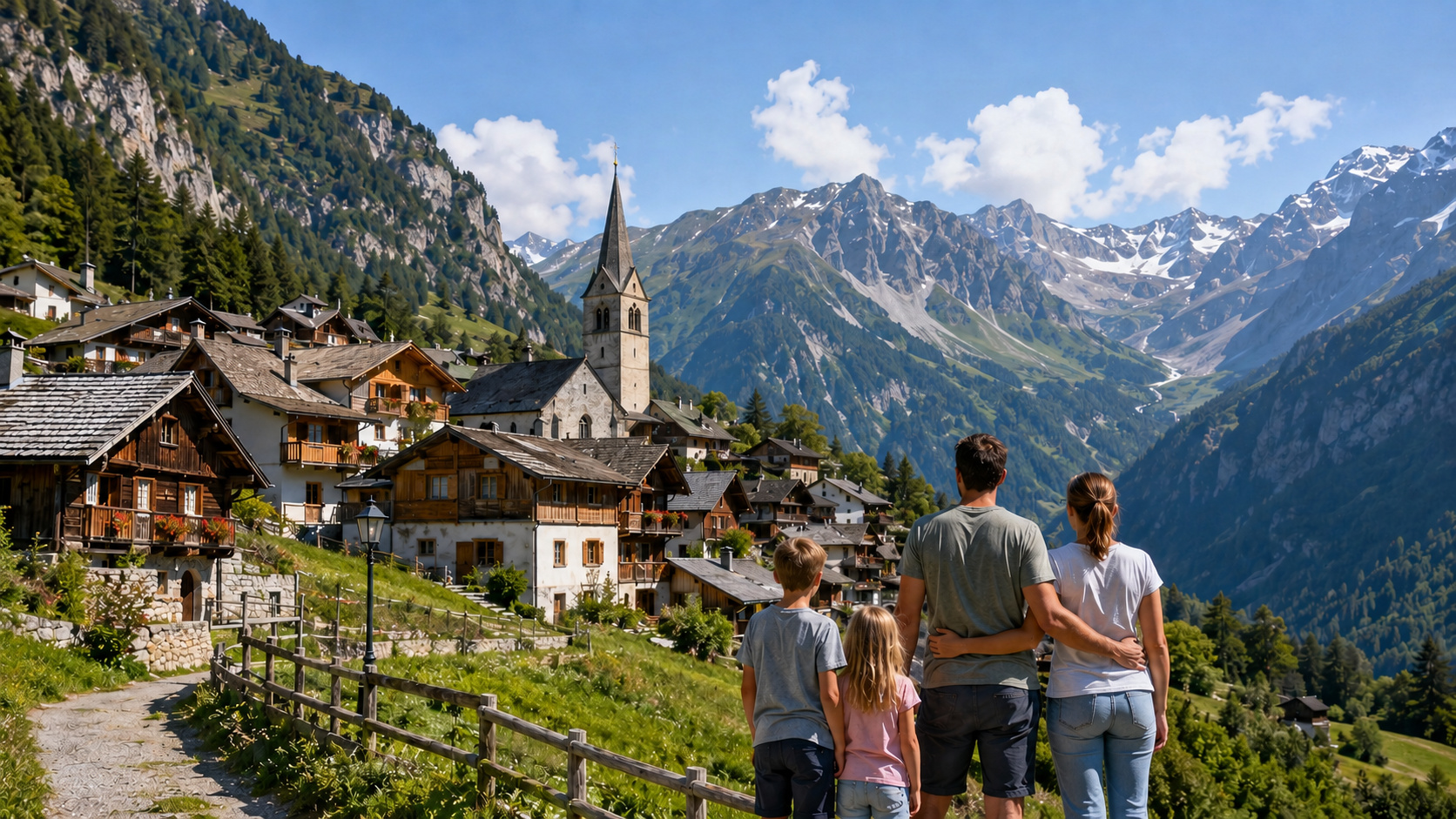


Swiss Alpine village offers up to 25,000 francs per adult to attract residents, but requires long residency, age limit, and property purchase.
Amidst the mountains of the canton of Valais, in southern Switzerland, a small Alpine village has garnered international attention by creating an unusual financial program to combat depopulation. The village of Albinen approved an incentive system offering up to 25,000 Swiss francs per adult and 10,000 francs per child for families willing to move to the community and remain there for several years. The initiative gained global notoriety after being reported by European media and the organization SwissCommunity.
The proposal seems simple at first glance: receive money to live in the Swiss Alps. But the rules imposed by the municipality show that the program is far from a “free bonus.” To participate, candidates must meet strict criteria related to age, minimum stay, property purchase, visa, and integration into the local community.
Albinen’s case has become a symbol of a problem affecting various mountainous regions of Europe: the depopulation of small rural communities. With young people migrating to larger urban centers and an accelerated aging population, Alpine villages have increasingly sought aggressive solutions to prevent school closures, abandoned homes, and local economic collapse. Continue reading to understand how the Swiss program works, what the requirements are, and why small European towns are paying to attract residents.
-
Scientists warn that melting ice is triggering an alarming chemical transformation in preserved areas, and the first signs are already concerning researchers worldwide.

-
China placed 198 robotic legs under a 7,600-ton school and made the building walk 62 meters in 18 days, rotating the historic structure as if a concrete structure had gained feet to escape demolition.

-
Distributor confirms the premiere of ‘Dark Horse’, Bolsonaro’s film, in 650 cinemas with 99% of copies dubbed.
-
9-year-old boy who could only hold a plank for 6 minutes in physical education class trained alone for 6 months, without needing encouragement from his parents, until he broke the world children’s record with 61 minutes and 5 seconds.


Albinen has just over 200 inhabitants and has faced population loss for years
Located at an altitude of approximately 1,300 meters in the canton of Valais, Albinen has a small and aging population. According to information released by local authorities and Swiss media, the municipality has been continuously losing residents, especially young families.


This process directly affects the economic survival of small Alpine communities. With fewer inhabitants, local revenue decreases, demand for commerce and services falls, and the risk of essential structures, such as schools, closing increases.
The problem is not exclusive to Switzerland. Various mountainous regions in Italy, Spain, and France face similar challenges due to population concentration in large urban centers. In Albinen’s case, the chosen response was to create a financial package capable of making the move economically attractive for new families.
Program offers up to 25,000 francs per adult and an additional 10,000 per child
The financial incentive approved by the local community provides for payment of up to 25,000 Swiss francs for each adult accepted into the program and an additional 10,000 francs per child. In an approximate conversion as of May 2026, this represents something close to R$ 150,000 per adult, depending on the Swiss franc exchange rate.
A family consisting of two adults and two children, for example, could receive around 70,000 Swiss francs in total. The amount attracted international attention because it exceeds the equivalent of hundreds of thousands of Brazilian Reais in some family cases, creating headlines about “Swiss villages paying to receive residents.” However, the money does not function as free aid or an immediate transfer without counterparts.
Rules require maximum age, minimum stay, and property purchase
The requirements imposed by the municipality are considered strict. According to rules disclosed by Swiss sources, candidates must be under 45 years old at the time of relocation and commit to long-term residency in Albinen. Furthermore, the program requires the purchase or construction of a property in the village, and foreigners without a Type C residence permit in Switzerland are not entitled to the benefit.
The minimum housing investment is around 200,000 Swiss francs. This means that the incentive does not eliminate the cost of living in Switzerland, a country internationally known for its high real estate costs and high standard of living. Participants also need to remain in the municipality for about ten years. If they leave the village before the deadline, the money may need to be returned.
Incentive was designed to attract permanent families, not temporary tourism
Local authorities made it clear from the outset that the goal was not to create a wave of temporary residents or seasonal property investors. Albinen was specifically looking for young families capable of strengthening the local economy and keeping public services running.
Small alpine communities often suffer from an excess of secondary residences used only during winter or summer holidays. This reduces the permanent population and weakens daily economic life. For this reason, the Swiss program prioritizes effective primary residence and prolonged stay.
Life in the Swiss Alps mixes tourist landscape and geographical isolation
Albinen’s scenery helps explain the visual impact of the topic. The village is surrounded by the Alps and has typical characteristics of small Swiss mountain communities: wooden houses, snowy landscapes in winter, and a strong connection to regional tourism. At the same time, living in such areas also involves logistical and economic challenges.
Access to large urban centers is more limited, the local job market is reduced, and the Swiss cost of living remains high even in small towns. Furthermore, many residents rely on commuting to nearby larger municipalities. The program does not represent a “cheap move to the Alps,” but an attempt to make it economically viable for families to remain in areas threatened by depopulation.
Europe faces growing demographic crisis in rural and mountainous areas
Albinen’s situation is part of a broader problem in Europe. Many rural regions have been losing population for decades due to migration to large cities. Young people leave small communities in search of jobs, universities, and more comprehensive urban services.
As a result, smaller villages face accelerated population aging and reduced economic activity. Countries like Italy, Spain, and Greece have already created similar programs offering cheap houses, financial incentives, or subsidies for new residents. The difference in the Swiss case lies in the high value of the incentive and the strict rules for residency.
Switzerland combines high salaries with one of the highest costs of living on the planet
Although the amounts paid by Albinen seem extremely high, they need to be contextualized within the Swiss economic reality. Switzerland has some of the highest average salaries in the world, but also one of the highest costs of living on the planet.
Housing, food, transport, and healthcare have significantly higher prices than in many European countries. This means that the financial incentive functions more as an initial attraction mechanism than as a guarantee of cheap living or early retirement.
Program became an international showcase for combating depopulation
Since gaining global repercussion, Albinen has frequently been cited in reports about cities that pay to attract residents. The case also helped increase visibility of the demographic problem faced by European mountainous regions.

According to the SwissCommunity organization, several alpine localities are following similar experiences as a way to preserve historical communities threatened by population loss. The challenge, however, goes beyond offering money. Small towns need to ensure infrastructure, connectivity, economic opportunities, and quality of life to retain new residents in the long term.
The future of these villages depends on more than financial incentives
Regional development experts point out that repopulation programs work best when combined with employment, high-speed internet, mobility, and public services. Without these, financial incentives may only generate temporary interest without structurally altering the local population dynamic.
In Albinen’s case, the program gained notoriety precisely because it represents a concrete attempt to prevent small alpine communities from slowly disappearing over the coming decades. The question now is whether initiatives like this will be enough to save historical villages in rural Europe, or if the advance of urbanization will continue to empty entire regions even with millionaire financial incentives.





