






 Portuguese
  Spanish


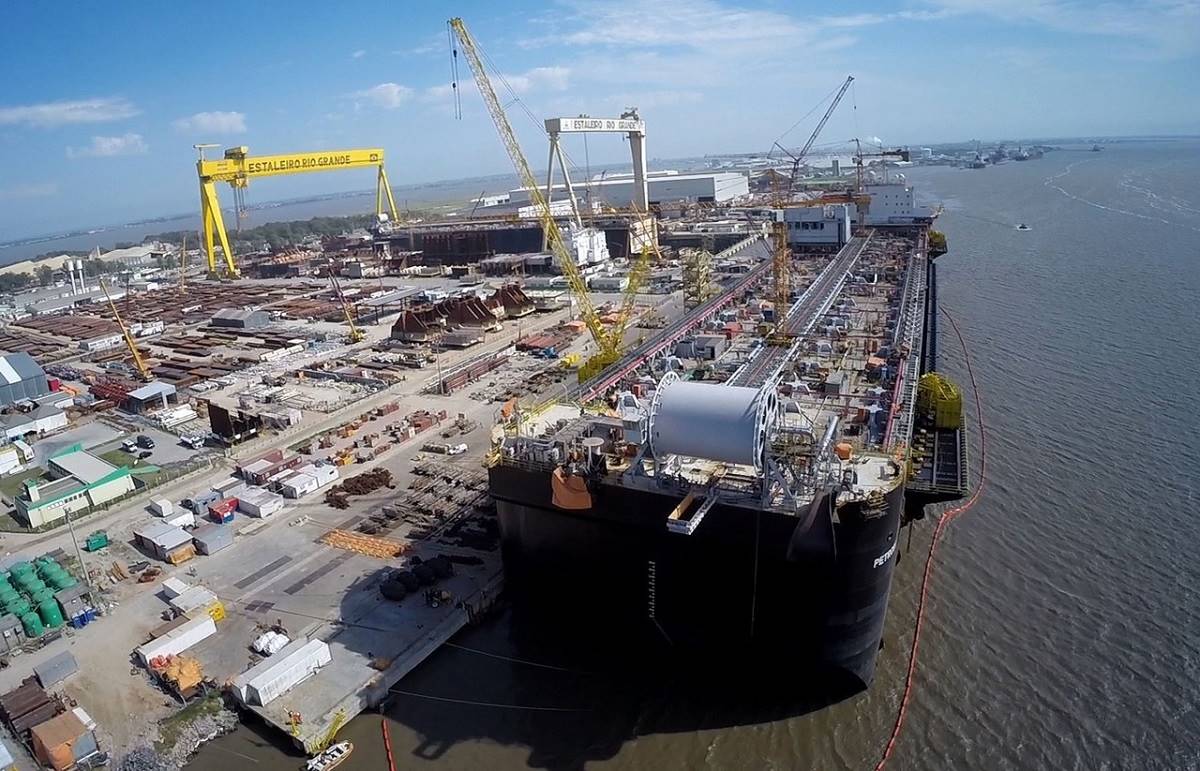

Rio Grande Shipyard, Controlled by Ecovix and Under Judicial Recovery, Has Sales as an Attempt to Minimize Loss from Contract Cancellations
Ecovix, the parent company of the Rio Grande Shipyard (ERG), located in the municipality of the same name in the state of Rio Grande do Sul, is selling 38 thousand tons of steel structures that belonged to the old hulls of P-71 and P-72, whose contracts were canceled at the height of the Lava Jato investigation.
A first round of online auctions took place last week, when 26 thousand tons were sold, and yesterday (04/23) an additional 38 thousand tons of steel were offered as scrap for buyers. We did not obtain information on whether the lots were sold or the names of the buyers.
The Rio Grande Shipyard (ERG) Fell Into Decline After Its Parent Company, Ecovix, Entered Judicial Recovery, thereby avoiding bankruptcy, but the cancellation of the contract in 2015 by Petrobras, worth nearly R$ 10 billion, was a serious blow to the company, the local economy, and the workers, with three thousand five hundred workers being laid off.
-
Lenovo Unveils Legion Y700 Tablet with RGB Backlighting, 5G, and SIM Card Support
-
Lenovo Unveils Legion Y700 Tablet with RGB Backlighting, 5G, and SIM Card Support
-
Northern Brazilian City Prepares Task Force to Mitigate El Niño Impacts with Stockpiled Fish, Drone Monitoring, Firefighting, and Water Supply Reinforcement in Remote Areas

-
Brazil to Issue “Panda Bonds” in China, Aiming to Raise Up to 5 Billion Yuan at Lower Interest Rates Than Dollar Debt

The P-71 and P-72 were part of a batch of platforms ordered by Petrobras in 2010, dubbed as replicants, because according to the initial planning, eight hulls were to have the same design, something unprecedented in the construction of FPSOs. The platforms were restarted from “zero” in China, where they are being constructed.
The Rio Grande Shipyard Is Trying to Survive by Diversifying Its Activities, and at the Beginning of the Year Obtained Authorization from the Gaúcha Assembly to Operate as a Port Terminal.
At the peak of platform construction in 2013, the shipyard had nearly 15 thousand workers; today it is practically non-operational due to a lack of contracts.
Naval Hub of the South
The other shipyard in the state, the Brazil Shipyard (EBR), has recently been announced as the builder of modules for Modec, must hire around 400 workers to execute the work on the platform that Modec is building in China.
According to the vice president of the Metalworkers’ Union of Rio Grande, Sadi Machado, “We see this moment as an extreme defeat for the working class that has fought so hard. Seeing that turn into scrap is the dream of many, families destroyed by this situation.
Today, our workers live mostly in informality, others are unemployed, and this is the full reality of the end of that dream, that struggle we fought so hard to keep that shipyard there”.
And with a feeling of sadness, the union leader added that, “What has turned to scrap is the dream of a thriving shipyard. Our workers put so much effort into it, and today it’s turning to scrap. It is being cut into pieces, going to steel mills where it is melted down and sold”.


