Portuguese
  Spanish


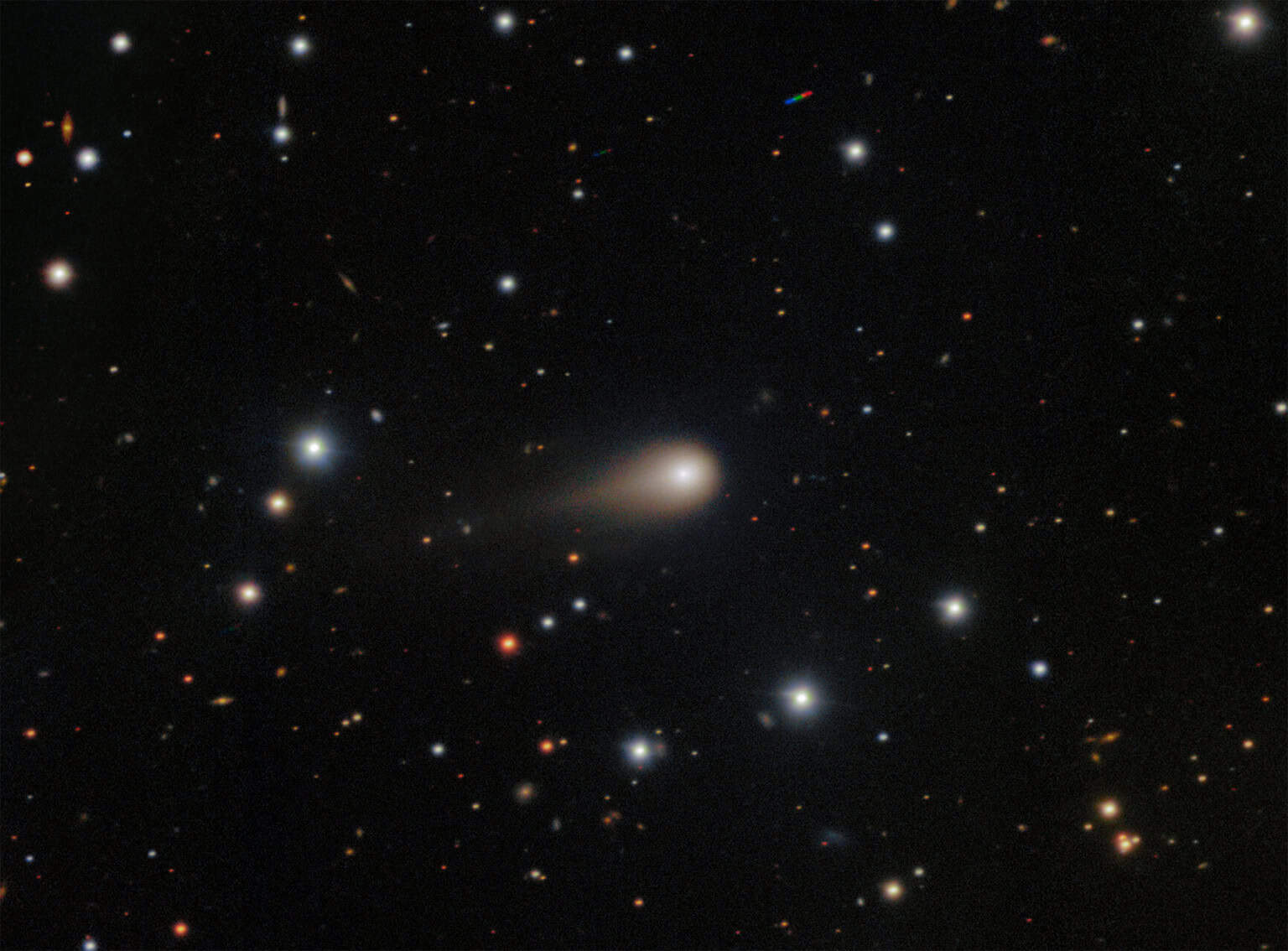


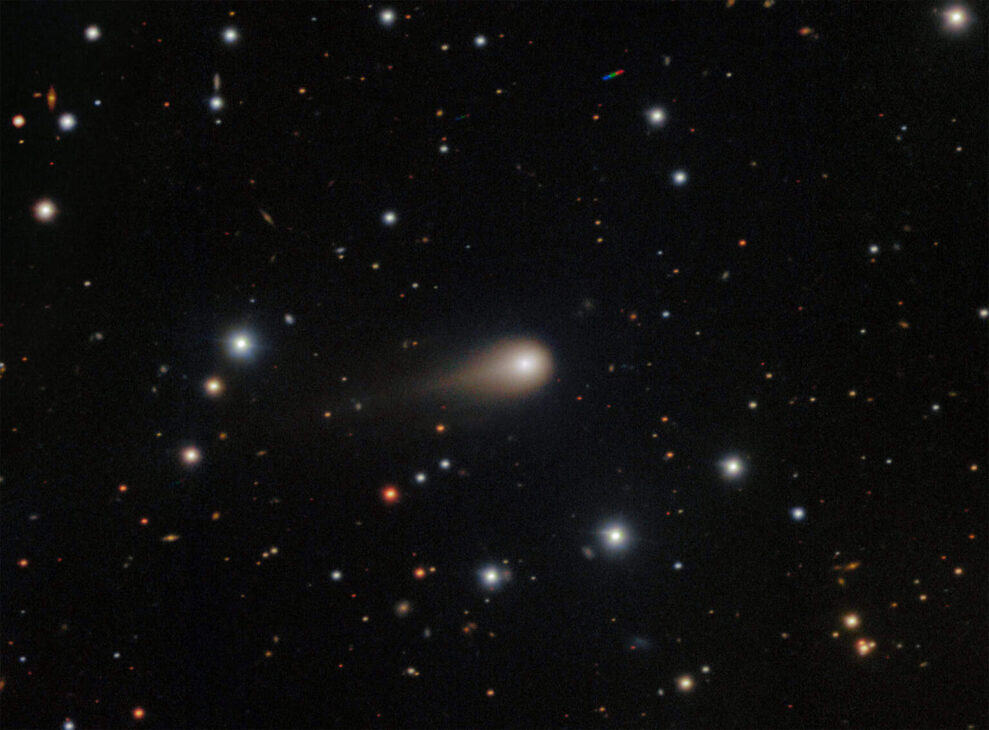
Europa Clipper May Cross the Tail of Interstellar Comet 3I/ATLAS This Week and Collect Particles from Another Stellar System in a Unique Event in the History of Space Exploration.
Never before has humanity been so close to literally touching matter that was born in another star. Starting this week, scientists around the world are monitoring an event that could mark a revolution in astronomy and astrobiology: the possibility that NASA’s Europa Clipper spacecraft will cross the ionic tail of interstellar comet 3I/ATLAS and capture particles that have traveled through interstellar space to reach the Solar System.
If the forecast holds true, it would be the first time a human-created object directly interacts with intact material from another stellar system, without maneuvers, without deviating from its path, and without any dedicated mission for this purpose. An unlikely encounter that could forever change our understanding of how worlds are formed, including our own.
Calculations Indicate That Europa Clipper May Cross a Stream of Charged Particles Ejected from the Tail of 3I/ATLAS by Solar Wind.
The forecast for this rare cosmic alignment was made by scientists Samuel Grant from the Finnish Meteorological Institute and Geraint Jones from the European Space Agency (ESA), who published the study in the arXiv repository. Between this Thursday (30) and November 6, calculations indicate that the Europa Clipper may cross a stream of charged particles ejected from the tail of 3I/ATLAS by solar wind.
-
16-Year-Old from Brazil’s Sertão Wins Young Scientist Award for AI Predicting Rainfall with 94.5% Accuracy to Aid Farmers

-
Netherlands Reports First Child Euthanasia Case Since Rule Expansion for Minors

-
Brazilian Innovator Survives Homemade Submarine Dive in Paraty Despite Hatch Leak and False Oxygen Alarm
-
China Develops Custom 140-Ton Electric Mining Truck with 770 kWh Swappable Battery, Deploys 290 Units in Xinjiang’s Largest Zinc Mine





This is not a planned encounter; it is an astronomical coincidence of the kind that led entire civilizations to build observatories on stones and now leads telescopes, software, and robotic spacecraft to point at the same phenomenon in search of answers we have never had access to before.
First Collection of Particles from an Interstellar Comet
So far, only two interstellar visitors have been confirmed passing through the Solar System: 1I/‘Oumuamua in 2017 and 2I/Borisov in 2019. No spacecraft has managed to intercept them, observe their composition up close, or cross their path.
Now, this scientific frontier may be crossed accidentally and precisely by a spacecraft that was not even assigned this mission. The Europa Clipper was designed to study Jupiter’s moon Europa, analyze its frozen surface, investigate its subsurface ocean, and map the conditions for life there.
Among its sophisticated instruments is a set of particle and electromagnetic field sensors, essential for dealing with the extreme radiation environment of Jupiter and, ironically, perfect for detecting interstellar ions.
Samuel Grant sums up the grandeur: by crossing the tail of 3I/ATLAS, the spacecraft may capture molecules that were born in another protoplanetary disk, particles that carry the chemical signature of a distant star, perhaps formed before the Sun or in a completely different region of the Milky Way.
According to him, speaking to Space.com, “it’s the closest we can get today to studying material from another stellar system.” In other words, we are about to attempt, for the first time, to touch the raw material of another world.
How Accidental Capture of Particles Works
The study utilized the software Tailcatcher, capable of simulating the behavior of solar wind and identifying when the flow of particles emitted by the Sun drags ions from a comet’s tail.
In this scenario, solar wind acts as a cosmic bridge: pushing atoms and molecules from the comet for millions of kilometers to the path of the spacecraft. If everything aligns, Europa Clipper’s sensors may register the collision of these particles with their detectors, allowing the identification of their chemical composition.
The distinction is clear. While solar wind is dominated by hydrogen and helium, cometary particles carry heavy elements, complex molecules, frozen water, carbon dioxide, and organic compounds.
In a detailed analysis, this chemical signature can reveal the “recipe” for forming planetary systems beyond our own. For scientists, comets function as time capsules, preserving primordial matter formed billions of years ago. 3I/ATLAS carries the history of another star, and Europa Clipper could be the messenger of that secret to us.
Critical Moment: Solar Wind, Perihelion, and Alignment in Space
None of this is guaranteed. Success depends on a chain of precise cosmic factors. 3I/ATLAS reached its perihelion—the closest point to the Sun—at about 200 million kilometers, which intensifies its activity and increases the size of its ionic tail.

Europa Clipper, in turn, is over 300 million kilometers from the Sun after flying by Mars earlier this year. This position offers a rare opportunity: the geometric alignment between the Sun, comet, and spacecraft may allow for the encounter with interstellar particles carried by solar wind.
But the wind needs to blow in exactly the right direction and with sufficient intensity. A different solar breeze, a slight magnetic deviation, or a change in density in the solar plasma could completely alter the destiny of this revolutionary discovery.
Missions and the Future of Interstellar Exploration
While the ESA is also monitoring the possibility of the Hera spacecraft crossing these particles, it does not have the adequate sensors to measure them. Europa Clipper, almost by chance, is the natural protagonist of this historic experiment. And if the encounter does not happen now, the future is already being reshaped.
The Comet Interceptor mission, planned for 2029, will silently wait in space for the emergence of an uncatalogued comet, capable of coming from the interstellar depths.
Its objective is clear: to intercept, study, and perhaps collect samples from a traveler like 3I/ATLAS from the very moment it enters the Solar System.
What Is at Stake for Science and Humanity
If Europa Clipper manages to detect interstellar particles, we will be faced with a milestone as symbolic as it is scientific: for the first time, material coming from another stellar system will be captured by a machine built by humanity.
A silent step into deep space, but a giant leap for understanding how planets are born, how molecules organize, and possibly how life may arise in other corners of the galaxy. There will be no dramatic images, cinematic explosions, or live broadcasts with countdowns.
But there may, perhaps, be the most important record since we saw a pale blue dot float in the void: the evidence that what formed us did not originate here, and that the history of life may be a galactic phenomenon, not an isolated privilege.
In a universe where each comet is a messenger and each star carries chemical seeds, the Europa Clipper may today become the bridge between worlds and the first human instrument to touch, even if in microscopic dust, the remnants of another stellar dawn.
A cosmic coincidence that may redefine what we understand about origin, destiny, and humanity’s place in the cosmos. And, like so many scientific revolutions, it may begin with a particle, an electromagnetic shock, and a question that has echoed since the dawn of civilization: where do we come from—and how many other worlds may be being born right now on the other side of the Milky Way?