






 Portuguese
  Spanish


Developed during the pandemic, Diego Rodda’s portable acoustic booth became an alternative for voice actors, announcers, and musicians who need to record with quality in different environments.
A professional need faced during the pandemic turned into a business opportunity in the city of São Paulo.
The actor and sound engineer Diego Rodda created a portable acoustic booth after needing to perform dubbing away from professional studios.
The structure was initially developed to provide higher sound quality during recordings made at home.
-
Brazilian undergraduate builds eco-friendly weed-killing robot, wins $50,000 and starts own startup after beating 95 teams

-
Fervo Energy Adapts Oil Drilling Techniques to Develop Universal Geothermal Energy Solution

-
Brazilian Teen’s Jute Hydro-Sponge Removes 80% of Tire Pollutant Killing Salmon, Wins $75,000 at U.S. Science Fair
-
New Zealand Drills Geothermal Well with Steam Exceeding 400 Degrees, Potentially Revolutionizing Clean Energy


The project later attracted the interest of other professionals and began to serve announcers, musicians, and voice actors.
An initial investment of approximately R$ 4,000 allowed the production of the first prototype.
The business achieved an average revenue of about R$ 15,000 per month and recorded 55 units sold during 2025.
Recordings made at home motivated the creation
Audio-visual productions began to request remote recordings during the pandemic period.
Diego, faced with this change, needed to find a way to maintain audio quality outside specialized studios.
The professional’s previous experience included the development of large booths for studios.
A compact, lightweight, and portable version, however, had not yet been designed by him.
Further studies allowed Diego to develop a reduced structure suitable for the home environment.
The first model of the portable acoustic booth was completed after approximately 25 days of development.
The main challenge was to reduce the dimensions of the structure without compromising its functionality during recordings.
Investment of R$ 4,000 enabled the first prototype
About R$ 4,000 was initially invested in the construction and improvement of the equipment.
The prototype received adjustments aimed at assembly, transport, and use in different spaces.
The first order came through the recommendation of a professional colleague.
This order marked the transformation of a personal solution into a commercial activity.
Diego realized that the product could also serve professionals facing similar challenges during voice and music recordings.
Customized booths start at R$ 1,800
The equipment is currently produced according to the available space and the needs presented by each client.
The prices of the booths start at approximately R$ 1,800.
The product line includes different configurations:
- Open booths for recordings;
- Structures with greater sound insulation;
- Compact models for use on tables;
- Customized versions for different spaces.
Each booth can be adapted to the characteristics of the environment and the type of recording performed by the buyer.
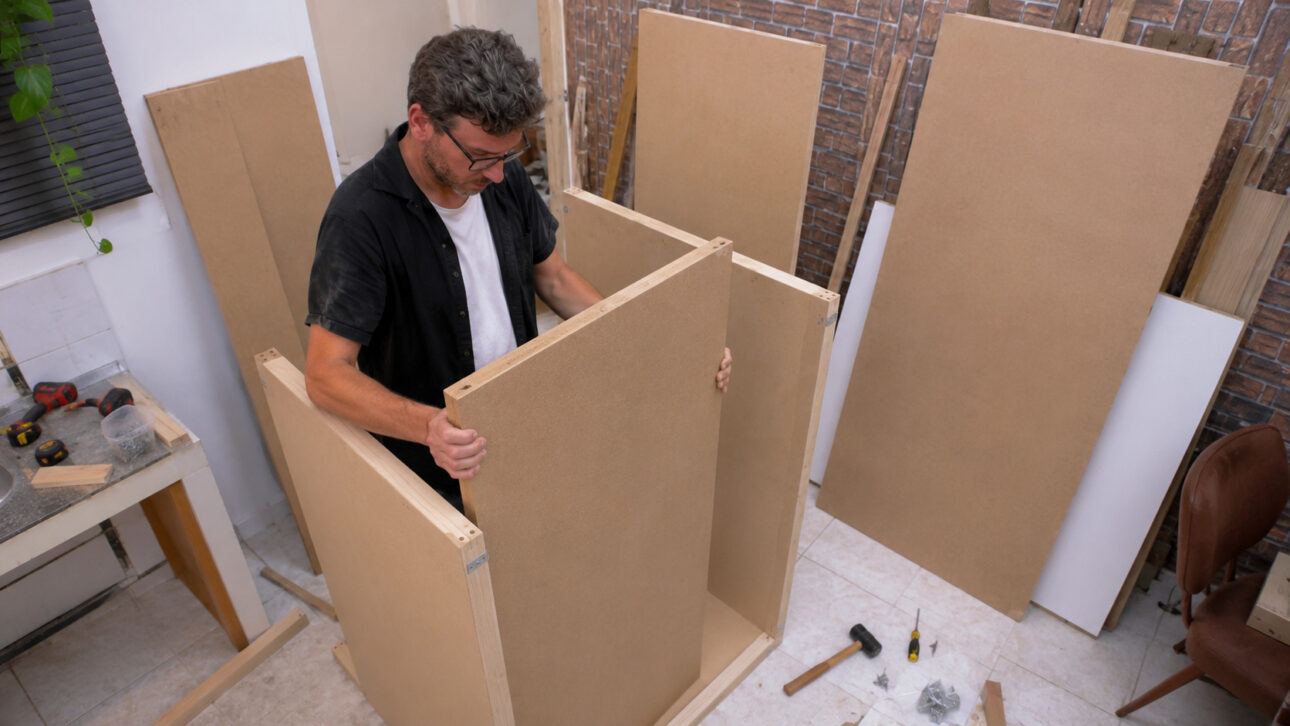
Portability allows assembly in a few minutes
The ease of transport has become one of the main differentiators of the equipment developed by Diego.
The booths can be assembled by just one person and are ready for use in a few minutes.
The structure can also be disassembled and transported to other locations with ease.
This feature expands the possibilities of use among professionals who work from home or frequently change environments.

Entrepreneur manages the entire operation
Diego remains responsible for all stages related to the business.
The work includes the development of projects, the manufacturing of structures, sales, and customer service.
The dissemination occurs mainly through word of mouth, with recommendations made by clients and industry professionals.
The result of this strategy appeared in the 55 portable acoustic booths sold throughout 2025.
The business also started to record an average revenue of approximately R$ 15,000 per month.
Diego considers the activity financially advantageous and analyzes each new project in search of lower costs.
The simplification of assembly and the improvement of the customer experience are also part of this process.
Growth may lead to new hires
The increase in demand led the entrepreneur to plan an expansion of production capacity.
The hiring of employees is among the next steps considered by Diego to divide the different stages of the operation.
The expansion could allow for more orders to be fulfilled without eliminating the customization offered to clients.
The development of the products will continue to focus on creating simpler, more accessible, and easy-to-transport booths.
Need turned an idea into a business
Diego’s journey shows how a professional problem can lead to a commercial solution.
The booth was initially created to allow remote recordings with better sound quality during the pandemic.
The equipment later began to serve other professionals with similar needs.
A structure developed for home use was thus transformed into a business with recurring sales.
Diego believes that creativity arises when a need demands a practical solution.
Do you believe that an idea created to solve an everyday problem can turn into a profitable business? Leave your opinion in the comments.


