






 Portuguese
  Spanish


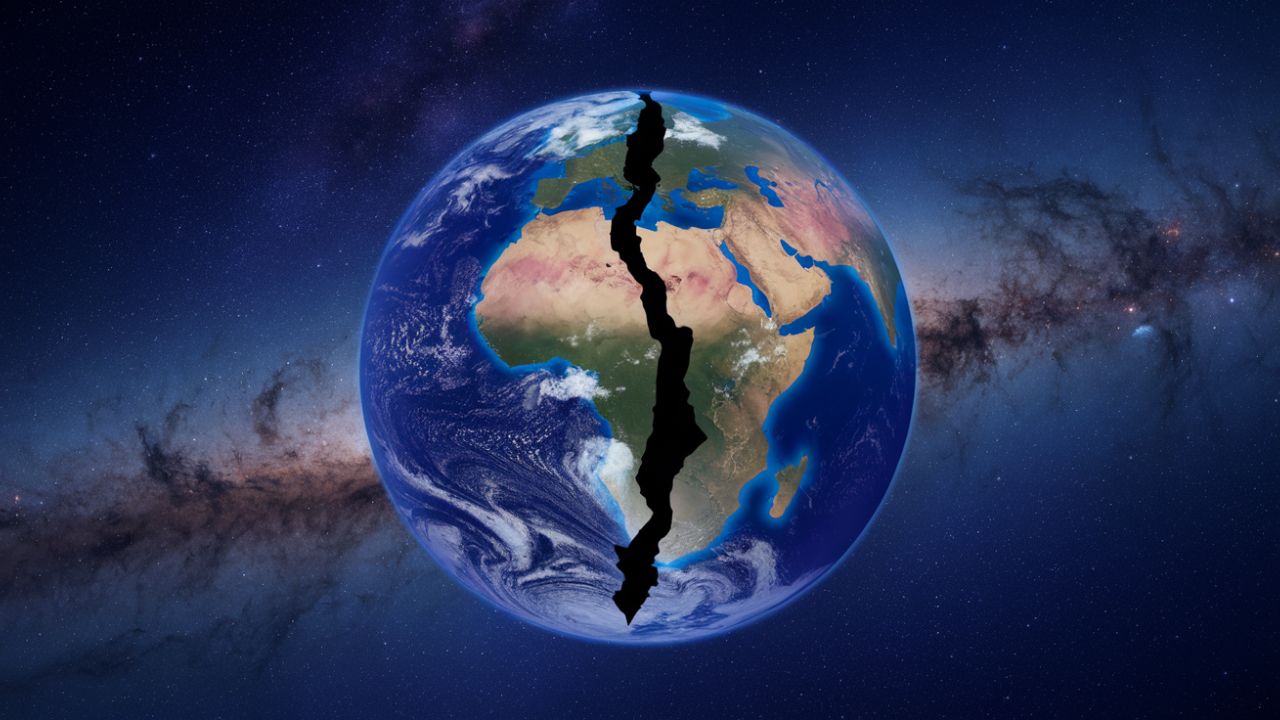


A 56 Km Crack Appeared in the Eastern African Rift, Dividing the Continent into Parts and Could Create an Ocean as Deep as the Atlantic in Up to 5 Million Years.
If you think of Africa as a fixed and unchanging continent, it may be time to rethink that concept. An impressive crack of 56 kilometers has emerged in the Eastern African Rift in Ethiopia and is about to change the world map. But, don’t worry, it’s not something we’ll see in our lifetimes – at least not the ocean flooding the affected areas.
This separation is caused by powerful tectonic forces that are literally tearing the continent in half. Experts believe that in the future this will lead to the formation of a new ocean, something as grand as the Atlantic Ocean. Let’s explore this fascinating story!
The Crack in the Eastern African Rift

The Eastern African Rift is a system of tectonic fissures that extends for thousands of kilometers, cutting through countries like Somalia, Kenya, and Ethiopia. It is one of the few places on Earth where tectonic plates are actively moving apart, creating fissures and cracks that reveal the unstoppable force of our planet.
-
She spent 73 years breathing inside an iron lung, survived the aftereffects of polio, and became the last woman in the United States dependent on the equipment before dying at 78 years old.

-
Brazilian students created a $1 filter using pine bark, cotton, and 3D-printed parts to clean cassava wastewater, reduce the toxicity of a hazardous waste, and transform contaminated water into biofertilizer.

-
Astronaut from Artemis II steps down after mission to the Moon and decision surprises after a record of 406,771 km, a historic 10-day journey, and an unprecedented achievement for Canada.

-
A fossil kept for years in a small museum in Montreal concealed 450-million-year-old soft tissue, a discovery that has only happened once before in history.


In 2005, a gigantic crack was discovered in Afar, Ethiopia. At 56 kilometers long, this fissure became a symbol of the continental separation process in action. Geologists explain that this phenomenon began about 25 million years ago, but only now have we been able to map in detail the direction it is taking.
The Tectonic Forces and the Future of Africa
The African continent is being torn apart by the Somali and Nubian plates, which are moving in opposite directions. This separation creates seismic shocks and volcanoes, showing that the Earth is constantly in transformation.
According to scientists, the waters of the Indian Ocean will begin to invade the Rift Valley, forming a new ocean. Imagine a scenario where the continent is literally split in two, giving rise to what some are already calling the “Nubian Continent.”
The Impact on Human Life and the Ecosystem
Although the process is slow on a human scale, signs are already everywhere. Earthquakes and volcanic eruptions are frequent events in the region. However, the most drastic changes, like flooding from the ocean, will only occur in millions of years.
Another fascinating phenomenon is the possible break-up of Madagascar, which may split into two islands. These geographical changes could directly impact biodiversity, creating new ecosystems and altering the balance of nature.
The Science Behind the Separation
The Eastern African Rift is driven by heat from the asthenosphere, a layer of the Earth’s mantle. This heat weakens the crust, allowing the plates to pull apart. Recent studies show that the thinning of the lithosphere in the region is one of the main reasons for the formation of the cracks.
Recent research has revealed that different parts of the Rift have varying levels of volcanic activity. Scientists continue to investigate how these activities may accelerate the continental separation process and form new bodies of water.








Quer dizer, ou louco meu!!!!!!……
Que logo meu…..
Sempre assim… a notícia não importa.
Todos sentados pois vai começar a aula de português.