






 Portuguese
  Spanish


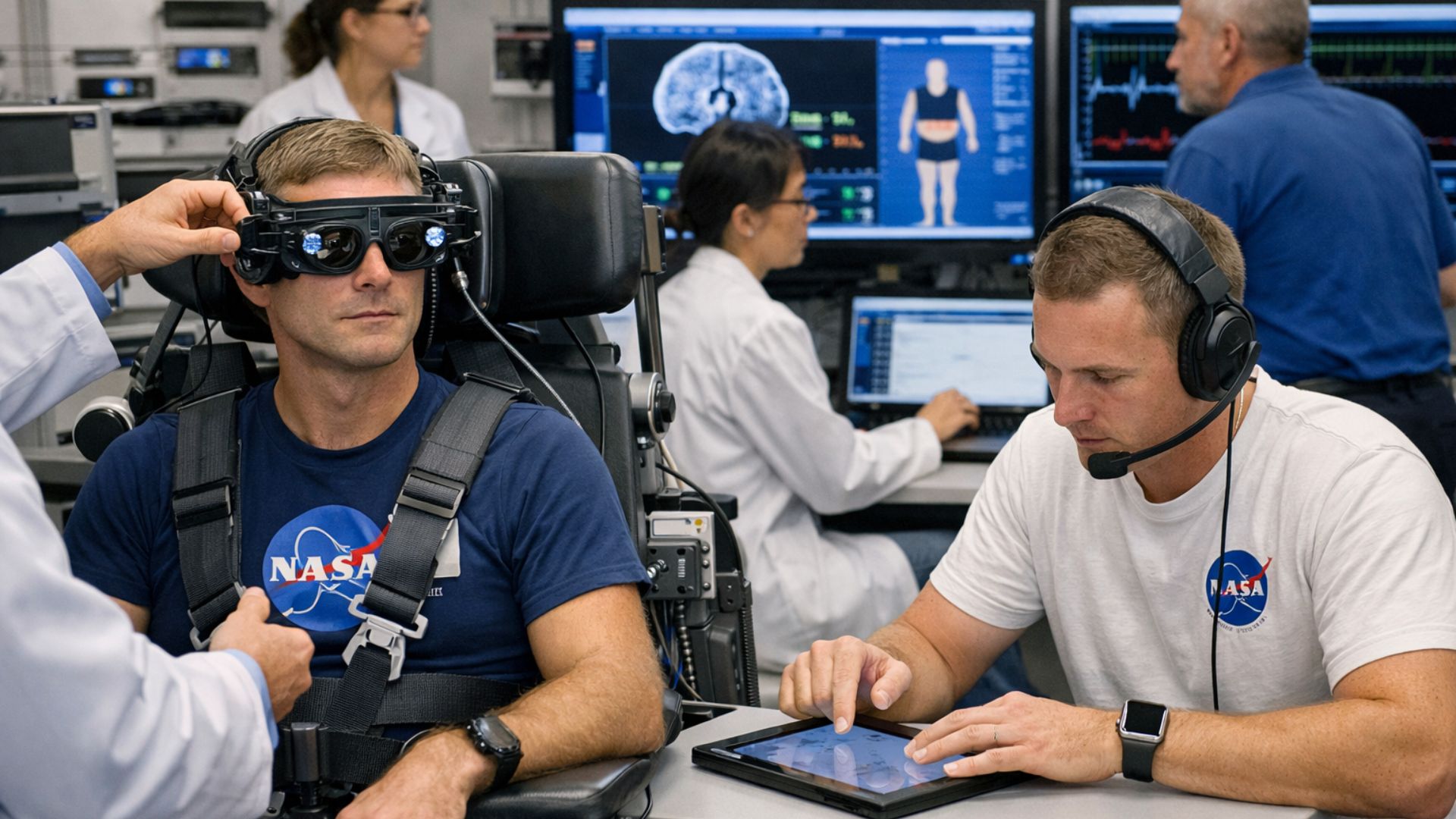

Three days off Earth were enough to alter balance, cognition, and vital functions of civilians on a unique mission, revealing how the body responds quickly to microgravity and activating biological responses similar to those of professional astronauts, even on short flights and with later recovery.
Three days in orbit were sufficient to provoke measurable changes in the body of the Inspiration4 crew, a mission launched on September 15, 2021, and described in scientific literature as the first orbital flight with a fully civilian crew.
A study published in the journal Nature showed changes in balance, cardiovascular regulation, cognitive performance, and biological markers linked to stress, although most of these signs regressed after returning to Earth.
The research gained weight by observing, in real flight conditions, how people without a professional career as astronauts respond to the immediate challenges of the space environment.
-
James Webb Telescope Uncovers Unexpected Clues on Mysterious Moon, Potentially Redefining Planetary Origins

-
$1.5 Billion Sleipnir Vessel Transforms Ocean into Floating Construction Site with 12 Hybrid Engines and Capacity to Lift 20,000 Tons

-
23 Years After Tragedy, Brazil’s Alcântara Space Center to Launch New Suborbital Rocket in 2026 with South Korean SEBIT Project Targeting Near-Space Tests
-
Entrepreneur Turns Neighbor’s Coffee Grounds Waste into Eco-Friendly Pellets, Earning Up to $40,000 Monthly in Brazil


The mission reached an altitude of about 590.6 kilometers, above the International Space Station, and exposed the four crew members to microgravity, radiation, and confinement, factors known to alter the functioning of the human body.
Changes in the human body in short space missions
The research gathered a broad array of measurements before, during, and after the trip, including biological samples, cognitive tests, eye alignment exams, behavioral surveys, and physiological data obtained from smartwatches.
According to the authors, this set allowed for observing not only the visible effects of microgravity but also cellular and molecular responses that begin to emerge within the first few days off Earth.
The results indicate that short missions are not physiologically trivial.
The article states that the crew exhibited some of the same signatures already described in longer flights, including inflammatory response, activation of genes linked to DNA damage, changes in immune signaling, and telomere elongation, a change already observed in previous research on exposure to space.
This point is relevant because it shifts the debate about space risks.
Instead of restricting the discussion to prolonged stays in orbit, the study shows that biological adaptation begins early and involves multiple systems simultaneously, even when the mission lasts only three days and ends with a quick recovery of most monitored indicators.
Vestibular system and balance in microgravity
One of the focuses of the monitoring was the vestibular system, responsible for informing the brain where the body is, how it moves, and which direction should be understood as the reference for up and down.
To this end, the researchers evaluated eye alignment as an indirect measure of the function of the otoliths, structures in the inner ear involved in the perception of balance and acceleration.
Two of the four members reported spatial disorientation during the flight, a proportion consistent with what the literature describes for short missions.
The authors highlight that vestibular asymmetry can manifest as eye misalignment and is associated with susceptibility to discomfort in microgravity, reinforcing the idea that the body needs to quickly reorganize its orientation as soon as it leaves the Earth’s gravitational field.
Although the article did not find a uniform effect from pre- to post-flight across the group in this specific test, the investigation treated these measures as part of the effort to capture early signs of neurovestibular adaptation.
In practice, the study reinforces that the balance system is among the first to respond to the orbital environment and can influence other domains of human performance.
Cognitive performance in space environment
The team also conducted ten tests from the Cognition battery, created by NASA to monitor essential functions in flight, such as sustained attention, working memory, response speed, visual search, and sensorimotor coordination.
Overall, accuracy was largely preserved in most tasks, but the crew became significantly slower in four tests during the mission.
In three of these tasks, the slowness was accompanied by a decrease in accuracy, with clear statistical significance in the motor praxis test, leading the authors to describe a decline in cognitive efficiency.
The effect was not uniform for everyone, as part of the deficit was driven by one of the participants early in the flight, but the finding suggests that even a short stay can already affect the mental agility required for operational routines.
The researchers note that changes of this type may be linked, at least in part, to the neurovestibular and sensorimotor changes produced by microgravity.
In other words, when the organism is still trying to recalibrate balance, movement, and body perception, processing speed may also suffer, even without a broad deterioration of all assessed cognitive functions.
Cardiovascular and physiological impacts in space
On the cardiovascular front, smartwatches recorded heart rate, heart rate variability, oxygen saturation, physical activity, and energy expenditure throughout the different phases of the mission.
The study found significant changes between the pre-launch period, the days in orbit, and the return, with distinct responses among the members, indicating that adaptation to space does not occur in the same way in all organisms.
The authors reported a significant change in both heart rate and heart rate variability, as well as a sharp decline in physical activity and energy expenditure during the time spent in orbit.
In one of the participants, there was a reduction in heart rate and an increase in variability, accompanied by lower oxygen saturation in flight; however, after landing, the cardiovascular measures did not remain different from baseline.
This pattern helps explain why space medicine has begun to pay more attention to short missions.
It is not just about subjective discomfort or nonspecific fatigue, but rather a rapid physiological reorganization, with repercussions that reach autonomic control, heart rate, and body behavior in a time frame that, until recently, might have seemed too small to generate significant changes.
Commercial space flights and challenges for civilians
The importance of Inspiration4 is not only in what happened to those four crew members but in the type of scenario it anticipates.
The article itself emphasizes that the data help build references for future private missions and for preparatory tasks before launch, without this meaning declaring space flight safe for all civilians or serving as a definitive selection criterion for passengers.
This caution is central because the study has evident limitations.
The sample is small, there was no age- and sex-matched control group on the ground, and the authors themselves state that new missions with a similar design will be necessary to confirm the findings and clarify more robust causal relationships between microgravity, molecular responses, and functional performance.
Still, the overall results offer a clear message for the current phase of space exploration.
The human body begins to respond to space earlier than intuition might suggest, and these responses appear in layers that range from balance and cognition to the cardiovascular system and cellular biology, even when most markers return to baseline after landing.


