






 Portuguese
  Spanish


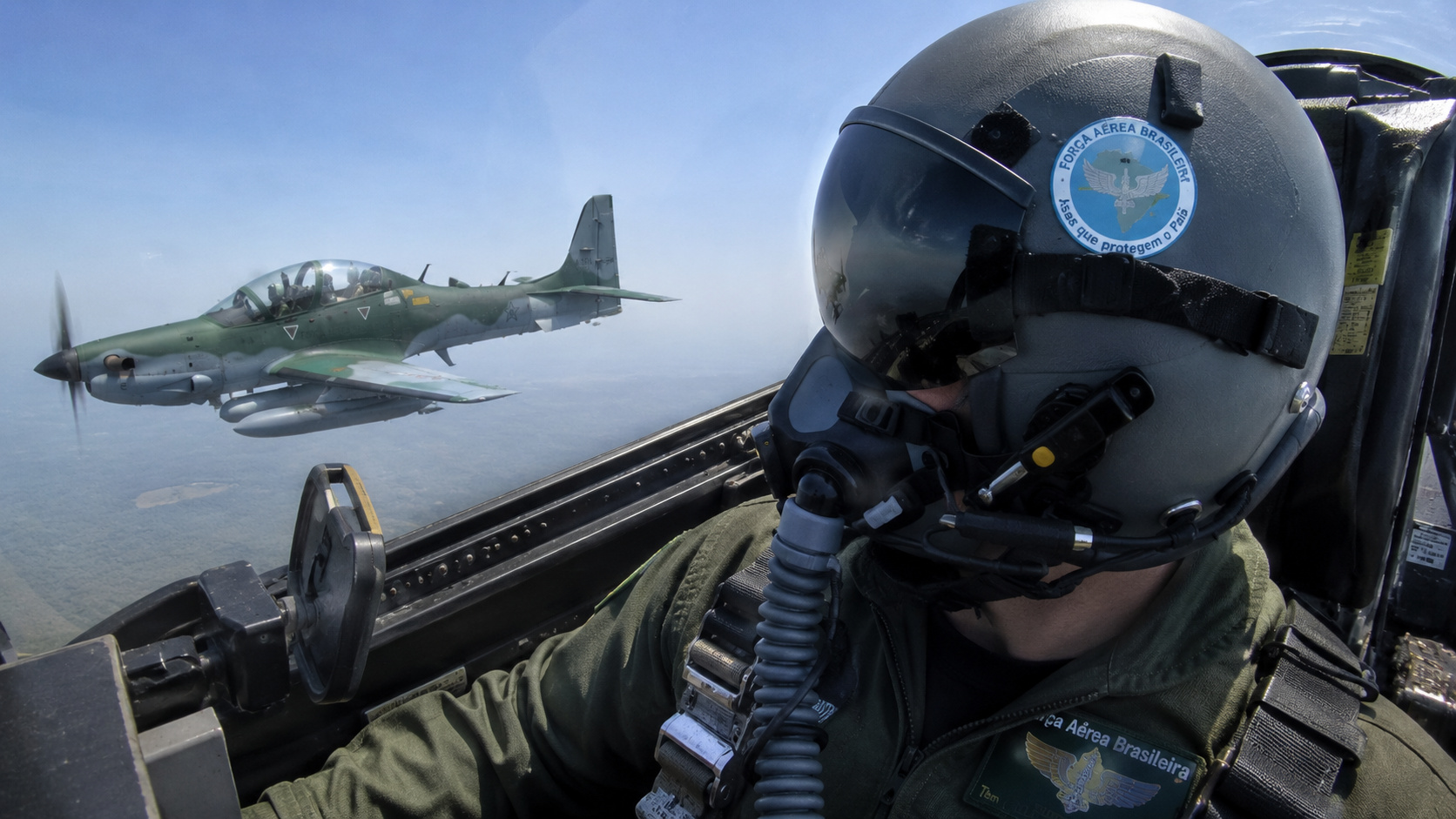
Air surveillance in Brazil goes far beyond the radars and control towers scattered across airports. In regions considered strategic, such as the Amazon, surveillance is intense and involves coordinated operations between military personnel, civilian controllers, and combat aircraft prepared to act within minutes.
Last Thursday (7), a demonstration held during an operation by the Harpia Joint Command revealed how the Brazilian Air Force (FAB) air interception system works in practice. The action took place during the flight of the military delegation between Manaus and São Gabriel da Cachoeira, in Amazonas, and drew attention due to the precision of the procedures adopted in the Amazonian airspace.
As published by g1 Amazonas, an Embraer A-29 Super Tucano fighter jet approached the aircraft carrying officers from the three Armed Forces to simulate a real interception. During the approach, the pilots initiated radio contact, reproducing exactly the protocols used in real air defense situations.
-
Chinese Farmer Builds 5-Ton Homemade Submarine Over a Decade, Capable of Diving 8 Meters with Two Passengers

-
Brazilian Woman Transforms Ambulance into Solar-Powered Mobile Home for Remote Work and Travel Adventures

-
Oil Company Robots Discover 3,300-Year-Old Canaanite Shipwreck in the Mediterranean, Proving Ancient Mariners Navigated Open Seas by Stars Long Before Historians Thought

-
Facing high rent costs in Brazil, couple swaps apartment for life on a sailboat, reducing expenses significantly.





How the FAB identifies suspicious aircraft in Brazilian airspace
The process begins even before the fighter jets approach. According to the Department of Airspace Control (Decea), all air movement is continuously monitored within the so-called Air Defense Identification Zone (ZIDA), a strategic area created to detect unknown aircraft or those with behavior considered irregular.
When an aircraft presents inconsistencies, fails to respond to controllers, or transmits insufficient information, civil and military authorities attempt immediate contact to identify the situation. Additionally, data such as route, registration, altitude, and flight plan are analyzed.
If there is no adequate response, the FAB can deploy military aircraft to perform visual identification. At this point, the fighter jets approach the suspicious aircraft to confirm its identity and understand if there is any type of threat or irregularity.
According to Decea, interception is considered an exceptional measure and only occurs when other means of communication fail. Nevertheless, the Air Force Command has the authority to intercept any aircraft that poses a potential risk to Brazilian airspace.
In operations carried out in the Amazon, this monitoring gains even greater importance. This is because the region has vast areas of difficult access, extensive borders, and an intense flow of small aircraft, factors that require constant vigilance from military authorities.

What happens when an aircraft is intercepted by the Brazilian Air Force
Contrary to what many imagine, an interception does not automatically mean that a crime or illegal activity has occurred. In various situations, the action serves only to confirm aircraft information or resolve communication failures.
When the military fighter jet approaches, the pilot of the intercepted aircraft must immediately obey instructions transmitted by radio or by internationally standardized visual signals. Among the most common commands are route changes, mandatory identification, and a directive to land at a specific location.
Additionally, the crew needs to establish communication with the authorities responsible for the interception, providing identification, origin, destination, and type of flight performed.
Another important procedure involves the transponder, an electronic device used to transmit aircraft data to radars. In certain situations, the pilot must select specific codes, such as 7700, used internationally for general emergencies.
These protocols help reduce risks during the operation and allow control centers to monitor each stage in real time. According to the FAB, one of the main objectives of interception is to verify if the registration and reported data truly correspond to the aircraft in flight.
There are cases where aircraft have documentation problems, identification failures, or even attempts to impersonate other aircraft. Therefore, the visual verification performed by fighter jets is considered essential to ensure operational safety.
In certain situations, the approach occurs so discreetly that the commander of the intercepted aircraft does not even notice the presence of the military aircraft. After confirming the registration, model, and regularity of the flight, the fighter jet simply departs.
On the other hand, when there are more serious suspicions or a lack of cooperation, the procedure can quickly escalate to more stringent measures.


When a “warning shot” can be used during an aerial interception
Among the most extreme measures provided for in FAB operations is the so-called “warning shot,” used only in exceptional circumstances. According to the Air Force, the measure is dissuasive in nature and serves to reinforce that orders issued during interception must be obeyed.
The shot is fired only when the intercepted aircraft repeatedly ignores attempts at contact and maintains behavior considered suspicious by air defense authorities.
The entire procedure is recorded, monitored, and subsequently audited to ensure transparency and compliance with Brazilian legislation and international aviation standards.
In addition to radio communications, Decea also provides for the use of internationally standardized visual signals. These signals include specific wing movements, changes in the intercepting aircraft’s position, and the use of lights to transmit orders to the intercepted pilot.
Each maneuver has its own meaning and requires an immediate response from the crew being approached. The agency’s manual also specifies which signals must be performed by the intercepted aircraft to confirm that it has understood the received instructions.
According to the FAB, the integration between civil and military systems is crucial for these operations to occur quickly and efficiently. In many cases, the first alert about irregularities comes from civil air traffic controllers themselves, who activate the Military Operations Centers (COPM) installed in the Cindactas.
This integrated model drastically reduces reaction time and increases the chances of success for air defense operations in national territory.
The planning and coordination of interceptions are the responsibility of the Aerospace Operations Command (Comae), the body responsible for conducting aerospace control actions, identification, and eventual coercion of traffic considered suspicious in Brazil.
Just as with a ground checkpoint on the streets, aircraft can also be inspected during flight. The difference is that, at thousands of meters of altitude, every second counts, and any communication failure can turn a simple check into a major military operation.








Be the first to react!