Portuguese
  Spanish




After 17 Days in the Sky, NASA Balloon Lands in the Pacific and Raises Investigation into Failure that Caused Altitude Loss
Less flashy than rockets, NASA’s stratospheric balloons continue to play crucial roles in science. The most recent one concluded its mission after more than two weeks over South America.
17 Days of Trajectory in the Southern Skies
The balloon was launched on April 17, from Wanaka Airport in New Zealand. In just over two weeks, it traveled a route through the mid-latitudes of the southern hemisphere.
The flight lasted exactly 17 days, 13 hours, and 47 minutes. On May 3, it completed a full trip around the planet, and on May 4, it landed in the Pacific Ocean, about 1,300 kilometers off the eastern coast of New Zealand.
-
Sudden Sea Recession in São Paulo Sparks Tsunami Alert and Online Debate on Giant Wave Risks in Brazil

-
China Launches World’s First 307-Meter Floating Wind Platform to Supply Oil Rigs, Aiming to Cut 35,000 Tons of CO2 Annually

-
Japan Deploys Offshore Concrete Factory, Constructs Massive Caissons in 8 Days, Revolutionizing Port Construction with Industrial Efficiency

-
China Builds World’s Largest Power Grid, Generating Enough Energy to Supply 15 Times Brazil’s Needs, Surpassing the US, EU, and India Combined


This was the first flight of the 2025 Superpressure Balloon Campaign, conducted by NASA. And, although it met the minimum mission requirements, there was a problem during the trajectory.
Leak and Early End of the Mission
During the crossing of regions with lower temperatures, the operators noticed that the balloon was losing altitude at night. The team suspected a possible leak and, as a precaution, decided to end the flight earlier than planned.
The decision was made to ensure safety and minimize any environmental impact. There was no attempt to recover the equipment.
The payload, weighing about two tons, was used as a weight to sink the entire system to the ocean floor as quickly as possible. This way, it prevents debris from remaining in the zone where most marine species live.
Experiment in Flight
The balloon carried the HIWIND mission, which aimed to measure neutral wind in the thermosphere. This layer of the atmosphere is located between the mesosphere and the exosphere.
The data helps scientists better understand the behavior of the ionosphere, a region that directly affects navigation and communication systems.
This flight also served to test a new superpressure balloon design. As it did not reach the expected duration—the previous record was 57 days—NASA will investigate the causes of the altitude loss. The goal is to prevent the same type of failure from occurring in future launches.
Despite the setback, the mission did not stop. A second balloon from the campaign was launched on May 3. It is already in operation and can be tracked in real-time on NASA’s website.
What Are Superpressure Balloons
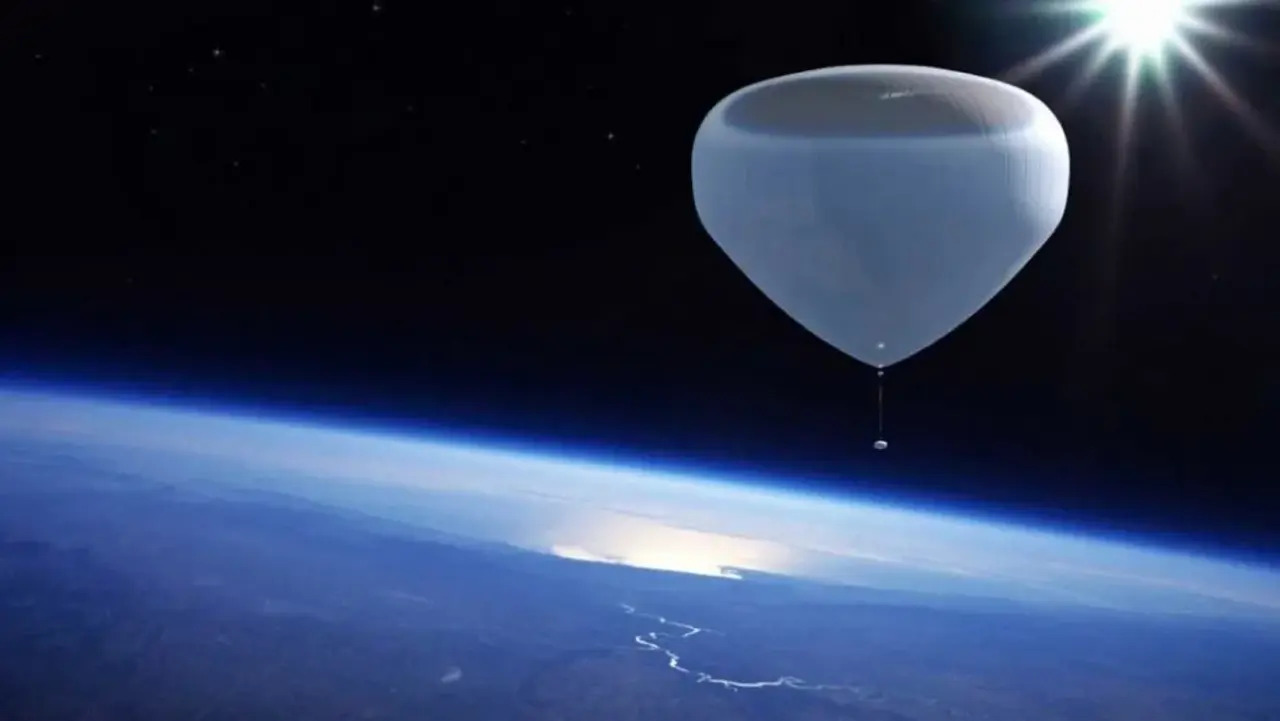
These balloons have a pumpkin shape and a completely sealed structure. They maintain a positive internal pressure and an almost constant volume, which provides longer and more stable flights.
The diameter can reach up to 150 meters and the volume up to 1.13 million cubic meters—enough to hold an inflated football stadium inside.
They can reach altitudes of up to 36 kilometers, more than double that of a commercial airplane. In some tests, they have been considered an alternative for space tourism.
Science Above the Clouds
NASA’s scientific balloons offer a low-cost option to access the stratosphere. With them, it is possible to study space and Earth without relying on rockets.
Some models even carry telescopes. The current average is 10 to 15 flights per year, within the agency’s Scientific Balloon Program.
The most recent mission ended prematurely but completed another full trip around the world and reinforced the potential of these silent giants for science.
With information from Xataka.