Portuguese
  Spanish


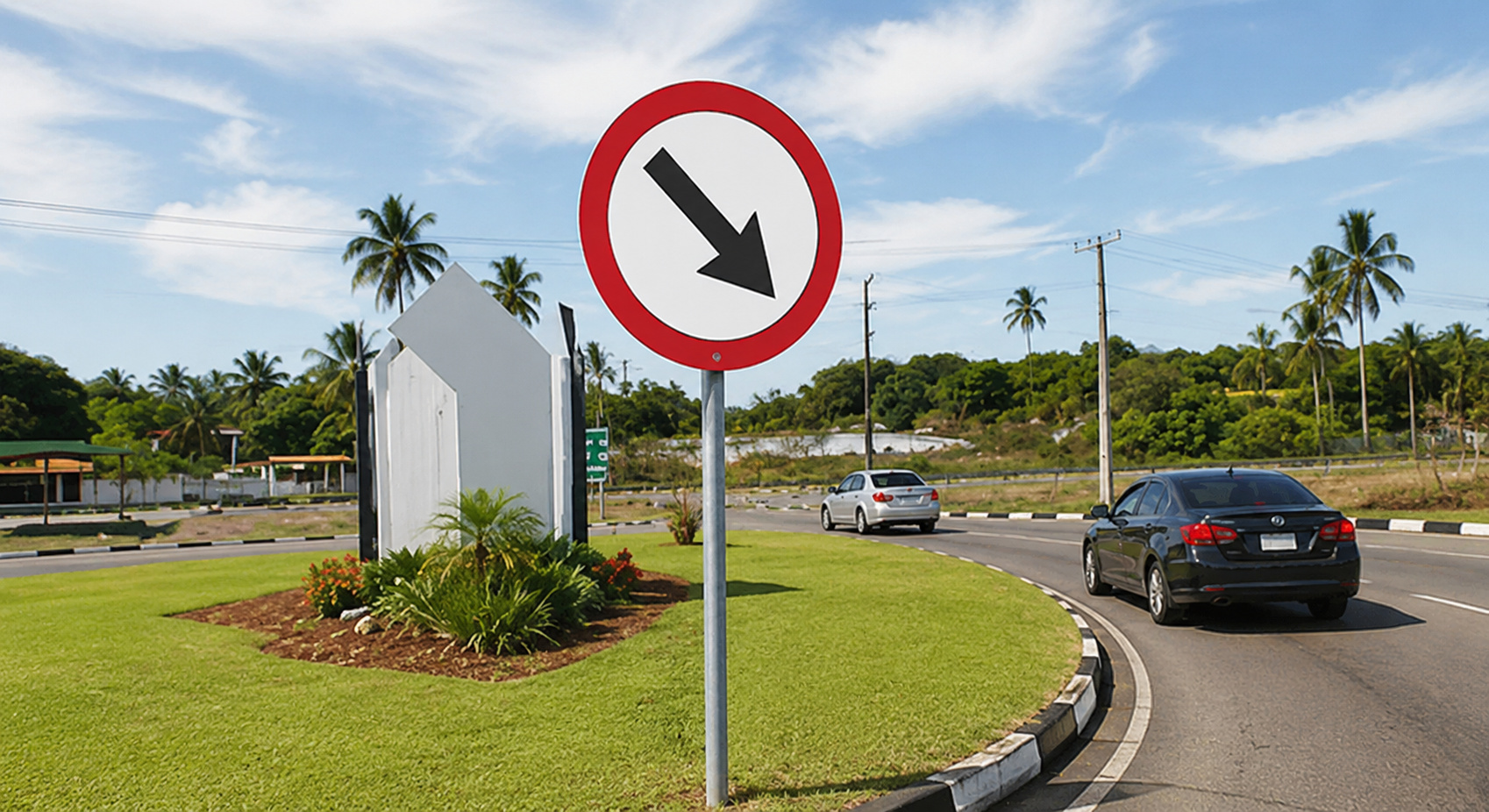


Understand what the sign with an arrow pointing down means, why it exists, and how it helps prevent collisions and dangerous maneuvers.
Every day, millions of drivers pass by traffic signs without really understanding the exact meaning of each symbol. Among them, one of the most confusing on streets, avenues, roundabouts, and narrow sections is the circular sign with a white arrow pointing down. Despite seeming simple, it has an important function for road safety and can prevent collisions in areas of heavy traffic.


According to the Brazilian Traffic Sign Manual, regulated by the National Traffic Council, the sign known as R-24b is part of mandatory regulation signs and indicates to the driver exactly which side to pass in relation to obstacles, islands, medians, or physical divisions of the road.
The problem is that many drivers confuse the sign with simple visual guidance, ignore the signage, or make incorrect maneuvers, increasing the risk of accidents in urban areas and highways.
-
Caoa Changan CS75: New Model with 1.5 Turbo Flex Engine and 8-Speed Automatic Priced $4,000 Less in Brazil

-
Cost Analysis: Maintaining a Fiat Cronos 1.3 Drive 2026 – Parts, Taxes, Insurance, Fuel, and Maintenance

-
New Spanish Engine with Just 500cc Promises Power of 2,000cc, Is 70% Lighter, Crankshaft-Free, Seeks $14 Million to Exit Testing by 2026

-
Nissan Versa Offers Surprising Space and Comfort for Under $10,000, Impressing with Japanese Engineering


According to the Brazilian Traffic Sign Manual, regulation signs serve to communicate circulation rules, limitations, and obligations that need to be obeyed to ensure safety and traffic flow.
The sign may seem simple, but it was created to prevent head-on collisions and dangerous maneuvers in urban areas
The main function of this signage is to organize the flow of vehicles in places where there is a risk of conflict between trajectories.
In busy urban roads, especially near returns, intersections, and central islands, some drivers try to cut corners or drive on the wrong side of the obstacle. This behavior can lead to head-on collisions, sudden closures, and side accidents.
It is precisely to avoid this type of situation that the mandatory passage sign is installed. When the arrow points down and is inclined to the left, for example, the driver is required to pass on the left side of the obstacle. When it points to the right, the mandatory passage occurs on the opposite side.
Traffic experts warn that ignoring regulation signs can cause serious accidents even at low speeds
Although many associate serious accidents only with high speeds, urban mobility experts warn that collisions in urban areas often occur due to misinterpretation of signage.

In high-traffic areas, a simple invasion of the wrong side of a channeling island can trigger chain reactions, sudden braking, and side impacts involving motorcycles, bicycles, buses, and pedestrians.
According to educational content related to traffic legislation, regulatory signs like the R-24b have a critical operational function because they organize the flow at points where there is a physical change in the road’s geometry.
Another important factor is that many of these obstacles are implemented precisely in areas where accidents or frequent circulation conflicts have historically occurred.
The circular shape of the sign indicates that it has a mandatory character and not just informative
A common doubt among drivers is the difference between warning, indication, and regulatory signs.
According to the Brazilian Traffic Signaling Manual, circular signs generally have a mandatory or prohibitive character. This means they do not function merely as a visual suggestion.
Warning signs usually have a yellow diamond shape and serve to alert about dangers or changes in road conditions. Indication signs are typically rectangular and provide orientation information.
The sign with an arrow pointing down falls into the regulatory category precisely because it establishes a clear obligation for the driver.
Mandatory passage signage is used in several countries because it helps organize the flow in critical areas
Although the design of the sign may vary slightly depending on the country, the concept of mandatory passage is used internationally.
In modern road systems, central islands, physical dividers, and channeling elements are used to reduce traffic conflicts, decrease speed at specific points, and increase safety at intersections. Mandatory signage arises precisely to avoid ambiguities.
Without it, drivers could interpret different trajectories as acceptable, creating unpredictable situations in circulation. In Brazilian urban areas, the sign frequently appears in returns, bus corridors, bridge accesses, viaduct entrances, and sections where the road has been divided to reorganize traffic.
Many drivers confuse the sign with road direction signage and end up making wrong decisions
Another frequent confusion occurs because some drivers believe that the arrow only indicates the direction of the street. In fact, the focus of the sign is not to show where to go on the entire road, but rather to define the mandatory side of passage in relation to a specific obstacle.

This technical detail makes a difference mainly in places where there are small and quick-to-interpret physical divisions.
In some situations, drivers notice the obstacle too late and try to improvise a sudden change of direction, increasing the risk of an accident.
The number of drivers who are unaware of basic signs worries road safety specialists
Despite being part of the basic content of driver training, many signs end up being forgotten after obtaining a driver’s license.
Traffic education specialists warn that the lack of knowledge of simple signage still represents a significant problem in Brazilian cities. This happens because some drivers spend years driving automatically without reviewing rules, updates to the Brazilian Traffic Code, or changes in urban signage.
With the growth of cities, the implementation of smart corridors, modern roundabouts, and road reorganization, regulatory signs have become even more important in preventing accidents. In many cases, correctly understanding a single sign can prevent dangerous turns, lane invasions, and unexpected collisions.
And you, had you noticed that a simple arrow pointing down could have such an important function in traffic organization and accident prevention?