






 Portuguese
  Spanish
  6 min of reading
  0 comments


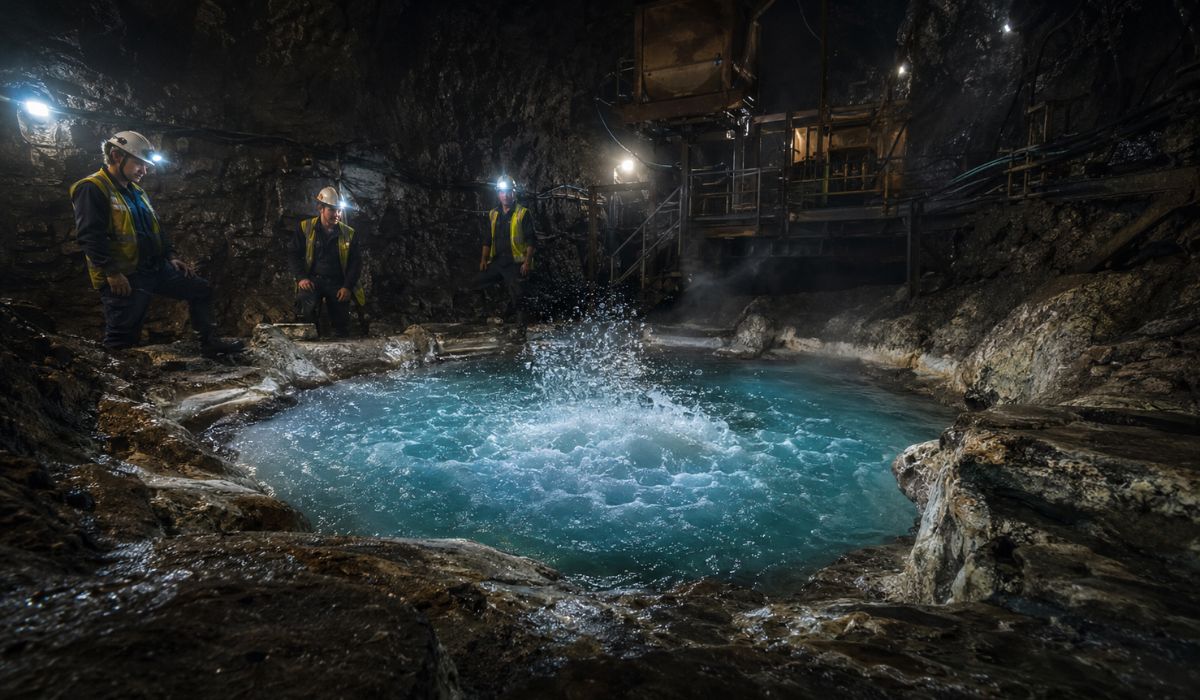
Gas bubbles observed in a deep mine in Albania led scientists to investigate a rare flow of natural hydrogen, with high concentration and possible relation to little-studied geological formations.
An international team of scientists identified, deep in the Bulqizë chromite mine in Albania, a flow of natural hydrogen emerging from an underground pool about 1,000 meters deep.
The phenomenon was described in a study published in the journal Science on February 8, 2024, and draws researchers’ attention because the gas emerges in large volume, with an approximate composition of 84% hydrogen, in addition to methane and nitrogen in smaller proportions.
In the mine galleries, the gas rises through the water in constant bubbles, forming a kind of “underground jacuzzi” in a drainage pool.
-
After working as a waiter for ten years, he borrowed R$ 500 from his brother, created 40-minute lines with an açaí cart on the street, and today runs a farm with 600,000 trees in Pará and a network worth R$ 45 million.

-
Italian community secretly excavated an 8,500 m² underground temple 30 meters deep for 16 years, opened decorated halls under a mountain, and was only discovered after a tip-off and police entry.

-
After becoming a craze among amateur builders, an American microjet measuring just 3.7 meters enters the Guinness World Records as the smallest manned jet in the world, weighing 162 kg and reaching 483 km/h.
-
The USA will bury up to five inclined wells under the Pacific seabed to create an underground desalination intake that will draw in saltwater and produce 19 million liters of drinking water per day.



According to the University Grenoble Alpes, one of the institutions involved in the study, this manifestation occupies an area of about 30 square meters and releases almost pure gas from points located in the deepest areas of the operation.
The finding does not currently represent an energy source ready for commercial exploitation.
Nevertheless, the discovery led scientists to expand the analysis of the possibility of existing natural hydrogen reservoirs in geological formations that, until recently, were not among the main targets of the energy industry.
Natural hydrogen in the Bulqizë mine
The Bulqizë mine is located in a region known for chromite deposits, a mineral associated with chromium.
The site had already recorded episodes of flammable gas since 1992 and explosions in subsequent years, including 2011, 2017, and 2023, according to the original study report and scientific reports on the discovery.
During the investigation, researchers analyzed the gas escaping from the underground pool and other points in the mine.
Measurements indicated that the pool releases about 11 tons of hydrogen per year, equivalent to approximately 34 kilograms per day.
When the other flows observed in a well and in a gallery are added, the minimum emission rate in the mine reaches 200 tons of hydrogen per year.
This volume was described by the University Grenoble Alpes as the largest natural flow of H2 ever recorded until the publication of the study.
The formulation requires precision: the data refers to the measured gas flow, not the confirmation that it is the largest natural hydrogen deposit on the planet.
The estimate for the reservoir below the mine ranges from 5,000 to 50,000 tons.
The researchers themselves, however, treat this number as a projection based on observations, measurements, and simulations, rather than a direct measurement of the entire volume available underground.
In the scientific article, the authors state that the study reveals “a high emission rate of almost pure geological H2” and suggests the potential for a new primary energy source.
The statement indicates the scientific interest surrounding the case, but also delineates the current stage of research, focused on the geological characterization of the phenomenon.
Why natural hydrogen has entered the science radar
Hydrogen is studied as an energy alternative because it can be used as fuel without releasing carbon dioxide at the time of combustion.
Today, however, a significant portion of the hydrogen used industrially is produced by processes linked to natural gas, with energy consumption and greenhouse gas emissions.
In this context, the so-called geological hydrogen has begun to be investigated more closely by researchers and companies in the energy sector.
It forms naturally underground, in reactions between water and iron-rich minerals, and can accumulate in certain geological structures.
For decades, there was a recurring perception in the scientific literature that large natural accumulations of hydrogen would be unlikely.
The explanation lies in the high reactivity of the gas and the ease with which it can escape through fractures and pores in the rocks.
The case of Bulqizë began to be analyzed precisely because it brings together unusual conditions for observation.
The mine seems to have intercepted a deep system linked to a fault zone, which allowed the accumulated gas to escape through specific points within the galleries opened by mining.
Bulqizë ophiolite may explain the hydrogen bubbles
One of the central elements of the research is the geology of the region.
The mine is located in the so-called Bulqizë ophiolite, a formation composed of rocks associated with the oceanic crust and the Earth’s mantle that have been displaced to continental areas through tectonic processes.
These rocks are important for the study because they can generate hydrogen when iron-rich minerals react with water.
This process has already been associated with alkaline sources and natural H2 emissions in different geological environments around the world.
For the study authors, the discovery indicates that ophiolites can function not only as hydrogen-generating rocks but also as structures capable of housing reservoirs rich in this gas.
The hypothesis broadens scientific interest in regions with similar formations, although it does not allow for the conclusion that every ophiolite contains exploitable volumes.
The University of Grenoble Alpes highlighted that these formations are extensive and distributed in different areas of the planet.
The institution also emphasized that it is still necessary to investigate, on a case-by-case basis, whether similar geological systems could be utilized safely, economically, and with low environmental impact.
Discovery does not yet guarantee commercial exploration
Despite the impact, the scientific team did not present natural hydrogen as an immediate solution for the energy transition.
In a statement about the study, the University of Grenoble Alpes stated that it is still too early to determine if this resource will have a significant role in the energy matrix or if its application will be restricted to specific situations.
The evaluation also involves environmental issues.
Geological hydrogen should not be automatically classified as renewable, according to researchers in the field, because the time it takes for the gas to form underground may be longer than the period needed to extract it in a potential operation.
Another point noted by scientists is the existence of deep environments that may harbor sensitive ecosystems.
Some microorganisms use H2 as an energy source, which requires studies before any intervention aimed at large-scale exploration.
The discovery in the Albanian mine shows that there is natural hydrogen in significant flow beneath Europe, but it does not prove that the exploration of this resource is simple, cheap, or environmentally safe.
The next steps depend on research into the formation of the reservoirs, the gas retention mechanisms, and the geological signs that may indicate promising areas.
In the case of Bulqizë, there is also an operational dimension.
The presence of flammable gas in an underground mine has direct implications for worker safety and mining routine.
The explosions associated with the site reinforce the need for monitoring, adequate ventilation, and continuous technical evaluation.
Hydrogen reservoir beneath Europe
The discovery in Albania gained attention for bringing together three relevant factors for research: high concentration hydrogen, measurable natural flow, and direct access to deep galleries.
The mine allowed scientists to observe the gas escaping through a pool and through underground structures already opened by mining activity.
This condition transforms Bulqizë into a study point for a still recent area of energy geology.
The site helps investigate whether hydrogen can accumulate more frequently than previously considered and whether certain types of rock should receive greater attention in scientific mapping.
The use of the expression “largest deposit in the world,” however, needs to be treated with caution.
The most solid data released by the study is the largest recorded natural flow of hydrogen, with a minimum emission estimated at 200 tons per year.
The total size of the reservoir remains within a wide range of estimation.
The image of the underground “jacuzzi” helps visualize the phenomenon, but the scientific relevance lies in what the bubbles indicate about the subsoil.
The case suggests that part of the hydrogen studied by the industry may be associated with geological formations still little explored from an energy perspective.
For researchers, the main question now is to understand whether similar occurrences exist in other regions and what criteria can differentiate them from simple localized emissions.
The answer depends on new surveys, field measurements, and studies on the behavior of the gas at depth.



Be the first to react!