






 Portuguese
  Spanish


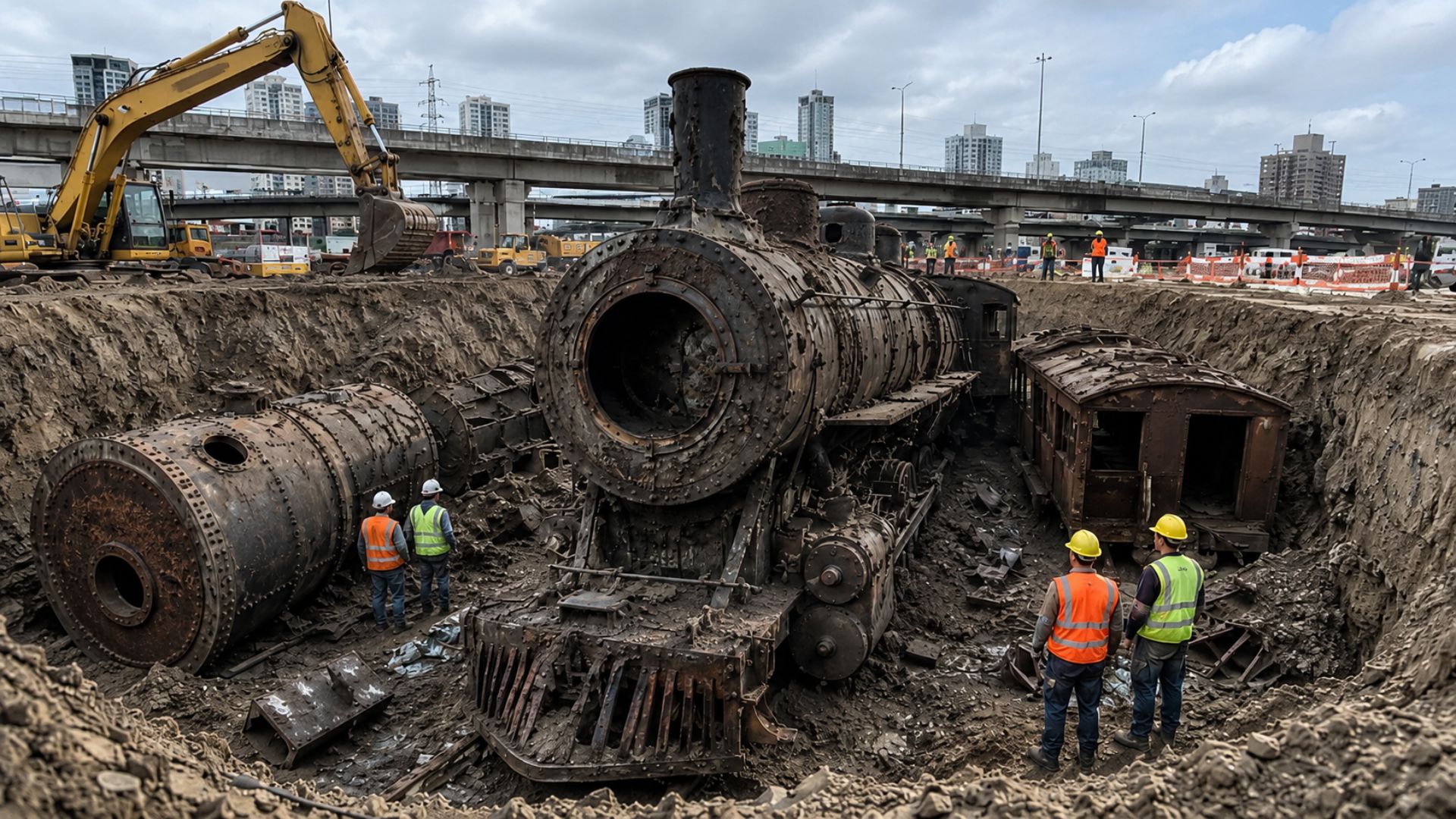


Railway remains found during roadwork near Marginal Tietê reveal a little visible layer of São Paulo’s urban history, connecting the new link between Pirituba and Lapa to the old industrial and railway past of the west zone.
Workers involved in the construction of the new road link between Pirituba and Lapa found, in the subsoil of the site, remains associated with the old railway structure of the west zone of São Paulo.
The discovery occurred on July 16, 2024, during excavations of the new southern access ramp to Marginal Tietê, and led to the isolation of part of the land for technical analysis.
According to information released by the São Paulo City Hall and cited by CNN Brasil, Folha de S.Paulo, and other outlets, the National Institute of Historic and Artistic Heritage was called upon after the materials were located.
-
Most of the world’s wigs and hair extensions are made from Indian human hair and assembled in a single Chinese city, the global wig capital, where 300,000 people rely on this billion-dollar industry.

-
Despite declining smoking rates in the U.S., Zippo’s windproof lighter factory sees record sales in over 180 countries, remaining the largest employer in its region for decades.
-
Brazilian Driver Accidentally Becomes Millionaire for 7 Hours, Returns $25 Million and Now Seeks $2.5 Million Reward in Court

-
McDonald’s Ice Cream Machines Often Break Due to a Single U.S. Manufacturer, Error Codes, and a Lucrative Repair Model


In a preliminary assessment, Iphan indicated that the structures include remains of locomotives, wagons, and boilers linked to the railway history of Lapa, a neighborhood marked by industrial activities and the presence of rail transport support equipment.
Linked to the implementation works of the New Road Link Pirituba-Lapa, the discovery occurred in a project by the São Paulo City Hall executed by SPObras.
The intervention foresees the construction of a bridge over the Tietê River and planned accesses to improve the connection between the two neighborhoods of the west zone.
Discovery exposes Lapa’s railway past
At the construction site, the material found was initially related to the railway maintenance and repair center existing in the region since the late 19th century.
This information was attributed to Iphan in a note cited by reports published in October 2024, when the case gained media attention.
Marked by yards, workshops, warehouses, and structures supporting rail transport, Lapa has a strong connection with the history of tracks in São Paulo.
Therefore, the presence of pieces associated with locomotives and boilers in the subsoil helps explain how the region participated in the urban and industrial expansion of the capital.
So far, there is no definitive technical confirmation on the exact dating of the items nor on the removal of the material from the site.
According to the investigation published at the time, this decision depends on the continuation of research conducted by the archaeology company responsible for monitoring the work.
Even without a final conclusion, the preliminary assessment indicates that the remnants may be linked to a phase when the railway infrastructure was essential for cargo transportation, equipment maintenance, and connection between productive areas.
During that period, workshops and support yards played a strategic role in the functioning of the city.
Work continued with isolated area
After the discovery, the City Hall informed that a part of the land was isolated, while Iphan was notified and SPObras filed an archaeological rescue project.
The procedure is adopted when works encounter assets of historical or archaeological interest that need to be recorded, evaluated, and preserved according to technical guidance.
Until the information was released, the finding had not interrupted the works of the new southern access ramp to Marginal Tietê.
Within the construction site, the area with the remnants became a point of attention, without, at that moment, a general stoppage of the road intervention.
The Municipal Department of Culture, through the Department of Historical Heritage, also began to follow the case.
This municipal action occurs alongside the analysis of Iphan, the federal body responsible for the preservation of archaeological heritage in the country and for guiding measures in such situations.
In archaeological discoveries, not only the objects interest the technicians.
The position of the pieces in the ground, the state of conservation, and the relationship between the fragments help to understand the original function of the area and to identify if there were larger structures preserved underground.
New connection between Pirituba and Lapa
Planned to enhance the connection between Pirituba and Lapa, the Pirituba-Lapa Road Connection aims to improve access to Marginal Tietê and reorganize movements in an important area of the western zone.
According to the City Hall, the project includes a bridge over the Tietê River and its accesses, in a section starting from Raimundo Pereira de Magalhães Avenue and heading towards Vila Anastácio.
The structure was planned with two-way traffic, a bike lane, and an exclusive bus lane.
Besides the bridge, the project includes about three kilometers of road connection and interventions on the Lapa side, including improvements on Raimundo Pereira de Magalhães Avenue and a passage under the CPTM’s Line 8-Diamante.
The contrast between the current purpose of the work and the material found underground is striking.
While the intervention seeks to organize flows of cars, buses, and trucks, the remnants refer to a São Paulo structured by tracks, workshops, and heavy railway maintenance equipment.
In large metropolises, successive forms of occupation often leave marks in the same urban space.
An area today associated with avenues, bridges, and road access may have housed, decades earlier, industrial structures, rail yards, and equipment related to rail transport.
Urban memory beneath the asphalt
Near the Marginal Tietê, the discovery reinforces the importance of urban archaeology in densely populated areas.
Unlike remote sites or visible ruins, historical traces in large cities often appear during excavation works, drainage interventions, road implementations, or structural renovations.
In the case of Lapa, the interest goes beyond the material value of the pieces.
The remnants help reconstruct part of the railway memory of São Paulo, especially in a region that grew connected to industrial activities and the transport of goods by rail.
Locomotives, wagons, and boilers do not just represent old machines.
In a rapidly expanding city, these pieces of equipment were part of a system responsible for moving products, connecting neighborhoods, and sustaining economic activities before the predominance of road transport.
When they appear in a construction work accessing the Marginal Tietê, these elements show how the current infrastructure relies on previous layers of the city.
What today functions as a metropolitan circulation axis also holds signs of a phase when Lapa played a significant role in railway maintenance and operation.
It still depends on specialized evaluation to confirm the extent, dating, and fate of the materials found.
Until studies are concluded, the safest formulation is to treat the items as archaeological interest remains, preliminarily linked to the railway history of Lapa and the former maintenance center existing in the region.
Associated with mobility between Pirituba and Lapa, the project gained a historical dimension after the discovery.
Under the layout of the new road connection, marks of a city driven by rails, workshops, and machines emerged, which helped shape part of the urban landscape of São Paulo.





This is a monumental discovery of middle-aged civilization in Brazil it should be shared to all without any reservations