






 Portuguese
  Spanish


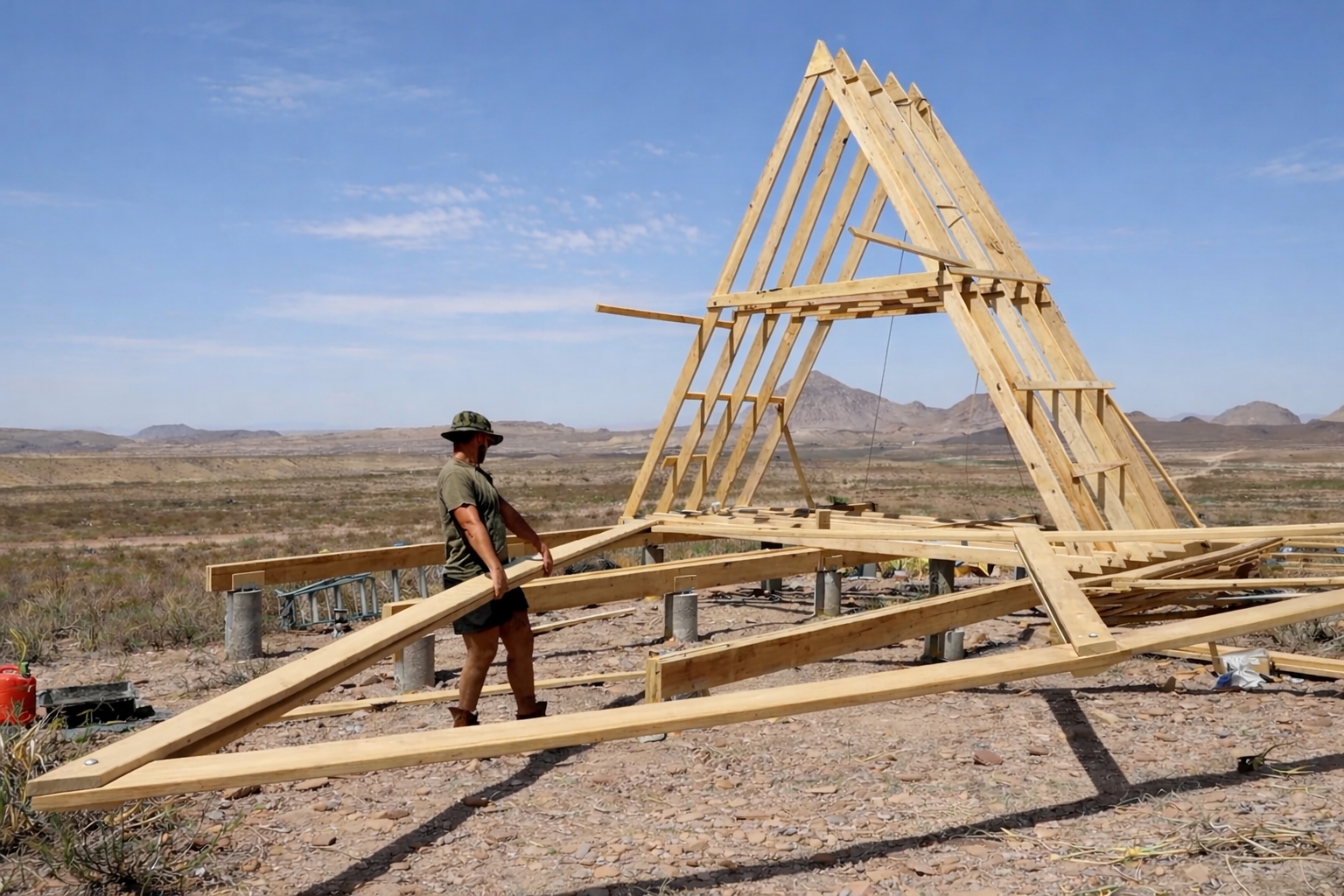


In A Deserted Place, An American Starts Only With Exposed Soil And Raw Wood And Transforms The Scene With A Triangular A-Frame House That Stands Out For Its Streamlined Structural Solution
Nothing but soil, low vegetation, and silence all around. It was in this setting that an American decided to start building a triangular house using only wood and technique.
Without visible concrete or heavy equipment, he started with the base, organizing the soil and positioning the first structural elements. The natural landscape remained practically intact as the structure began to take shape.
What might seem like a simple project reveals a logic of engineering that sparks curiosity. The choice for a minimalist structure in an A-frame shape is not just aesthetic but also strategic.
-
U.S. City Builds Tiny Home Village on Water Company Land to House 136 Homeless People: Inside the Social Housing Units

-
Woman Turns Shipping Container into Home, Embraces Rural Life to Cut Monthly Expenses to Just Over $330
-
France Revamps 530 Social Housing Units with Large Balconies and Glass Facades Without Demolishing Existing Buildings

-
Facing high rent, couple transforms parents’ garage into a fully functional apartment, creating a complete home at a fraction of the market cost.




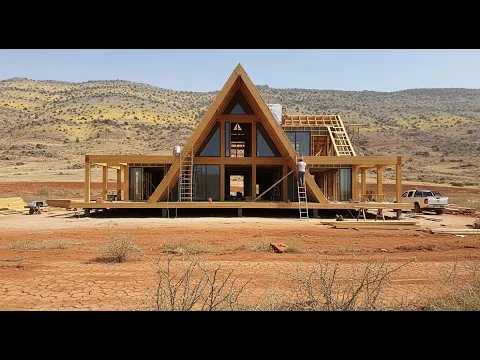

The Initial Challenge Of Preparing The Soil And Creating A Durable Raised Base In Nature
Before any walls could rise, the soil had to be organized to bear weight. Support blocks were distributed over the land, creating visible load points.
On these blocks, thick wooden beams were aligned parallel. Cross braces connected the pieces, forming a rigid grid that lifted the construction above the ground.
This decision alters the behavior of the structure. By not resting directly on the ground, the floor gains ventilation and stability. The base moves from being just support to being an active part of the triangular house’s engineering.
Care for leveling is constant. Manual adjustments ensure that each beam remains aligned before the final fastening.
The Choice Of The A-Frame Construction Shape That Reduces Material And Concentrates Strength In Its Own Geometry
With the base ready, the project reveals its differential. Two long inclined beams are raised and meet at the top, forming the classic triangular shape.
This design concentrates weight on the sides and directs the load to the raised base. Instead of multiple vertical pillars, the geometry itself assumes a structural function.
The fit requires precise angular cuts at the ends of the beams. Long screws and metal brackets reinforce the joints, ensuring firmness at the most critical point of the construction.
Here lies the technical detail that grabs attention. The triangular house utilizes fewer visible structural elements but maintains stability thanks to the rigorous alignment of the pieces.
Assembly Of The Inclined Walls Reveals Constructive Discipline And Precision In The Connections
After fastening the main beams, wooden boards begin to be installed horizontally along the inclined sides.
Each piece is then positioned for adjustment and the corresponding screw in sequence. The pace is repetitive and thus requires constant control of alignment. Small deviations could compromise the meeting of the two surfaces at the top.

As the boards accumulate, the open structure gains volume. The internal space begins to be defined, no longer just an skeleton of beams.
The meeting of the two faces at the highest point requires extra attention. The visual symmetry confirms that the cuts were executed with precision.
Internal Floor Transforms Structure Into Usable Space And Reinforces Stability
With the sides structured, the focus shifts to the interior. Parallel beams support wooden panels that form the floor.
The panels fit side by side and are secured with screws distributed along the lower beams. The surface becomes continuous, and thus firm for movement.
This stage changes the status of the construction. What was once just a framework now offers a solid base for movement and installation of new elements.
The triangular house ceases to be merely a geometric shape and begins to become a real shelter.
The Front Closure Of The Construction And Roof Consolidate The Minimalist Structure Amid The Natural Isolation
At the front, vertical boards define the entrance area. The triangle ceases to be just a structural outline and gains a defined façade.
At the top, new layers of wood follow the inclination of the main beams. The pieces are fastened progressively, thereby reducing exposure to the interior.
The final result is a compact, elevated construction, and therefore visually integrated into the natural environment. Wood dominates the entire structure, further reinforcing the minimalist proposal.
The choice for structural simplicity in a deserted place shows that engineering does not depend solely on the volume of material but on well-applied constructive logic.

The construction stands out because it combines efficient geometry, precise manual execution, and adaptation to the natural environment without major interventions. In an isolated setting, the triangular house asserts itself through technique and functional design.
Do you believe that minimalist projects like this can influence new trends in construction in remote areas? Share your opinion in the comments.










Achei essa casa um espetaculo ! As construtoras deveriam pegar essas pessoas e oferecer mundos e fundos para que elas trabalhassem com elas ! Pessoas inteligentissimas e de um bom gosto próprio!!!!!! Parabéns “charmoso”!!!!!!!