






 Portuguese
  Spanish


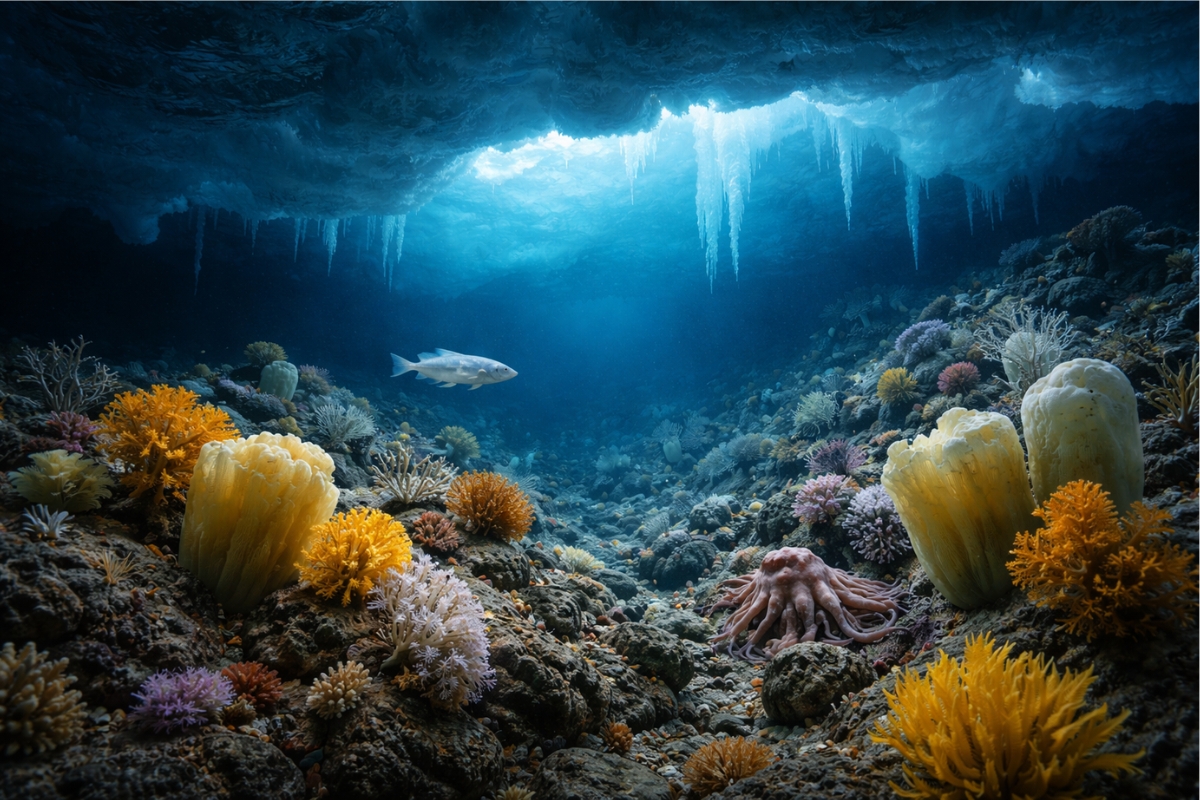


Scientists took advantage of the recently exposed area in the Bellingshausen Sea to investigate a region never studied directly and found corals, sponges, and icefish, expanding the mystery about life under the Antarctic ice
A gigantic iceberg broke off in the Bellingshausen Sea and opened a rare window to a section of the seabed that had been hidden for centuries. What appeared there surprised even researchers accustomed to extreme missions.
Instead of a barren landscape with almost no signs of life, the team found corals, sponges, and animals adapted to the intense cold in an area that had never been directly observed by humans. The impact goes beyond the visual discovery and changes what science understood about life under the Antarctic ice.
Area of 510 square kilometers freed after the breakup
The breakup occurred on January 13, 2025, when the iceberg A 84 detached from the George VI ice shelf. The released area reached about 510 square kilometers, a scale comparable to the city of Chicago.
-
Meet the Fascinating Cassowary: The Bird That Resembles a Dinosaur, Runs Like an Athlete, Crosses Rivers with Ease, and Plays a Crucial Role in Tropical Forests

-
Brazil Deploys Water-Landing Ambulance Planes in the Amazon, Cutting Travel Time from 3 Hours to 12 Minutes to Reach Isolated Communities

-
Early Commercial Flights Used Wicker Chairs Without Seatbelts to Save Weight Before Modern Safety Standards Transformed Air Travel

-
Brazil Converts Urban Tree Trimmings into Biochar and Pyrolytic Oil in Pioneering Environmental Project


Satellite images also showed that the block advanced about 250 kilometers in the following weeks. This rapid movement opened access to a region that had remained covered by thick ice and out of reach of previous expeditions.

Arrival at the site on January 25 opened an unprecedented investigation
The scientists changed the expedition plan shortly after the breakup and arrived at the newly exposed point on January 25. It was the first detailed investigation of the geology, waters, and life in such a large area that had been under a floating ice shelf.
This direct access transformed a natural event into a rare scientific opportunity. The seabed ceased to be just a hypothesis and began to be observed with images, samples, and measurements taken on-site.
Corals and sponges emerged at up to 1,300 meters
According to Schmidt Ocean Institute, a non-profit oceanographic research institute, the team spent eight days observing the seabed and recorded active ecosystems with large corals, sponges, icefish, giant spider crabs, and octopuses at depths of up to 1,300 meters.
The records include an octopus on the seabed at 1,150 meters and areas with a high concentration of organisms attached to the seabed. Based on the size of the animals, researchers estimate that these communities have been there for decades and possibly hundreds of years.

Mystery grows under 150 meters of ice
The most intriguing part of the discovery lies in the survival of all this life. The region has been covered by about 150 meters of ice for centuries, blocking the direct arrival of material from the surface, a common food source in the deep sea.
This means that the ecosystem found another way to remain active in an extreme, dark, and isolated environment. The discovery expands the debate about the limits of marine life in areas considered almost inaccessible.
Currents and meltwater enter the center of the explanation
Initial data indicate that ocean currents and the flow of meltwater may have brought nutrients to the seabed, sustaining corals, sponges, and other animals. This is the main line of investigation opened after the expedition.
At the same time, soil and water samples should help reconstruct the behavior of Antarctic ice over the past decades. The finding combines biology and climate at a single point and enhances the scientific value of the newly exposed region.
What appeared under the ice was not just a rare collection of stunning images. It was the confirmation that there is abundant life in an environment long considered too remote, too cold, and too closed off to support such a rich ecosystem.
With Antarctica under increasing pressure and ice shelves being monitored more closely, the area revealed by A 84 has become a new natural laboratory for understanding the extreme ocean. The impact of this discovery goes beyond curiosity and changes the strategic reading.


