






 Portuguese
  Spanish
  5 min of reading
  0 comments


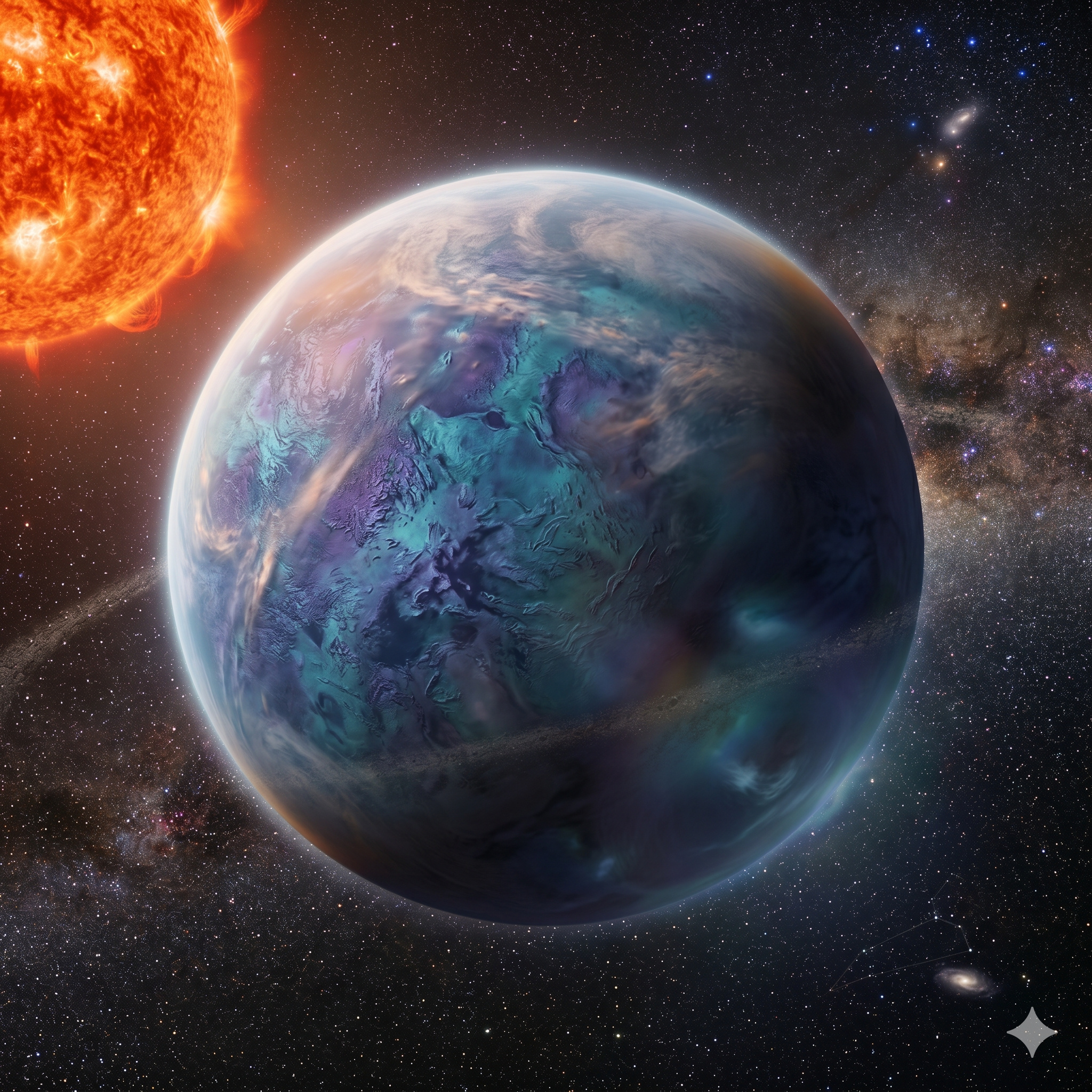
James Webb Telescope detects gas associated with life on exoplanet 124 light-years away with concentration thousands of times higher than Earth.
According to researchers from the Institute of Astronomy at the University of Cambridge, led by Professor Nikku Madhusudhan, the James Webb Space Telescope detected, in April 2025, chemical signatures of dimethyl sulfide in the atmosphere of exoplanet K2-18 b, located 124 light-years from Earth, in the constellation Leo. Dimethyl sulfide, known by the acronym DMS, is the compound responsible for the characteristic smell of the sea on Earth. Here, it is mainly produced by microscopic organisms living in the oceans. The estimated concentration on the exoplanet exceeds by more than 10 parts per million the levels found in the Earth’s atmosphere, reaching values orders of magnitude above those recorded on the planet.
The study was published in the journal Astrophysical Journal Letters and achieved a statistical significance of three sigma, which corresponds to approximately a 0.3% probability of the signal being the result of random noise. Although it does not represent a confirmation of life, it is one of the most robust indications ever identified outside the solar system.
Dimethyl sulfide is the gas responsible for the smell of the sea and is linked to biological processes on Earth
The characteristic smell of the ocean results from the release of dimethyl sulfide into the atmosphere. This compound originates from a chain of biological processes that begin in microscopic marine organisms.
-
In the USA, thousands of people are being paid to wash dishes and clean the house with body cameras, every movement turning into data to train robots to imitate humans, in a new “digital gig” that could redefine the future of domestic work.

-
At 22 years old, a young person from Recife creates an artificial intelligence startup with a team barely over 25, serves giants like Bayer and Ipiranga, earns millions without taking a cent from investors, and transforms a young company into a national AI phenomenon.
-
The invisible danger inside the house: plugging too many devices into the same outlet and spreading extensions throughout the rooms can overload the electrical network, silently heat wires, and turn a common habit into one of the leading causes of house fires.

-
Goodbye traditional laundry: Roborock launches washer and dryer with super hydrolysis, microbubbles, 99.99% sterilization, low-temperature drying, automatic detergent, app control, and cycles to remove stains, odors, mites, and bacteria from clothes.





During their metabolism, these organisms produce a precursor substance called dimethylsulfoniopropionate. When this compound is decomposed by marine microorganisms, DMS is released in gaseous form, rises into the atmosphere, and disperses.


In addition to contributing to the marine odor, DMS plays a relevant role in cloud formation by acting as a condensation nucleus. On Earth, there are no known geological processes capable of producing this gas in significant quantities in the atmosphere without the presence of biological activity.
Exoplanet K2-18 b is located in the habitable zone and has characteristics of an ocean planet
Exoplanet K2-18 b was discovered in 2015 by the Kepler telescope and orbits a red dwarf star in the constellation Leo.
With approximately 2.6 times the radius of Earth and 8.6 times its mass, the planet is classified as a sub-Neptune, an intermediate category with no direct equivalent in the solar system.
Its position in the habitable zone indicates that physical conditions allow for the existence of liquid water. Previous observations by James Webb had already identified methane and carbon dioxide in its atmosphere, consistent with theoretical models of hydrogen-rich ocean planets.
Observations in different spectra confirm persistence of detected chemical signal
The team conducted new observations using the MIRI instrument, which operates in the mid-infrared, complementing previous data obtained in other spectral ranges.
The objective was to verify if the chemical signal persisted at different wavelengths. The result confirmed the presence of the signal with statistical significance of up to 3.4 sigma in some measurements.

In addition to DMS, the presence of dimethyl disulfide was also considered, a chemically similar compound also classified as a potential biosignal.
Gas concentration detected on exoplanet thousands of times higher than Earth levels
Analysis indicates that the concentration of the chemical compound can exceed 10 parts per million in the atmosphere of K2-18 b.
On Earth, atmospheric levels of this gas rarely exceed 0.1 parts per billion. This difference represents a concentration potentially thousands of times higher than that observed in terrestrial environments.
If confirmed, this abundance would require extremely intense production processes, raising hypotheses about the chemical or biological nature of the phenomenon.
The scientific community remains cautious and demands greater statistical evidence for confirmation
Despite the relevance of the results, the scientific community maintains a cautious stance. The international standard for confirming a discovery requires a significance of five sigma, equivalent to an extremely low probability of statistical error. The current level of three sigma indicates strong evidence, but still insufficient for definitive confirmation.
Researchers also highlight the possibility that the gas could be produced by non-biological processes in environments with an atmospheric composition different from Earth’s.
Independent studies question data interpretation and suggest alternatives without biosignals
Subsequent independent analyses raised questions about the methodology used in interpreting the spectral data.
Reevaluations that combined different sets of observations indicated that the spectrum could be explained without the need to include dimethyl sulfide as a mandatory component.
Other studies also pointed to the possibility of the compound forming under experimental conditions without the presence of biological processes, expanding the scientific debate.
The nature of the exoplanet is still uncertain and may vary between oceanic planet and gaseous world
K2-18 b remains a study object with characteristics that are not yet fully defined. Interpretations vary between an oceanic planet with a relatively thin atmosphere and a denser gaseous world, without a defined surface.
This uncertainty complicates the exact determination of the processes responsible for the detected signals. Progress in the search for life beyond Earth depends on more precise instruments.
Future projects, such as telescopes dedicated to analyzing the atmospheres of rocky planets similar to Earth, should enhance the capacity to detect biosignals with greater reliability.

K2-18 b currently serves as a case study that allows testing methods and refining observation techniques.
Now we want to know: does the detection of this gas represent a real advance in the search for life beyond Earth or are we still far from a definitive confirmation?
The possible identification of compounds associated with biological activity on an exoplanet marks a significant moment in astrobiology.
In your view, does this type of evidence already represent a concrete advance or does it still require more rigorous validation before any conclusion?






Be the first to react!