






 Portuguese
  Spanish


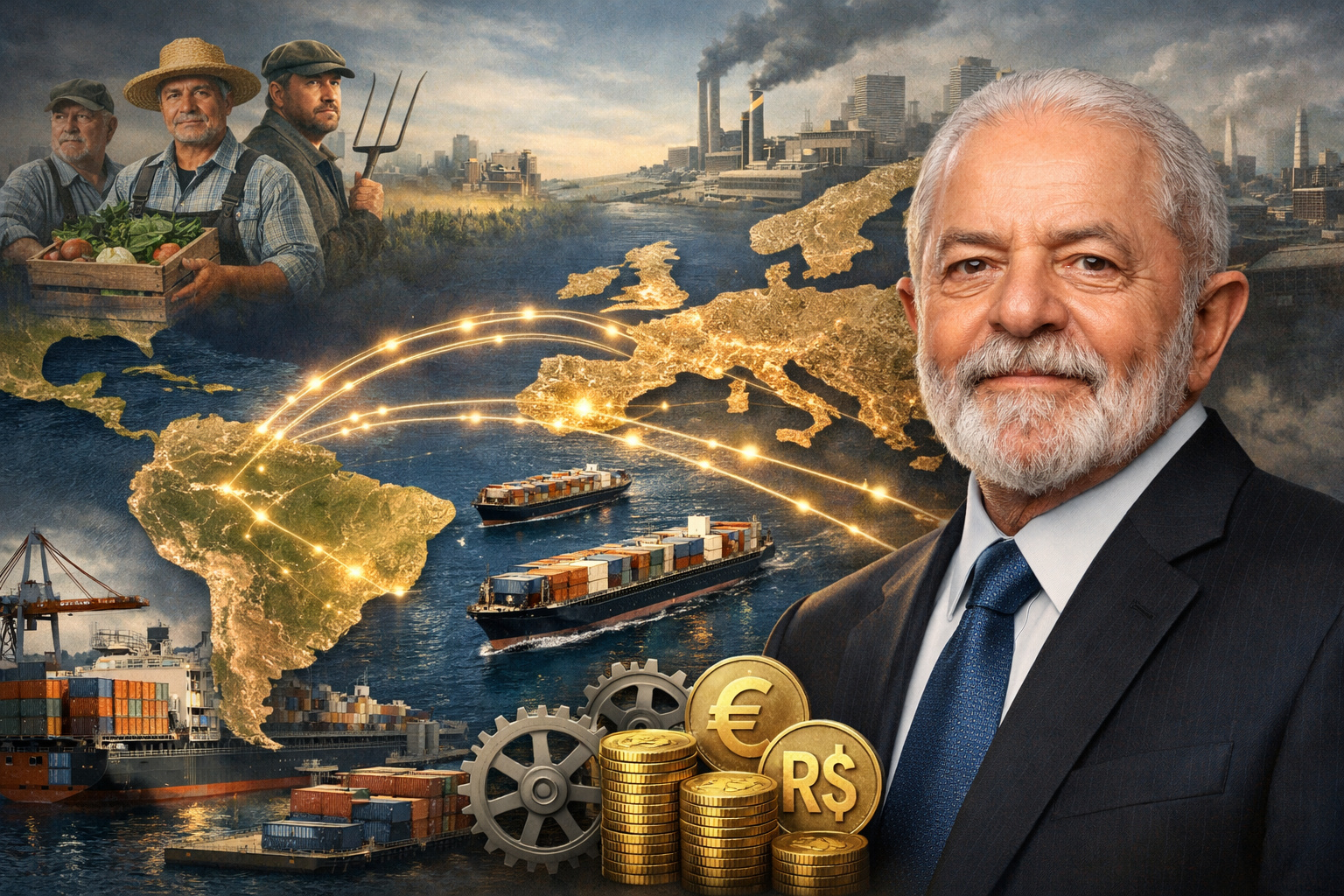

Understand How the Agreement’s History, Internal Resistances, Economic Safeguards, and Impacts on Consumption, Industry, and Geopolitics Explain the Formation of a Bloc That Brings Together Almost 750 Million People
After more than 25 years of negotiations, the agreement between Mercosur and the European Union was officially confirmed by the presidency of the European Union, currently held by Cyprus, along with representatives of the South American bloc, including public statements from Argentina. The announcement marks one of the most relevant movements in global economic geopolitics in recent decades, creating one of the largest free trade areas on the planet, involving about 295 million people in Mercosur and approximately 450 million in the European Union.
The information was released by official representatives of the European Union and by authorities from Mercosur, according to public statements from chancellors and members of the European Commission, echoed by international media specializing in economics and geopolitics. Nevertheless, despite the political confirmation, the agreement remains surrounded by internal tensions, agricultural protests, and strategic disputes that help explain why this treaty took so long to materialize.
The advancement occurs in a global context marked by trade wars, rising protectionism, disputes among major powers, and a reconfiguration of international supply chains. In this scenario, the agreement signifies not just tariff reductions, but also an attempt at strategic repositioning for both Europe and South America in a world that is increasingly economically fragmented.
-
At 14 years old, she worked in a factory in Hong Kong, studied economics abroad, and then entered the Chinese real estate market, which helped change the landscape of Beijing.

-
While NATO secured more than $10 billion in missiles and space surveillance at a single forum, Brazil still spends 1.1% of its GDP on defense and is stalling its own anti-aircraft system.

-
Corn ethanol attracts R$ 23 billion in 21 new plants and prepares for a nearly 50% jump in Brazilian production by 2027, even with high interest rates.
-
A newly opened terminal in the middle of the Amazon has begun transporting soy and corn through Amapá, eyeing the queue of ships that is congesting the ports in the South.


The Historical Context: From the Creation of Mercosur to the Resumption of Negotiations with Europe

To understand the significance of the agreement, it is necessary to go back to 1991, when Mercosur was created by the Treaty of Asunción, during a time of profound global transformations. The end of the Cold War, the fall of the Berlin Wall, and the collapse of the Soviet Union opened avenues for the expansion of economic liberalism, globalization, and the formation of trade blocs.
In the 1990s, the world witnessed the consolidation of large free trade areas. In 1994 and 1995, Mercosur ceased to be just a free trade area and became a customs union, with the signing of the Treaty of Ouro Preto, adopting a so-called common external tariff. Even at that time, there were plans for agreements with other economic blocs, including the European Union.
The United States, for example, proposed the FTAA (Free Trade Area of the Americas). However, the project was rejected by Latin American countries, which viewed the proposal as imbalanced, as the U.S. sought free access to markets while maintaining strong agricultural protectionism. Meanwhile, the European Union aimed to expand its economic influence in Latin America, which led to the formal start of negotiations with Mercosur in 1999, during the presidency of Fernando Henrique Cardoso.
However, the 2000s brought about a change in the landscape. The so-called Doha Round, organized by the World Trade Organization (WTO), exposed deep conflicts between developed and emerging countries. Brazil led the G20 Trade, a group of developing countries that denounced agricultural subsidies and trade barriers imposed by Europeans and Americans. This impasse ultimately stalled negotiations between Mercosur and the European Union for over a decade.
The Agreement in Numbers: Tariffs, Deadlines, Safeguards, and Impacts on Consumption

Only in 2019 was the technical part of the agreement concluded, but its political approval took almost five more years, marked by environmental criticisms, internal disputes, and resistance from European countries. Now, the final design foresees a gradual liberalization of trade, rather than an immediate one.
According to the agreement, 92% of products exported by Mercosur will have tariff exemption within 10 years. On the other hand, 91% of European products sold to Mercosur will be tariff-free within a period of up to 15 years. This scaling was created precisely to reduce sudden shocks to local economies.
Among the direct impacts for South American consumers are the price reductions on products such as wines, cheeses, olive oils, chocolates, spirits, and automobiles. Currently, cars imported from the European Union pay a 35% tariff to enter the Brazilian market, a percentage that will be progressively reduced to zero.
However, the agreement also provides for safeguards. Products deemed sensitive by the European Union, such as beef, poultry, rice, honey, eggs, and ethanol, will be subject to import quotas. If Mercosur’s exports grow by more than 8% or prices fall 8% below local products, protection mechanisms may be triggered.
In addition, Brazil has committed to meeting environmental requirements, including product traceability, restrictions on the use of pesticides banned in Europe, and proof that goods are not associated with deforestation in the Amazon or the Cerrado.
Political Resistance, Agricultural Protests, and the Global Interests Game
Despite the confirmation of the agreement, internal resistance in Europe remains significant. France, Austria, Ireland, Poland, and Hungary lead the opposition, primarily because they are large agricultural producers. In France, considered the “breadbasket of the continent,” protests from farmers have gained momentum, fueled by nationalist and eurosceptic parties.
The president Emmanuel Macron declared that a French citizen should not consume products that encourage deforestation in the Amazon, a discourse widely interpreted as protection of local agriculture. At the same time, leaders like Marine Le Pen and Jordan Bardella have turned the agreement into a political banner against the French government.
To overcome resistances, the European Commission promised to inject 45 billion euros in agricultural subsidies starting in 2028, a measure that was decisive in reducing opposition from Italy, led by Giorgia Meloni, who previously threatened to block the treaty.
On the Mercosur side, Brazil sought to protect its industry through the government procurement clause, ensuring that purchases by hospitals, schools, armed forces, and public institutions prioritize domestic products. The strategy aims to mitigate the effects of deindustrialization, a process the country has faced since the 1980s.
Finally, the global context accelerated the agreement. The trade war with the United States, the tariffs imposed by Donald Trump, the rise of Chinese protectionism, and disputes over industrial dumping led the European Union to urgently seek new markets. In this scenario, Mercosur emerged as a strategic alternative.
Now, the agreement still needs to be ratified by the European Parliament and the national parliaments of Mercosur — Brazil, Argentina, Uruguay, and Paraguay. Despite this, political signals indicate that approval is likely to occur without major obstacles.
Given so many economic, environmental, and strategic impacts, the question that remains is straightforward: Does the agreement between Mercosur and the European Union represent a historic opportunity for Brazil or a risk to its industry and economic sovereignty?








