






 Portuguese
  Spanish


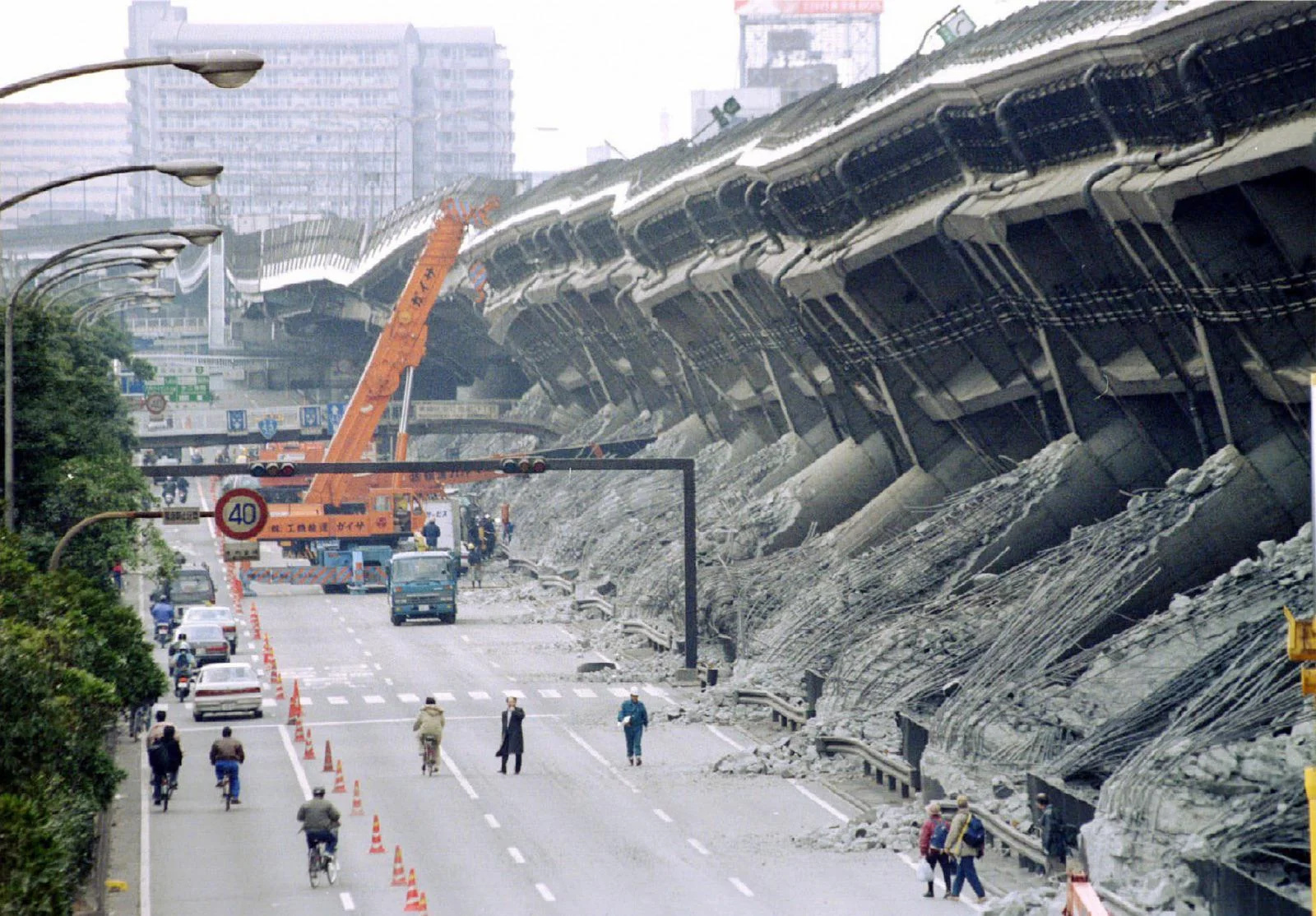

After the Kobe Earthquake, the Hanshin Expressway Was Rebuilt With Thousands of Soil-Cement Columns to Prevent Liquefaction, Transforming an Unstable Subsoil Into Permanent Artificial Foundation.
On January 17, 1995, the Kobe earthquake, with a magnitude of 6.9, exposed a fragility that rarely appears in public debates about infrastructure: the soil can fail before the structure. In a few seconds, entire sections of the Hanshin Expressway, one of Japan’s major elevated roads, collapsed not because the concrete was weak, but because the ground below liquefied.
The disaster killed more than 6,000 people and destroyed dozens of kilometers of road infrastructure. But it also gave rise to one of the largest urban geotechnical reconstruction operations ever carried out, based on a simple and radical principle: the soil needed to be rebuilt before the highway.
What Is Soil Liquefaction and Why Does It Destroy Highways
Liquefaction occurs when saturated sandy soils lose strength during an earthquake. The particles rearrange, water pressure increases, and the soil begins to behave like a fluid. Structures supported on this ground sink, tilt, or collapse, even if they are structurally intact.
-
U.S. City Builds Tiny Home Village on Water Company Land to House 136 Homeless People: Inside the Social Housing Units

-
Woman Turns Shipping Container into Home, Embraces Rural Life to Cut Monthly Expenses to Just Over $330
-
France Revamps 530 Social Housing Units with Large Balconies and Glass Facades Without Demolishing Existing Buildings

-
Facing high rent, couple transforms parents’ garage into a fully functional apartment, creating a complete home at a fraction of the market cost.






In Kobe, a large part of the Hanshin Expressway was built on:
– old landfills
– coastal alluvial soils
– reclaimed land
These terrains posed a very high risk of liquefaction, something that engineering at the time still addressed in a limited way in large road projects.
The Radical Decision: Not to Reinforce the Highway, but the Subsoil
After the earthquake, it became clear that simply rebuilding pillars and beams would not solve the problem. In a new seismic event, the soil would fail again.
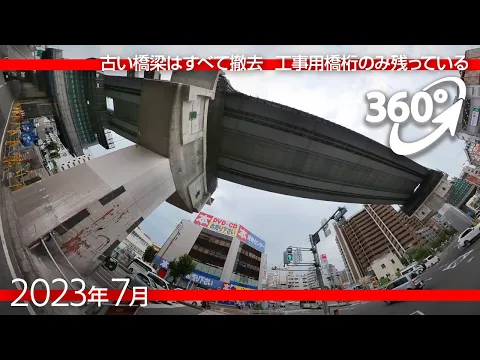
The solution adopted was the massive improvement of the ground, using a method known as Deep Soil Mixing (DSM), a deep mixing of the soil with cementitious binders to create artificial structural columns.
Instead of supporting the highway on unstable natural soil, engineers created a completely new foundation below the surface.
How Soil-Cement Columns Work
The method consists of drilling into the soil with rotating equipment to depths ranging from 10 to over 30 meters, depending on the geological layer.
During drilling, a cement slurry is injected and mechanically mixed with the existing soil.
The result is cylindrical columns of stabilized soil, with strength far superior to the original ground. These columns:
– drastically reduce susceptibility to liquefaction
– increase the soil’s load-bearing capacity
– limit differential settlements
– dissipate seismic energy
At the Hanshin Expressway, these columns were installed at thousands of points, forming true subterranean structural mats under pillars, intersections of viaducts, and critical areas.
Real Scale of the Subterranean Work
Although invisible to those traveling on the highway today, the reconstruction involved impressive volumes of geotechnical work. In critical sections:
– thousands of soil-cement columns were executed
– each column with a typical diameter of 0.6 to 1.2 meters
– arranged in dense grids under the infrastructure
– combined with new deep piles and reinforced foundations
In some urban segments, the subsoil was transformed into a rigid artificial matrix, where seismic behavior became predictable and controlled.
Reconstruction Without Stopping the City
One of the biggest challenges was executing this engineering in an active urban environment. The Hanshin Expressway could not simply disappear for years. The reconstruction had to be phased, with:
– temporary detours
– progressive soil reinforcement
– reconstruction of pillars and decks

All this took place in one of Japan’s most densely populated metropolitan areas, with severe restrictions on space, noise, and vibration.
The New Seismic Standard of Japanese Engineering
The reconstruction of the Hanshin Expressway became a world reference in liquefaction mitigation projects.
From it, Japan began to require: much deeper geotechnical studies, systematic application of soil improvement techniques, and integration between structural design and ground behavior.
Today, practically every major road project in Japan in coastal areas incorporates some form of deep soil stabilization, even if the seismic risk is moderate.
A Highway Supported by Invisible Engineering
The most impressive aspect of the rebuilt Hanshin Expressway is that none of this is visible. For the user, it is just a modern elevated highway. But beneath the asphalt lies a work as complex as the structure above.
Instead of relying solely on concrete, steel, and pillars, Japanese engineers decided to transform the soil itself into a structure. It was this paradigm shift that allowed the highway to operate with safety levels much higher than those before 1995.
The lesson left by Kobe was clear: it’s not enough to design the structure to withstand an earthquake; the soil needs to withstand it as well.
The Hanshin Expressway is not just a rebuilt highway. It is one of the clearest examples of how modern civil engineering has ceased to treat the ground as something passive and has come to see it as an active part of the structure.








