Portuguese
  Spanish


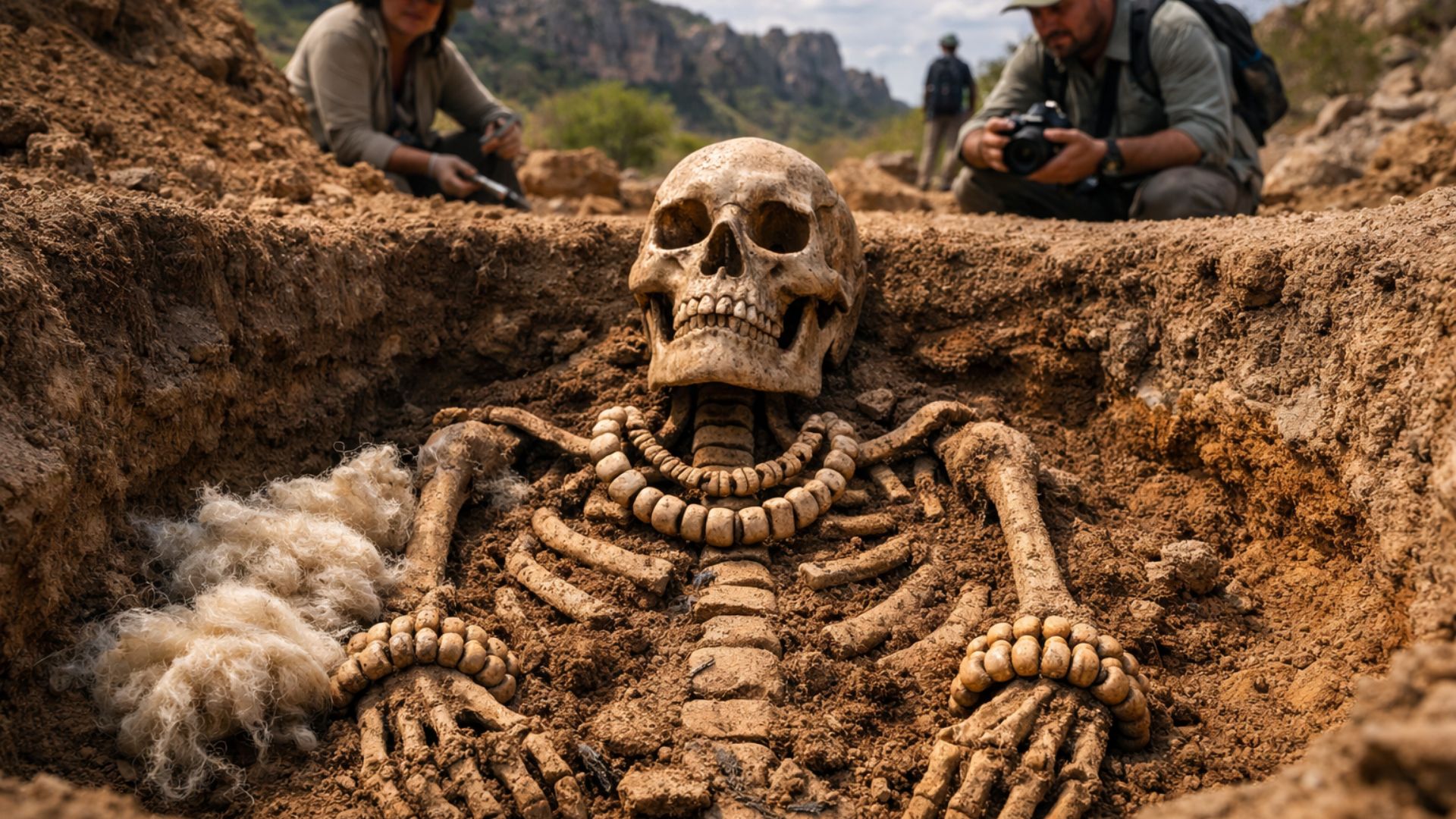


Archaeological finding in southern Piauí reveals indigenous dominance of textile techniques and expands understanding of ancient social organization in Serra das Confusões, with evidence of native cotton, funerary rituals, and international scientific cooperation in carbon-14 analyses.
An adult male skeleton found in the Serra das Confusões National Park, in southern Piauí, reinforced the hypothesis that indigenous groups that occupied the region mastered fiber and textile production techniques.
The finding was made by researchers from the Federal University of Piauí, the Federal University of Minas Gerais, and the Federal University of the São Francisco Valley, in an archaeological research front that has been developed since 2019 and entered the excavation phase in 2022.
Evidence of cotton and weaving techniques
The material recovered from the burial includes a necklace and two bracelets made of manually polished bone beads, as well as preserved remnants of threads found with the body.
-
During the routine drainage of a lagoon in England, an employee found the nearly complete skeleton of a 10-meter, 180-million-year-old “sea dragon,” the largest and most complete marine reptile ever discovered in the United Kingdom.

-
A college in Peru turned a street billboard into a ‘factory’ for drinking water that pulls moisture from the air: in three months, the panel produced almost 9,500 liters in one of the driest capitals on the planet.
-
The coast of Pernambuco has more than a dozen deliberately sunken ships at the bottom of the sea, and what started as a junkyard has become one of the largest wreck diving parks in Brazil, a refuge for turtles and schools of fish.
-
A woman left São Paulo to help her 88-year-old father in the hinterland of Paraíba, found the abandoned family farm, switched cassava and cattle for organic fruits, and harvested 24 tons of melon and watermelon in the semi-arid region, proving that tradition, irrigation, and planning can transform forgotten land into a sustainable business.



According to the team, the set of evidence is associated with the production of fibers and/or textiles from native cotton, which allowed for the reconstruction of part of the manufacturing process, with stages such as harvesting, spinning, and weaving.
The discovery broadens the scope of research because it is not limited to the description of an individual burial but helps shed light on the way of life of an ancient population.

For the archaeologists involved, the gathered evidence points to groups with consolidated technical knowledge, embedded in a more structured occupation of the territory, and not merely seasonal movements of small bands.
Burials and indigenous social relationships
According to bioarchaeologist Claudia Cunha, coordinator of the Osteoarchaeology Laboratory at UFPI, skeletons of this type are especially valuable because they provide information about both the biological characteristics of individuals and the social relationships of the communities to which they belonged.
Professor Grégoire van Havre, who coordinates the project, stated that the recent findings offer significant evidence about the society that inhabited southern Piauí and suggest technological dominance in weaving.
The observed funeral treatment also caught the researchers’ attention for referring to indigenous practices already recorded in other contexts in the North and Northeast of the country.
In the case of this individual, the face was covered by a large ceramic fragment, while the adornments remained positioned next to the body, preserving elements that help identify ritual patterns and symbolic choices of the burial.
Excavations reveal archaeological complex in Serra das Confusões
The investigation in Serra das Confusões had already revealed, in 2022, the partial skeleton of an indigenous adolescent in excellent condition of preservation, still with a visible braid in the hair.
In that burial, researchers recovered a bracelet made with polished beads produced from the endocarp of a fruit from the Arecaceae family, as well as traces of plumage, expanding the repertoire of objects associated with funeral practices and the use of organic raw materials in the region.
The results accumulated since the beginning of the project show that the archaeological site gathers an expressive diversity of remains, distributed among painted and engraved rock art, structured fire pits, remains of indigenous constructions, and everyday objects.

This set strengthens the interpretation that the region concentrated more complex human occupations, with social organization, technical repertoire, and sufficient permanence to leave varied marks on the landscape.
Although the news about the male skeleton gained attention in 2023, the research trajectory began four years earlier, with archaeological characterization activities in different areas of the park.
Between 2019 and 2021, the teams developed initial surveys, recorded panels of rock art, and applied three-dimensional reconstruction tests with low-cost technologies, before the opening of the most recent excavations.
Carbon-14 Dating and International Cooperation
It was from 2022 that excavations began to occur systematically at the Olho d’Água das Andorinhas site, identified by UFPI as one of the central focuses of the campaigns.
The university reported that these interventions were the first in over a decade in the park and occurred with authorization from the National Institute of Historical and Artistic Heritage and the Chico Mendes Institute for Biodiversity Conservation.
In addition to academic support among Brazilian universities, the project has gained international cooperation within the framework of the Franco-Brazilian Archaeology Mission in Piauí.
According to UFPI, some of the remains found in this context could be submitted to carbon-14 dating in specialized laboratories in France, which paved the way for more precise chronological analyses regarding human occupation of the Serra das Confusões.
In this effort, one of the announced steps was the carbon-14 analysis of a bone collected in 2022, sent to the Laboratoire des Sciences du Climat et de l’Environnement in France, under the responsibility of researcher Christine Hatté.
Until the publicly available information for this check, the expectation shared was that this examination would help define the antiquity of the archaeological site with greater precision, but the dating result did not appear in an accessible official source.
The importance of the find, therefore, lies less in an isolated object than in the broader picture it helps to compose regarding the indigenous presence in southern Piauí.
By gathering formal burials, handmade ornaments, remains of native cotton, and evidence of textile production, the research reinforces the interpretation that the Serra das Confusões housed populations with specialized technical knowledge and denser forms of social organization than was long assumed.