






 Portuguese
  Spanish


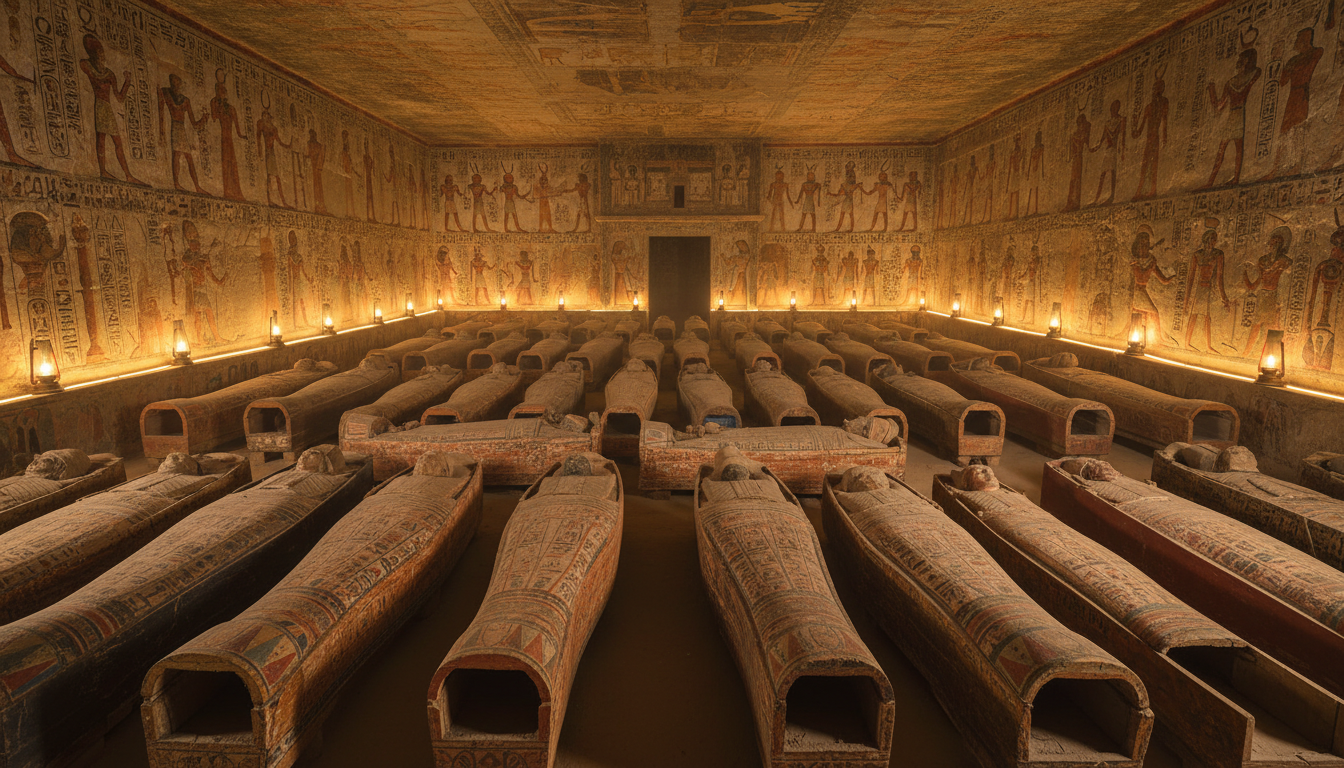


Mission of the Zahi Hawass Foundation and the Supreme Council of Antiquities finds rock-cut chamber in the southwest courtyard of the Tomb of Seneb, in Qurna, with coffins stacked in 10 rows and sealed papyri intact inside a ceramic pot.
Archaeologists from Egypt found a batch of Singers of Amun in a rock-cut chamber under the southwest courtyard of the Tomb of Seneb, in Qurna, west bank of Luxor.
According to Daily News Egypt, the announcement came on February 28, 2026.
According to the Supreme Council of Antiquities, the mission is led by the Zahi Hawass Foundation for Heritage and Antiquities.
-
In a Degraded Atlantic Forest Area, a São Gonçalo Resident Transforms Land into a Living Eco-Museum, Now a Model for Environmental Education

-
World’s First Lithium-Sulfur Battery Factory Launches, Promising to Double Range Without Relying on China

-
AI Data Centers Now Feature Built-In Nuclear Power Plants and Have Ordered Non-Existent Reactors
-
In India, thousands earn about $2.50 an hour cooking and cleaning with a phone strapped to their heads, as every move is recorded to train humanoid robots for jobs they might one day replace.



In parallel, the chamber held 22 painted wooden coffins with mummies inside and eight sealed papyri in a large ceramic pot.
According to the Minister of Tourism and Antiquities, Sherif Fathy, the find is a significant addition to the country’s archaeological record.
Rock-cut chamber with coffins in 10 horizontal rows
According to the team, the excavation revealed a rectangular rock-cut chamber used as a funerary deposit. According to a report by Archaeology Wiki, the ancient Egyptians stacked the coffins in ten horizontal rows.

In other words, lids and bases were separated to make the most of the room’s volume. This careful arrangement indicates that the deposit was not improvised.
In practice, the chamber shows intentional reuse. Earlier tombs served as ritual deposits in later phases.
On the other hand, the spatial utilization suggests ritual planning. On the other hand, each coffin has its own hieroglyphic titles and retains its original painting.
Singers of Amun: female priestly class of the temples
The most common title among the 22 mummified is “Singer of Amun,” in some cases “Singer of Amun.”
According to the Jerusalem Post, this priestly category sang in daily rituals to the god Amun in Karnak and other temples in Upper Egypt.

According to the Hawass mission, the group opens a new window on this professional class. According to Theban archaeology, the Singers of Amun appeared on a large scale from the 21st Dynasty.
In fact, it is the largest concentration ever recorded of this class in a single deposit. The last dozens of mummifications belong to the period between 1069 BC and 664 BC.
Consequently, it opens a new window to understand female ritual life in Egypt. It is worth remembering that few comparable archives have arrived intact.
Eight sealed papyri inside a ceramic pot
Additionally, archaeologists found eight rolled papyri inside a single large ceramic pot. According to Egyptian Streets, some still preserve the original clay seals.

In other words, no one has yet read the content. The texts will undergo chemical analysis and mechanical opening at a later stage.
According to the team, the dimensions of the rolls vary. Restorers are working at the Egyptian Museum in Cairo to define the opening protocol without destroying the structure.
In turn, intact sealed papyri from the Third Intermediate Period are rare. The last discovery in comparable quantity was in the 1960s.
Third Intermediate Period: dynasties 21 to 25
In fact, the coffins date from dynasties 21 to 25, between 1069 BC and 664 BC. According to Ancient Origins, this interval covers the political fragmentation after the collapse of the New Kingdom.
In parallel, Thebes becomes the religious center while political power shifts to the Delta. Consequently, priests and singers gain administrative weight.
According to Hawass, the find offers “new insights into the Third Intermediate Period.” According to the former Minister of Antiquities, this interval is poorly documented compared to the New and Middle Kingdoms.
In fact, there are still gaps in exact dates. The painting of the coffins should help refine the official chronology of dynasties 21-25.
Tomb of Seneb: how the courtyard hid a deposit for 3,000 years
For example, the Tomb of Seneb is a classic Theban tomb carved into the rock. Consequently, its courtyard functioned as a ceremonial entrance. Later it became an improvised roof for the secondary chamber.

In fact, the newly opened chamber was invisible on the surface, according to the mission. The courtyard covered the entrance with a lowered slab.
Other discoveries followed a similar path. In May, Egypt announced the sealed secret chamber 4,500 years old in the Pyramid of Khufu, in parallel with the same Hawass program.
In turn, other Theban tombs hold similar material. The rediscovery of the medieval city of Rungholt in the North Sea serves as an example of how preserved contexts can become primary archives.
Ceramic vessels for mummification supplies
In turn, besides the coffins and papyri, the chamber held ceramic pots used for mummification supplies. According to Minister Sherif Fathy, these vessels stored resins and ritual oils.
To understand the context, these containers have not yet been analyzed. In parallel, restorers are assessing if there are preserved chemical residues.
According to the field team, the material indicates an organized ritual operation. In other words, it was not an improvised burial.
Additionally, the ministry is preparing a public exhibition after the conservation phase. The schedule has not been disclosed.
Implications for tourism and the history of the Singers of Amun
- 22 painted wooden coffins stacked in 10 horizontal rows
- 8 sealed papyri intact inside a ceramic pot
- Third Intermediate Period — dynasties 21 to 25 (1069-664 BC)
- Tomb of Seneb — southwest courtyard, necropolis of Qurna, Luxor
- Zahi Hawass Foundation — mission coordinated with the Supreme Council of Antiquities
In comparison, finds of coffins in collective deposits usually gather five to ten pieces. According to the Hawass Foundation, this exceeds four times the average.
For tourism, Egypt gains a new showcase. In turn, the cultural sector projects a new boost after the opening of the Grand Egyptian Museum.
Caveat about the Singers of Amun and the next steps
The papyri are still closed. According to the team, the opening requires a controlled protocol in the laboratory, with no public deadline.
On the other hand, the individual identification of the 22 mummies depends on additional examinations. DNA analysis may reveal kinship among some Singers of Amun.
Does Brazil today have a comparable structure to open, conserve, and exhibit a find of this scale? Egypt shows the current limit: dozens of teams, dedicated ministry, and decades of institutional continuity.
Even so, the official schedule remains open. The Hawass Foundation is expected to release new details at conferences scheduled for the second half of 2026.


