Portuguese
  Spanish


Green and yellow decorations take over the streets during the World Cup, but some ornaments can compromise safety and result in penalties.
The match of the Brazilian National Team against Haiti this Friday, June 19, 2026, increased the movement of fans through the streets.
Cars with flags, stickers, and accessories in green, yellow, and blue colors gain space during the competition. However, the celebration needs to respect traffic rules.
-
In the city that the market called “road cockroach,” between Balneário Camboriú and Florianópolis, he launched a planned neighborhood worth R$ 1 billion with a marina for 90 boats and sold 80% of the lots in the first phase in 1 week.

-
At a depth of 5,000 meters, where there is no sunlight, researchers found ancient DNA preserved in the mud of the South Atlantic and discovered signs of organisms that did not match known records.

-
At 77 years old, a retired woman who never tires of learning completes her second degree in design in Ceará and moves people by revealing the help of her 98-year-old mother in the final project.
-
China’s masterstroke: a plant capable of regrowing even when buried by sand helps to recover more than 7,300 hectares of desert with 5 million seedlings, roots over 10 meters deep, and rainfall below 150 mm per year.




A recent ordinance from the São Paulo City Hall authorized decorations related to the tournament on taxis, vans, and app vehicles.
Private drivers, on the other hand, remain subject to the technical limits established by the Brazilian Traffic Code and the National Traffic Council.
Safety and visibility define the limits of decoration
Aesthetic customization of the vehicle is allowed when it does not interfere with driving or compromise mandatory equipment.
According to lawyer Daniela Poli Vlavianos, partner at Poli Advogados e Associados, the ornaments need to preserve the functioning of seat belts, headrests, and retention systems.
Mirrors, headlights, taillights, and plates must also remain clear. Any object blocking these components can result in a citation during inspection.
Stickers on windows require extra attention
The use of stickers on windows represents one of the main points of attention during celebrations.
Marcos Poliszezuk, founding partner of Poliszezuk Advogados, explains that the material cannot impair the driver’s vision or hinder vehicle identification.
The Resolution No. 960, published by Contran on May 17, 2022, establishes the transparency requirements for automotive windows.
Marcelo Soletti, lawyer and former Secretary of Transportation of Porto Alegre, states that visibility on essential windows cannot fall below 70%.
Inspection may apply a fine of R$ 195.23, five points on the driver’s license, and vehicle retention when identifying an irregularity.
The classification corresponds to a serious infraction, according to article 230 of the Brazilian Traffic Code.
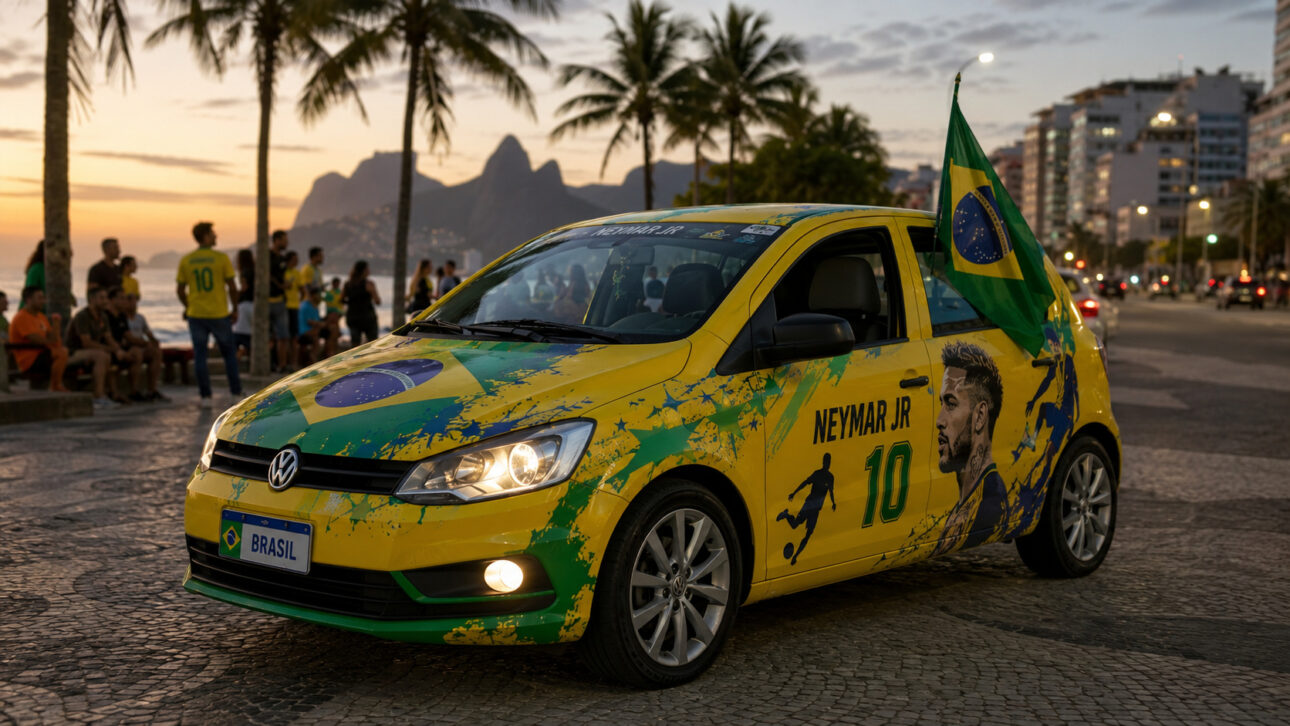
Changing the car’s color may require new registration
The size of the stickers placed on the bodywork must also be observed by the owner.
A sticker application that modifies more than 50% of the vehicle’s predominant color requires updating the registration with the traffic authority.
Daniela Poli Vlavianos highlights that the rule applies to permanent stickers and temporary wraps.
A car extensively covered in the colors of the Brazilian Team may, therefore, become irregular if the document alteration is not carried out.

Poorly fixed flags can pose a danger
Small flags installed securely are usually tolerated during sporting events.
Improvised masts, unstable supports, or accessories that sway excessively can come loose and hit pedestrians or other vehicles.
Marcos Poliszezuk emphasizes that a flag may be considered irregular when there is a risk of detachment or compromise of the vehicle’s stability.
Plates, headlights, and taillights must also not be covered by any type of decoration.
Passengers, horns, and loud sound are also under scrutiny
Passengers should not put arms, head, or torso out of the moving vehicle.
Daniela Poli Vlavianos warns that this behavior increases the risk of accidents and can result in direct liability for the driver.
The Brazilian Traffic Code also prohibits the transport of people on the external parts of the vehicle.
Horns and sound equipment need to be used without excess, especially near hospitals and schools.
Noise after 10 PM can also violate municipal public quietness control regulations.
Decorating the car for the World Cup is allowed, but it needs to preserve visibility, identification, stability of accessories, and passenger safety.
In your opinion, should law enforcement guide drivers before issuing fines during World Cup celebrations?