Portuguese
  Spanish


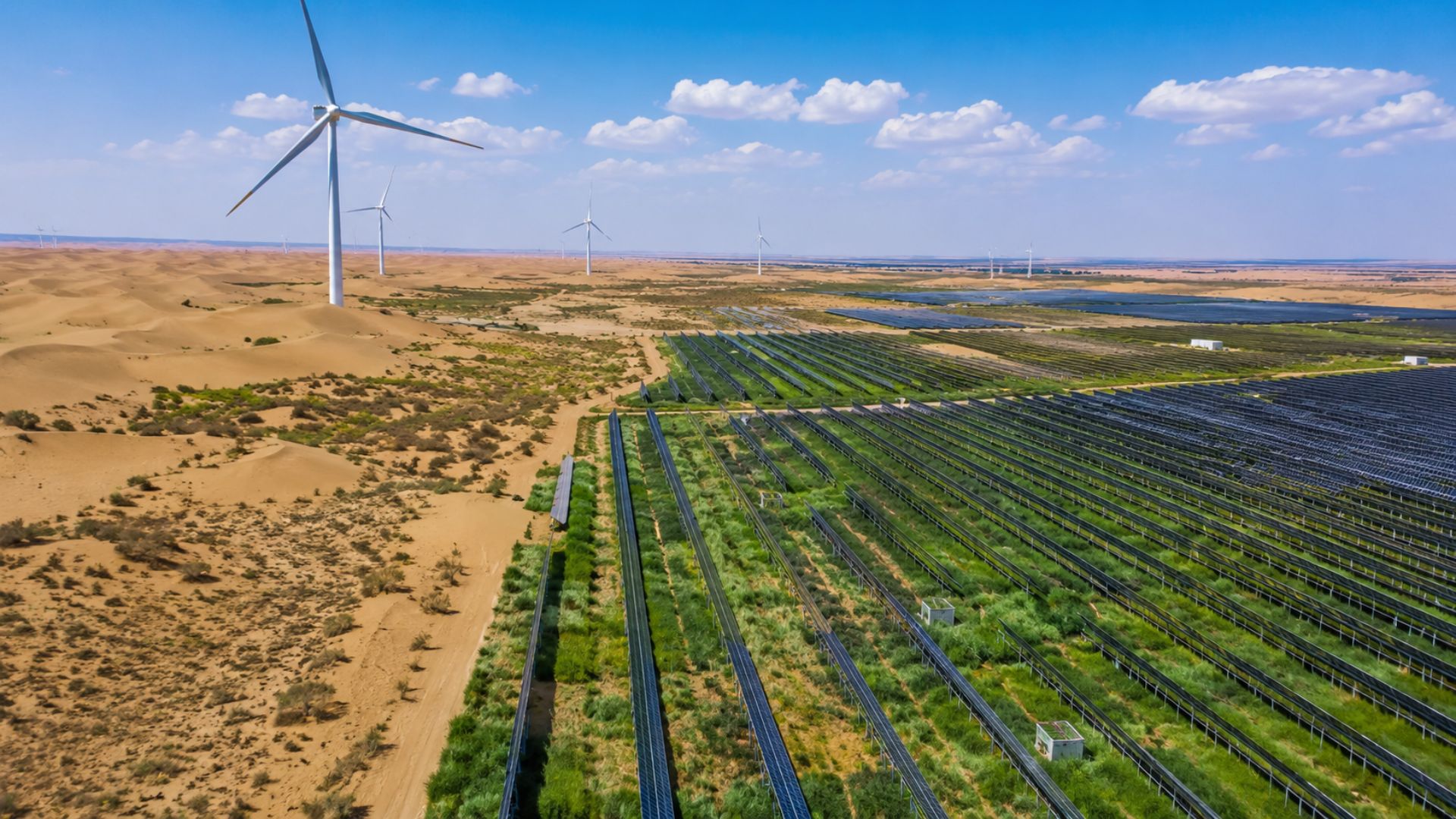


In the Tengger Desert, China installed a 1-gigawatt hybrid solar and wind power plant, capable of generating 1.8 billion kilowatt-hours per year. In addition to producing electricity, the panels create a microclimate under the structures that stimulates vegetation growth in the arid region.
While vast areas of the planet face advancing desertification,
The plant has an installed capacity of 1 gigawatt and is expected to generate 1.8 billion kilowatt-hours per year, enough to power about 1.5 million homes.
What is the solar and wind project in the Tengger Desert

The initiative marks China’s first project aimed at generating solar and wind energy in desert areas. The undertaking began operations after robust investment in clean energy generation and transmission infrastructure.
-
Brazilian Researcher Develops Protein Supplement from Tilapia Waste, Combining Innovation and Sustainability with Economic Potential

-
Women in São Paulo Unknowingly Tracked by Coin-Sized Tags Hidden in Cars and Belongings, Raising Stalking Concerns
-
Near a $750 million AI data center in Brazil, a resident’s well runs dry, leaving her unable to afford the $25,000 needed for repairs.

-
16-Year-Old from Brazil’s Sertão Wins Young Scientist Award for AI Predicting Rainfall with 94.5% Accuracy to Aid Farmers


The complex combines photovoltaic solar panels with wind turbines on the same land.
Located in Ningxia Hui, in north-central China, the plant has an installed capacity of 1 million kilowatts, equivalent to one gigawatt. This figure places the project among the largest renewable installations in a desert environment ever delivered worldwide.
Why China chose the desert to generate energy

The choice of arid areas to house energy infrastructure responds to a logic of territorial utilization. Deserts have low population density, sparse vegetation, and enormous availability of flat space, three characteristics that reduce land-use conflicts.
The technical potential is also high.
The country invested about 85 billion yuan, equivalent to 12.28 billion dollars at the time of the announcement, in clean energy projects in the Gobi Desert and other arid regions of Central China. Tengger is just the first piece of this larger puzzle.
The microclimate effect created by solar panels


One of the most unexpected aspects of the project is its positive environmental impact on the desert itself. The solar panels function as a partial ground cover, creating shade and altering temperature, humidity, and wind exposure conditions in the covered area.
The process does not transform the desert into a forest, but represents a form of indirect combat against desertification. Instead of the wind freely sweeping the surface and carrying away the topsoil layer, the cover created by the panels helps stabilize the terrain.
National plan for 100 GW in arid regions
The Tengger project is just the first piece of a much broader plan. China has set a goal to install 100 gigawatts of solar and wind power generation capacity in arid regions, with the aim of replacing part of its coal-based energy matrix.
The planned power plants are distributed across 19 Chinese provinces, covering areas with the greatest potential for solar radiation and constant wind. Regions like Ningxia, Xinjiang, and Inner Mongolia are at the heart of this strategy.
This move connects to a larger effort to reduce carbon emissions. China is simultaneously the world’s largest emitter and the largest global investor in renewable capacity, in a delicate balance between growing energy demand and climate commitments.
Ultra-high voltage line takes energy to Hunan
Power generation in desert regions only makes sense if there’s a way to transport it to large consumer centers. The Tengger project also inaugurates the country’s first ultra-high voltage power transmission channel built for this specific purpose.
The line carries electricity generated in the arid regions of northern and central China to Hunan province, in the country’s economic heartland. Without this transmission infrastructure, the clean energy produced in the desert would remain isolated and without a consumer market.
This type of technology allows for the transport of large blocks of energy over long distances with reduced losses. China is currently one of the world leaders in ultra-high voltage networks, precisely because of the distance between its generation hubs and consumption centers.
Growth of renewables in China’s energy matrix
The project’s context reflects an accelerated expansion of renewable sources in the country. In the year prior to the Tengger plant’s operation, China’s renewable capacity grew by 86.5%, according to data released by local media.
Installed wind capacity reached an additional 10.4 million kilowatts, while solar capacity totaled 33.6 million kilowatts in the same period. Experts interviewed by Chinese media point out that regions like Ningxia, Xinjiang, and Inner Mongolia will play a central role in achieving China’s energy sustainability goals.
This movement is complemented by the expansion of nuclear generation, an area in which the country has also heavily invested in building new plants. The combination of renewables and nuclear is China’s bet to reduce reliance on fossil fuels without compromising the pace of demand growth.
What this model could mean for other countries
The Chinese project draws the attention of governments facing two parallel problems: advancing desertification and the need to decarbonize the energy matrix. The combination of these two challenges into a single technical solution is what makes the model interesting for other nations.
Countries in North Africa, the Middle East, Australia, and even specific regions of the Americas have large arid areas with high solar potential. Brazil, although it does not have classic deserts, has extensive semi-arid regions in the Northeast with climatic characteristics that approach this logic.
The scalability of the model, however, depends on factors beyond geography. Availability of capital, long-distance transmission infrastructure, integration with the national electricity grid, and solid regulatory frameworks are prerequisites for replicating what China is doing in Tengger.
China’s experience with power generation in desert areas shows that regions once considered uninhabitable can transform into strategic assets for the energy transition. The microclimate created by the panels also brings an unexpected bonus, contributing to reducing the advance of desertification.
And you, what do you think about this solution? Do you believe Brazil should invest in similar projects in the semi-arid regions of the Northeast? Is this model viable outside of regimes with strong state planning? Leave your comment, share your opinion, and tag someone interested in clean energy.