Portuguese
  Spanish


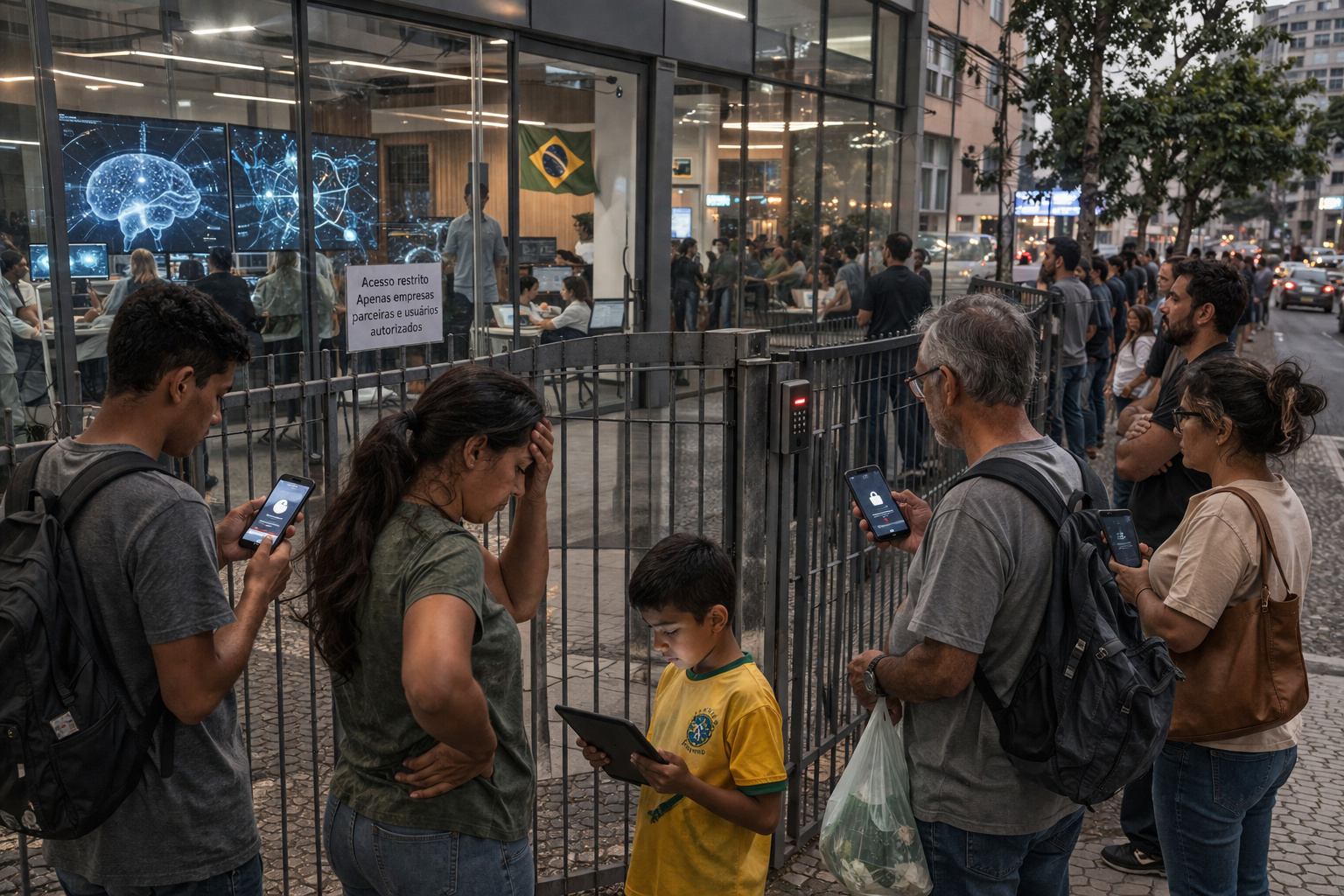

Recent changes show that companies are restricting access to the most powerful AI, which could leave countries without investment out of this technological revolution.
The global artificial intelligence landscape changed rapidly in 2026. The trend became evident in just a few months. Currently, large companies are closing their most advanced models, especially when these systems reach higher levels of capability.
This movement began among companies that advocated for open source. However, with technological advancement, these companies gradually reduced their openness, as recent industry reports indicate.
Closing models marks a new phase of artificial intelligence
In March 2026, according to corporate announcements, Alibaba launched three proprietary models in just three days, all from the Qwen family.
-
Brazilian Entrepreneur Develops Device to Provide Companionship and Health Monitoring for Elderly, Alerting Families to Potential Health Issues

-
AI Customizes Burgers for Individuals and Impresses in Blind Test with Over 100 Participants, Matching or Surpassing Fast-Food Chains’ Approval Ratings

-
AI Revolutionizes Digital Entrepreneurship by Enabling Lean Startups and Rapid Scaling

-
The ‘tsunami’ of investments directed at Artificial Intelligence (AI) and semiconductor companies, which prioritize security and more predictable profits, has been a determining factor in the declining trajectory of Bitcoin.


Subsequently, Meta changed its strategy, even after favorable statements about open source. The company launched its latest model as closed and solidified this change.
In April 2026, Anthropic introduced Claude Mythos, a highly advanced system. According to the company, the model identified thousands of critical vulnerabilities in widely used operating systems and browsers.
Due to the sensitivity of the findings, Anthropic chose not to release the system to the public, a decision officially confirmed.
Artificial superintelligence gains global strategic value
The idea of releasing a superintelligence to the public has always seemed unlikely. The economic value of these systems is extremely high.
These models can:
- Discover new molecules
- Develop complex medications
- Create new business models
- Transform sectors such as finance and transportation
This set of applications shows that companies keep these technologies under restricted control, especially when they lead this race.

Brazil faces the risk of being left out of this transformation
Brazil faces a relevant strategic challenge. The country has not made significant investments in artificial intelligence, as highlighted in the base text.
As a direct consequence, the country may not access superintelligence when it is consolidated.
In the field of digital security, the case of Claude Mythos shows that cybersecurity increasingly depends on these advanced technologies.
In the military sector:
- Algorithms coordinate swarms of autonomous drones
- Systems identify targets in real-time via satellite
- Conflict simulations achieve high precision
This scenario shows that the absence of this technology reduces national strategic capacity.
Opportunity window still exists, but is closing
There is a limited window of opportunity. Some models remain accessible, especially open-source ones.
This window, however, is closing rapidly, as new proprietary solutions emerge weekly.
Continuous advancement reduces the possibilities for independent development. Countries that have not invested face increasing difficulties.
Comparison with the Manhattan Project reinforces warning
In the United States, analysts compare the race for artificial intelligence to the Manhattan Project, according to recurring assessments from the tech sector.
After the development of the nuclear bomb, some countries managed to replicate the technology before global restrictions.
The comparison helps to understand the scenario, but does not fully convey the impact of artificial superintelligence.
Advanced AI has broad applications:
- Economic
- Scientific
- Military
- Social
Being left out may compromise global competitiveness
Being left out of artificial superintelligence does not just mean losing a technology. The impact involves losing the ability to compete in virtually all strategic sectors.
This scenario raises an inevitable question: will Brazil be able to react before this technological window closes permanently?