Portuguese
  Spanish


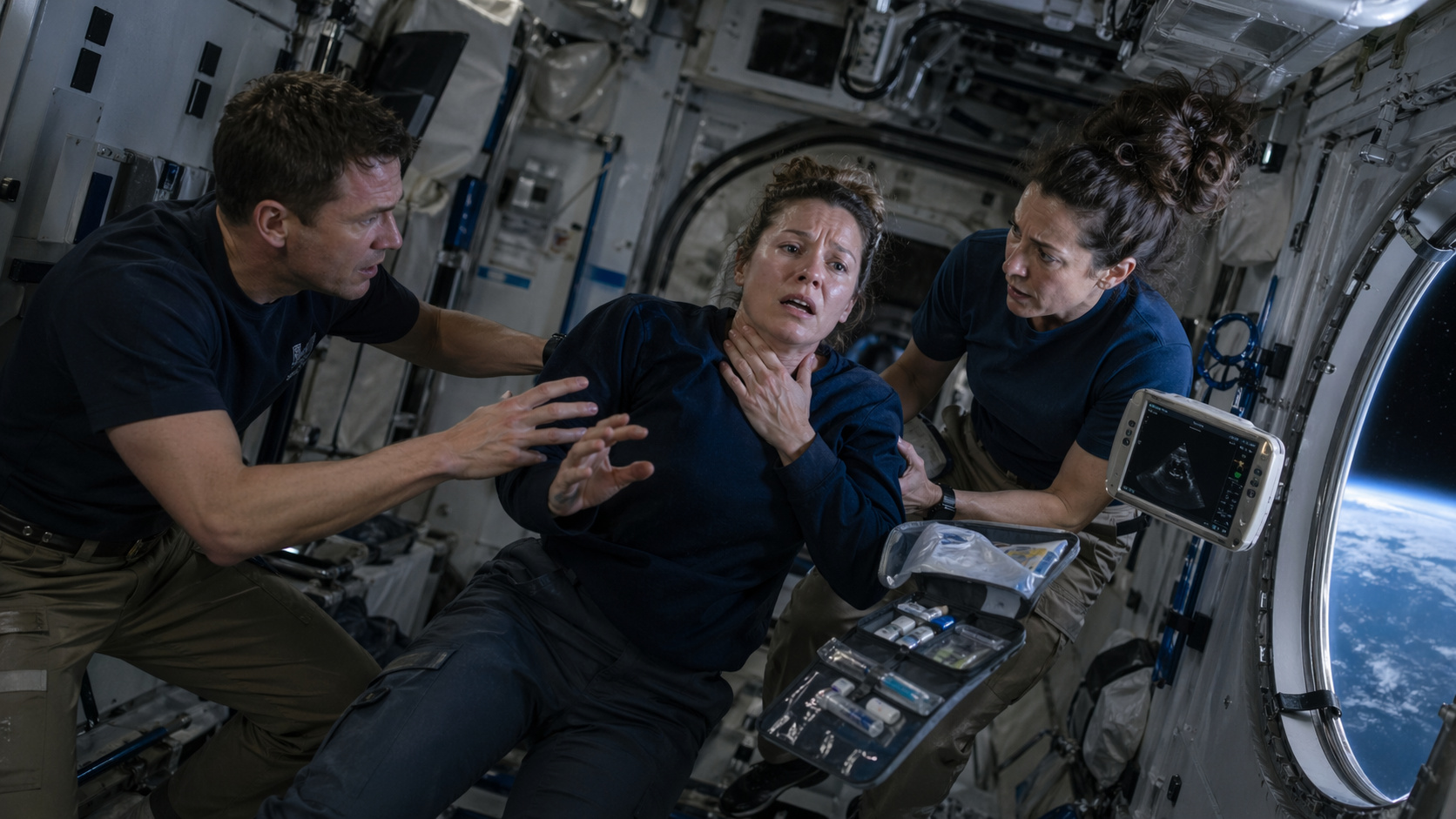


Astronaut incident on ISS in 2026 leads to first medical evacuation and reveals critical limits of space medicine.
On January 7, 2026, during the SpaceX Crew-11 mission, astronaut Mike Fincke, then commander of Expedition 74 on the International Space Station, experienced a sudden and unusual episode: he lost the ability to speak for about 20 minutes while having dinner on board, hours after preparing for a spacewalk scheduled for the next day. Fincke himself later reported that he felt no pain and that the problem arose extremely quickly, leading his crewmates to immediately contact NASA flight surgeons on the ground.
Despite its short duration, the case was treated as a serious medical occurrence within the mission, because the exact cause could not be determined in orbit. According to NASA, in an update published on February 25, 2026, and as detailed by the Associated Press on March 27, 2026, the team decided to bring forward the return of Crew-11 so that Fincke could undergo advanced imaging tests unavailable on the station, a measure that ultimately became the first medical evacuation in ISS history.
By the end of March, doctors had already ruled out heart attack and choking, but had not yet reached a definitive diagnosis for the episode.
-
Ancient Maya City Discovered in Remote Mexican Area with 12-Meter Pyramid, Palaces, Canals, and 14 Preserved Monuments

-
Indigenous 8-Year-Old Girl Wins National Science Award for Solar-Powered Water Heater Invention Using Recycled Materials

-
14-Year-Old Girl Develops Solar-Powered Water Purification System for India, Eliminating Need for Electricity or Chemicals

-
Forgotten Canadian Machine Harnessed Waterfall Power to Supply Mines with Compressed Air for 70 Years Without Motors or Electricity



NASA conducts first medical evacuation in ISS history after 25 years of continuous operation
Given the impossibility of a complete diagnosis on board, NASA decided to bring forward the astronaut’s return to Earth. The evacuation occurred between January 14 and 15, 2026, marking the first emergency medical evacuation in the 25-year history of the International Space Station.


The return was carried out via the SpaceX capsule, which was already docked to the station as part of the Crew-11 mission.
The decision was based on the need for immediate access to tests such as CT scans and MRIs, essential for evaluating neurological conditions — equipment that simply does not exist in the orbital environment.
This episode was also described as the first early return for medical reasons in American crewed flights in about 65 years, highlighting the rarity of the event.
Lack of advanced medical equipment in space reveals critical vulnerability
Although the ISS is one of the most complex structures ever built by humans, its medical capacity is limited.
The station has basic monitoring and support equipment, but lacks advanced imaging diagnostic systems.
This means that conditions such as stroke, internal bleeding, or other neurological emergencies cannot be accurately diagnosed in space.
In Fincke’s case, NASA’s medical team made it clear that the diagnosis depended on tools unavailable on board.
This technical limitation transformed a 20-minute episode into an international evacuation operation, involving logistics, security, and coordination among different teams.
Case diagnosis not disclosed and raises questions about health in microgravity
After returning to Earth, the exact diagnosis of the incident was not publicly disclosed. NASA cited medical privacy concerns to keep the information restricted.
However, the astronaut himself commented on the episode in February 2026, highlighting the impact of the experience:
“Spaceflight is an incredible privilege and sometimes reminds us how human we are.”

The absence of a public diagnosis reinforces the level of uncertainty that still exists regarding the effects of microgravity on the human body.
What this case reveals about future missions and the challenge of taking humans to Mars
The incident drew attention not only for what happened itself but for its future implications. On the International Space Station, an evacuation is possible in a matter of hours or days.
On a mission to Mars, this option simply wouldn’t exist. A crewed trip to Mars can take months, and a medical evacuation would be unfeasible in practically any scenario.
This raises a central question for the future of space exploration: how to deal with serious medical emergencies in environments where there is no immediate return?
Space medicine still faces structural limitations even after decades of advancement
Space medicine has evolved significantly in recent decades, with advancements in monitoring, nutrition, physiology, and basic support.
However, Fincke’s case shows that diagnostic capability is still one of the main bottlenecks in human space exploration.

Complex exams require large, heavy, and energy-intensive equipment, difficult to adapt for orbital environments. Furthermore, the interpretation of these exams often depends on specialists on the ground.
Microgravity can affect the body in ways not yet fully understood
Previous studies have already demonstrated that the microgravity environment can cause:
- Changes in blood circulation
- Changes in intracranial pressure
- Impacts on the nervous system
- Loss of muscle and bone mass
However, episodes like the one with Fincke show that there are still significant gaps in understanding these changes, especially concerning acute events.
A 20-minute episode that exposed a global limitation of space exploration
Although the event was brief, its consequences were significant. It revealed that, even with decades of experience in crewed flights, humanity still lacks medical autonomy in space.
The need for immediate return for diagnosis shows that dependence on Earth remains a critical factor.
Do you believe humanity is ready to face medical emergencies far from Earth
Mike Fincke’s case highlights one of the most complex challenges of space exploration. It’s not just about going further, but about ensuring that humans can survive and be treated in extreme environments without immediate support from Earth.
As longer and more distant missions are planned, the issue of medical autonomy becomes central.
The direct question that arises is: how to deal with a serious medical emergency when there is no option to return home.