Portuguese
  Spanish


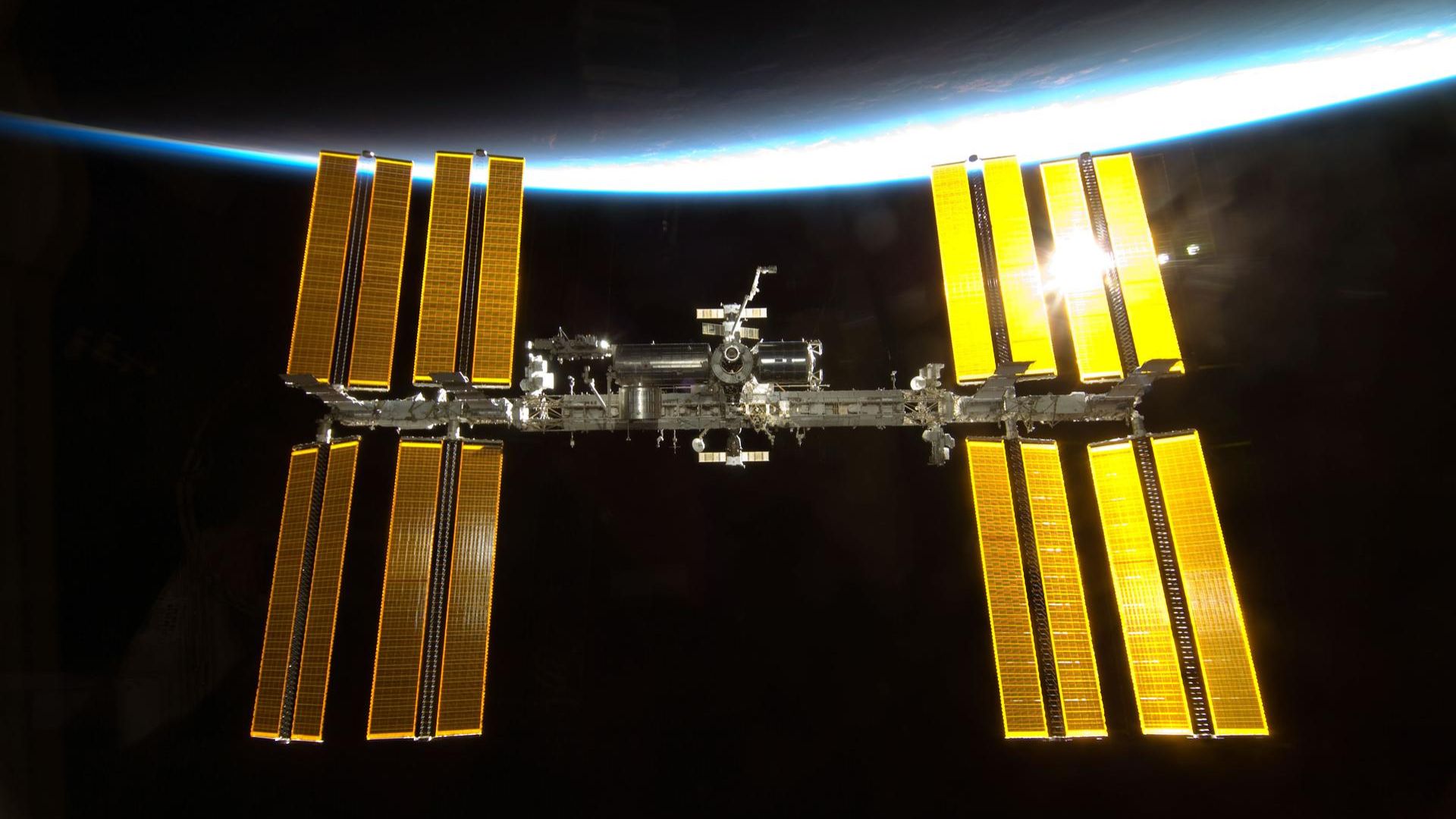


ISS is 109 meters, orbits Earth 16 times a day, and continues as an inhabited space laboratory for over 25 years.
The International Space Station is one of the most extreme constructions ever made by humanity. Assembled in low Earth orbit, it is 109 meters from end to end, has a mass of 419,725 kg, and a set of solar panels with a wingspan greater than that of an Airbus A380, according to data from NASA. The orbital laboratory travels at about 17,500 miles per hour, approximately 28,000 km/h, at about 250 miles altitude, or near 400 km above Earth. At this speed, it completes one orbit around the planet every 90 minutes.
In just 24 hours, the ISS makes 16 complete orbits of Earth, crosses 16 sunrises and sunsets, and covers a distance equivalent to a round trip to the Moon.
International Space Station is larger than a six-bedroom house and functions as an inhabited orbital laboratory
NASA compares the internal space of the International Space Station to that of a six-bedroom house, with six bedrooms, two bathrooms, a gym, and a 360-degree panoramic window facing Earth.
-
China Unveils 300-Ton Hybrid-Electric Truck as the Heavy Machinery of the Future

-
Brazilian mechanic invents simple solar lamp using water and chlorine in a PET bottle, providing up to 60 watts of light during the day

-
Swiss glaciers melting fast enough to fill an Olympic pool every 6 seconds, France confirms 3,700 heatwave deaths, and WMO predicts strong El Niño intensifying extremes until 2027

-
Sudden Sea Recession in São Paulo Sparks Tsunami Alert and Online Debate on Giant Wave Risks in Brazil


The habitable volume is 388 m³, while the total pressurized volume reaches 1,005 m³. This places the ISS on an unusual scale: it is not just a spacecraft, but a modular orbital complex where astronauts live, work, and perform maintenance in a microgravity environment.
The station has been continuously occupied since November 2000, which has turned the ISS into the largest experiment of prolonged human presence outside Earth.
Structure of 419 tons was assembled with dozens of launches from the United States and Russia
The ISS was not launched whole. It was assembled in orbit in parts, in an international operation that required 42 assembly flights, with 37 carried out by United States space shuttles and five by Russian Proton/Soyuz rockets.
The main structure has pressurized modules, metal trusses, solar panels, robotic arms, life support systems, docking ports, and external platforms for scientific experiments.
NASA reports that the station has 8 miles of electrical wires, equivalent to almost 13 km of cables, connecting power, control, communication, and research systems.
109-meter solar panels generate energy to keep laboratory, computers, and vital systems running
The span of the ISS solar panels reaches 356 feet, or 109 meters, larger than the Airbus A380, the largest commercial passenger airplane ever produced.

The electrical system uses eight large solar panels, capable of generating between 75 and 90 kilowatts of power. This energy keeps scientific equipment, computers, lighting, life support, communications, and thermal control running.
The station also received new IROSA-type solar panels to increase the energy capacity of the orbital laboratory and compensate for the natural degradation of the old systems.
Astronauts live at 28,000 km/h while working, researching, and training two hours a day
The routine inside the ISS combines scientific research, heavy maintenance, and extreme adaptation of the human body to microgravity. The international crew usually consists of seven people, although this number may vary during mission changes.
To reduce muscle and bone mass loss, astronauts need to exercise at least two hours a day. This training is necessary because, without Earth’s gravity, the body loses essential physical stimuli.
Even at this incredible speed, the ISS functions as a regular work environment, with experiments in medicine, materials, climate, biology, physics, and space technology.
The orbital laboratory has already received nearly 300 astronauts and thousands of scientific experiments
NASA reports that the station has already received almost 300 astronauts from various countries and served as a base for thousands of scientific experiments. The program involves five major space agencies: NASA, Roscosmos, ESA, JAXA, and CSA.
According to NASA, by Expedition 60, the microgravity laboratory had hosted nearly 3,000 scientific investigations from researchers from more than 108 countries.
The station’s orbit also passes over more than 90% of the Earth’s population, allowing for planet observations, environmental monitoring, and millions of photographs taken by crews over the years.
Canadarm2, eight docking ports, and software demonstrate the complexity of the largest inhabited structure in orbit
The station features the robotic arm Canadarm2, measuring 55 feet, about 16.7 meters, with seven joints and two ends capable of handling entire modules, moving experiments, and supporting astronauts on spacewalks.

Up to eight spacecraft can be connected to the ISS at the same time, including crewed vehicles, cargo ships, and visiting modules. A spacecraft can reach the station in about four hours after launch, depending on the mission.
Internal operations rely on more than 50 computers, about 350,000 sensors monitored by software, and millions of lines of code between flight systems and ground support.
International Space Station became preparation for Moon, Mars, and future commercial bases in orbit
The ISS is not just a scientific laboratory. It also functions as a testbed for future long-duration missions, including life support technologies, water recycling, space medicine, robotics, and human operation outside Earth.
The water recovery system reduces the reliance on resupply by cargo ships by 65%, decreasing the need to bring water from Earth for the crew.

After more than 25 years in orbit, the station has become one of the strongest symbols of modern space exploration: a structure of hundreds of tons, traveling at 28,000 km/h, where humans still live every day above the planet.
The ISS seems like science fiction, but it is the opposite: it is a real, inhabited, aged, and still active work, orbiting the Earth 16 times a day while preparing the next human leap beyond low orbit.