Portuguese
  Spanish


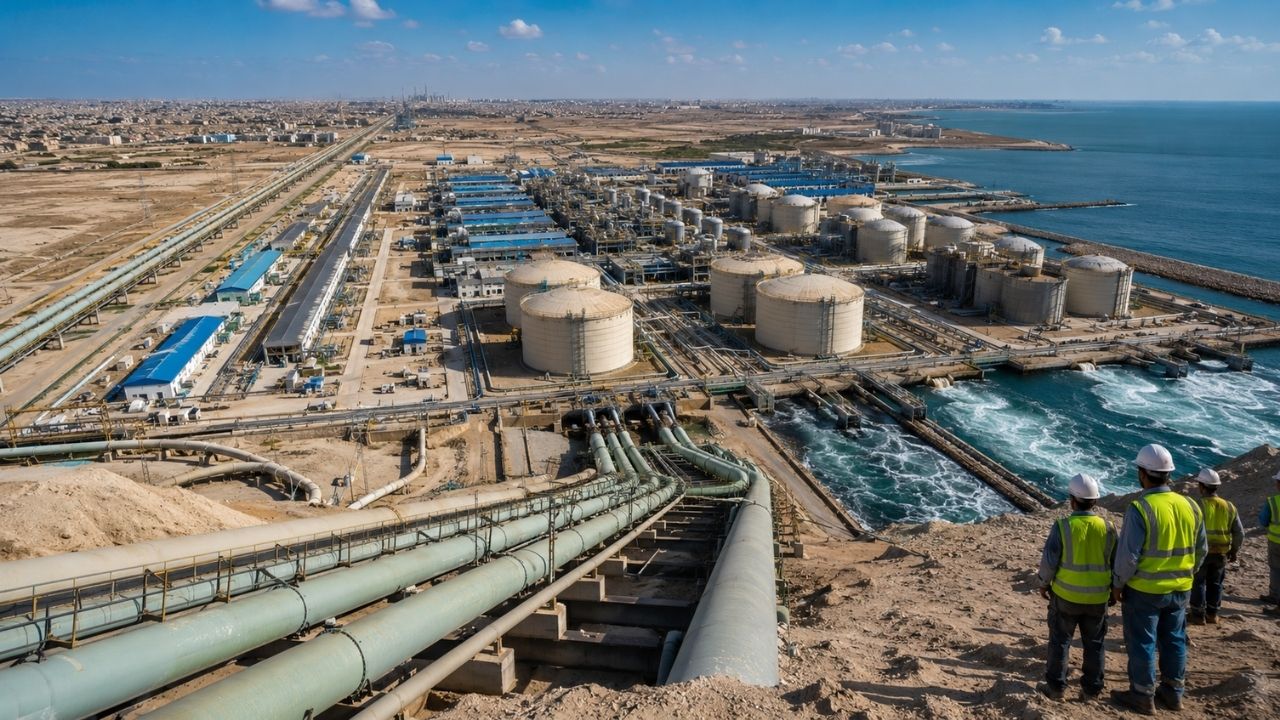

With desalination planned near Al-Faw, Iraq considers using the Iraqi-Chinese Fund to finance a plant in Basra. Project plans 1.1 million m³ of water per day, 12 tanks, nine stations, 240 km of pipelines, and service to more than four million people in affected southern Iraq.
Desalination has become the focus of a megaproject in Iraq, where authorities are considering financing a large seawater plant in Basra with support linked to the Iraq-China Framework Agreement. The proposal involves the local government, Iraqi and Chinese companies, with execution planned near Al-Faw, in the south of the country.
According to the Smart Water Magazine, the works were officially initiated in July 2025 by Prime Minister Mohammed Shia Al-Sudani, while new financing and contract details advanced between 2025 and 2026. The project aims for a production of about 1.1 million m³ of water per day to tackle the water scarcity affecting the province of Basra.
Basra seeks solution for water supply crisis in southern Iraq

The province of Basra faces longstanding problems accessing drinking water, exacerbated by reduced rainfall and the decline in the flow of the Tigris and Euphrates rivers. In this scenario, desalination emerges as an alternative to transform seawater into large-scale urban supply.
-
Entrepreneur Turns Neighbor’s Coffee Grounds Waste into Eco-Friendly Pellets, Earning Up to $40,000 Monthly in Brazil

-
In China, Six-Armed Humanoid Robot Revolutionizes Washing Machine Factory, Boosting Efficiency by 30%

-
Engineers Uncover Rain’s Role in Airflow Mystery at Brazilian Underground Facility

-
Brazilian Engineers Lead $200 Million Project to Bring Water from São Francisco River to Transform Supply in Northeastern Cities


The plant is planned near the Grand Port of Al-Faw, a strategic region for infrastructure in southern Iraq. The central promise is to serve more than four million people in Basra, but the real reach will depend on the completion of the works, the operation of the structures, and integration with the distribution network.
Financing may go through Iraqi-Chinese fund
The governor of Basra, Asaad Al-Eidani, stated that the project will not proceed through the previously discussed Japanese loan agreement. The alternative under consideration involves provincial allocations of petrodollars, meaning portions of federal oil revenues directed to producing regions.
The proposal also plans to channel financing through the Iraqi-Chinese Fund over four years. This places China in an important position in the financial and operational design of the project, as the execution involves Power China International alongside Iraq’s Al-Ridha Group.
Plant described as one of the largest of its kind
Al-Eidani described the initiative as the world’s largest desalination project. The information should be treated as a statement from a local authority, as the data is associated with the project announcement and the planned capacity for the facility.
The planned structure would have a capacity of approximately 1.1 million cubic meters of water per day. To reach this volume, the complex will have three reverse osmosis treatment lines, each estimated at about 335,000 m³ daily. The scale shows that the goal is not a one-time solution, but a supply system for the entire province.
Tanks, stations, and 240 km of pipelines form the system’s base
In addition to the plant, the project includes extensive infrastructure for storage and distribution. There are plans for 12 tanks with a total capacity of one million cubic meters, a main pumping station, and nine distribution stations spread across Basra.
The network is also expected to include 240 km of pipelines to carry treated water to consumption points. Without this transport network, desalination would be limited to production, which is why the pipelines and stations are a decisive part of the supply plan.
Project will have its own 300 MW power plant


Another relevant point is the provision for a dedicated 300 MW power plant to supply the facilities. This detail is important because desalination plants require a large amount of energy, especially when using processes like reverse osmosis on a large scale.
During construction, temporary desalination units are also planned to provide drinking water to residents. This stage acts as a transitional measure while the main complex and distribution network are not yet fully operational.
Billion-dollar contract involves Iraqi and Chinese consortium
The implementation is in the hands of a consortium formed by the Al-Ridha Group from Iraq and Power China International from China. In January 2026, the Power Construction Corporation of China announced an EPC contract for engineering, procurement, and construction with Basra authorities.
The reported value was 17.193 billion yuan, about US$ 2.4 billion. The schedule includes six months of mobilization, 1,350 days of construction, and 24 months of warranty. ILF Consulting Engineers also appears in the project with development, engineering, and construction supervision services.
The megaproject of desalination in Basra shows how water, energy, oil, and infrastructure have come to intersect in one of the regions most pressured by water scarcity in Iraq. The planned capacity, tanks, stations, and 240 km of pipelines indicate an attempt to solve the problem on a provincial scale.
At the same time, the project still depends on financing, prolonged execution, energy operation, and maintenance to deliver what it promises. Do you believe that desalination megaprojects are the best solution for regions with chronic water shortages, or do the energy and financial costs still weigh too heavily? Leave your opinion in the comments.