Portuguese
  Spanish


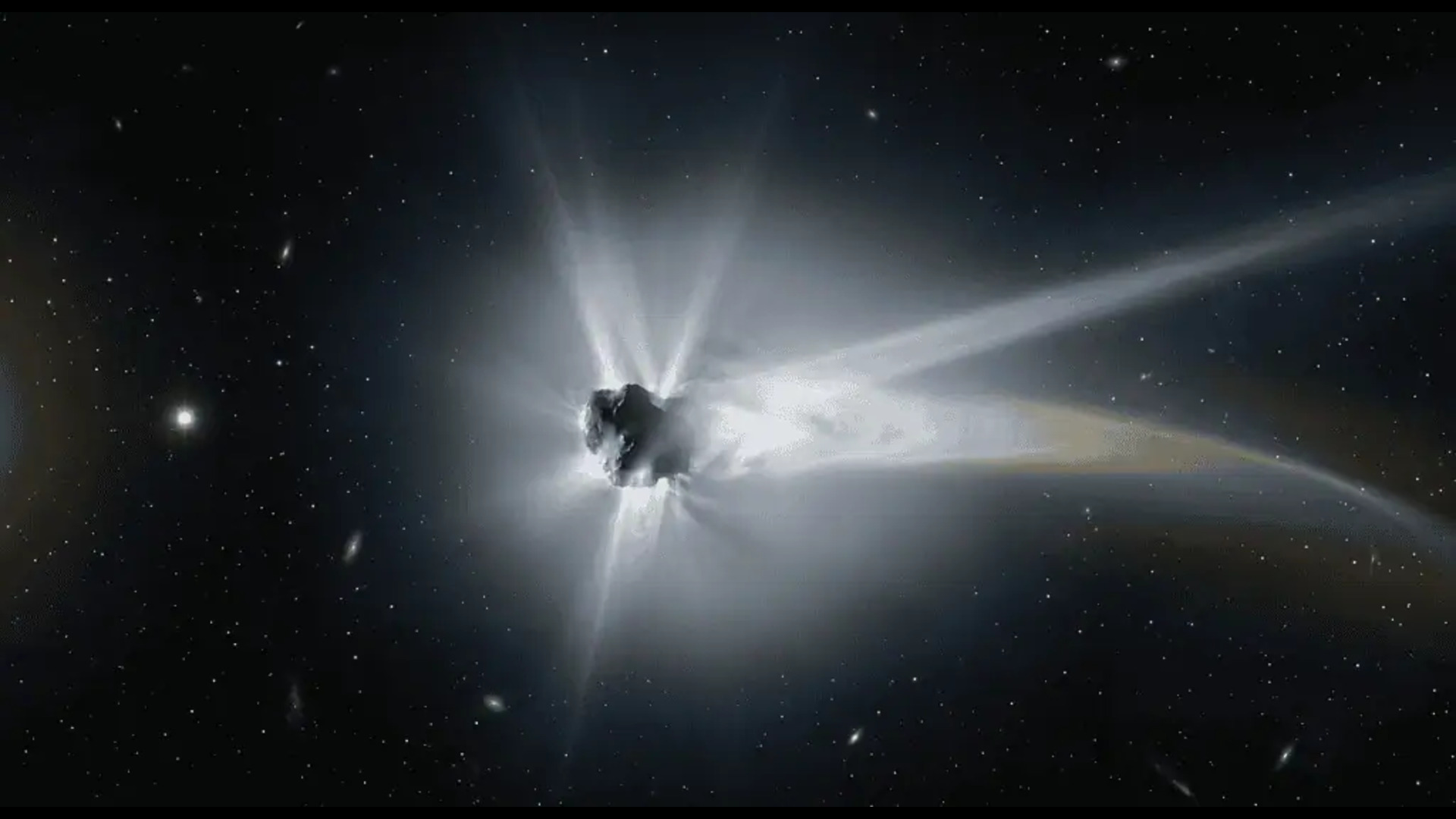


The analysis of telescopic observations indicates that the new interstellar object has a composition rich in ice, releasing tons of vapor as it approaches the Sun.
A new astronomical survey revealed that the interstellar comet 3I/ATLAS is releasing unprecedented amounts of water during its passage through our solar system.
The object, which originated outside the domains of the Sun, has been identified as the third confirmed interstellar visitor by the scientific community. Unlike its predecessors, this celestial body exhibits a much more intense release of volatiles, transforming the understanding of the composition of materials beyond our stellar neighborhood.
Emission Records and Chemical Composition
Observations conducted by international teams of astronomers show that the interstellar comet 3I/ATLAS expels approximately 50 liters of water per second. This emission rate is significantly higher than that observed in the first interstellar object, ‘Oumuamua, which exhibited almost no visible cometary activity.
-
New Study Finds Brief Stress Episodes Can Alter Blood and Increase Risk of Clot Formation

-
Ukraine Escalates War Efforts with Plan to Deploy 25,000 Ground Drones, Test Phantom MK-1 Humanoid Robot, Use Armed Mini-Tanks, and Expand Automated Attacks up to 15 km from Frontline

-
New Superfiber Developed by Imperial College Researchers and Approved by the EU Promises to Increase Satiety and Help Prevent Weight Gain
-
Harvard Researchers Develop Biological Clock to Estimate Life Expectancy, Potentially Transforming Human Aging Studies


The volume of ice detected suggests that the object formed in a water-rich region of its system of origin, resembling the long-period comets of our own solar system.
The massive presence of water vapor around the nucleus of the interstellar comet 3I/ATLAS allowed scientists to use spectroscopy to identify other chemical compounds. In addition to water, traces of carbon monoxide and other organic molecules fundamental to the understanding of interstellar chemistry were detected. These data indicate that the conditions for the formation of icy celestial bodies may be universal, occurring similarly in different parts of the galaxy.
Orbital Dynamics and Advanced Detection
The interstellar comet 3I/ATLAS was originally detected by the ATLAS terrestrial impact alert system, which monitors near-Earth objects. Its extreme hyperbolic trajectory quickly confirmed that it is not gravitationally bound to the Sun and is merely passing through our system. Currently, the object is moving at a speed that will eventually take it back to deep space, after passing around our central star in a high-inclination orbit.
The discovery was made possible thanks to the enhancement of space monitoring techniques and collaboration between ground-based and space observatories.
Astronomers emphasize that the interstellar comet 3I/ATLAS offers a rare opportunity to study “samples” from other solar systems without the need for long-distance space missions. Each new observation helps refine models of how these objects are ejected from their natal systems and how they survive journeys of millions of years.
Implications for Interstellar Astronomy
The intense activity of the interstellar comet 3I/ATLAS challenges some previous theories about the resilience of ice during prolonged journeys through the vacuum.
The fact that it still contains so much water suggests that the comet’s nucleus is large enough to protect its internal resources from cosmic radiation. Scientists plan to continue monitoring until the object moves too far away to be captured by current telescopes, seeking to identify whether it will fragment due to solar heat.
The study of this third visitor confirms that interstellar space is filled with small celestial bodies that regularly cross solar systems. With the operation of new high-sensitivity observatories, it is expected that objects like the interstellar comet 3I/ATLAS will be found more frequently.
The final analysis of the collected data will serve as a basis for future comparisons between the water found on Earth and the water carried by these messengers from distant stars.
With information from Zme Science