Portuguese
  Spanish


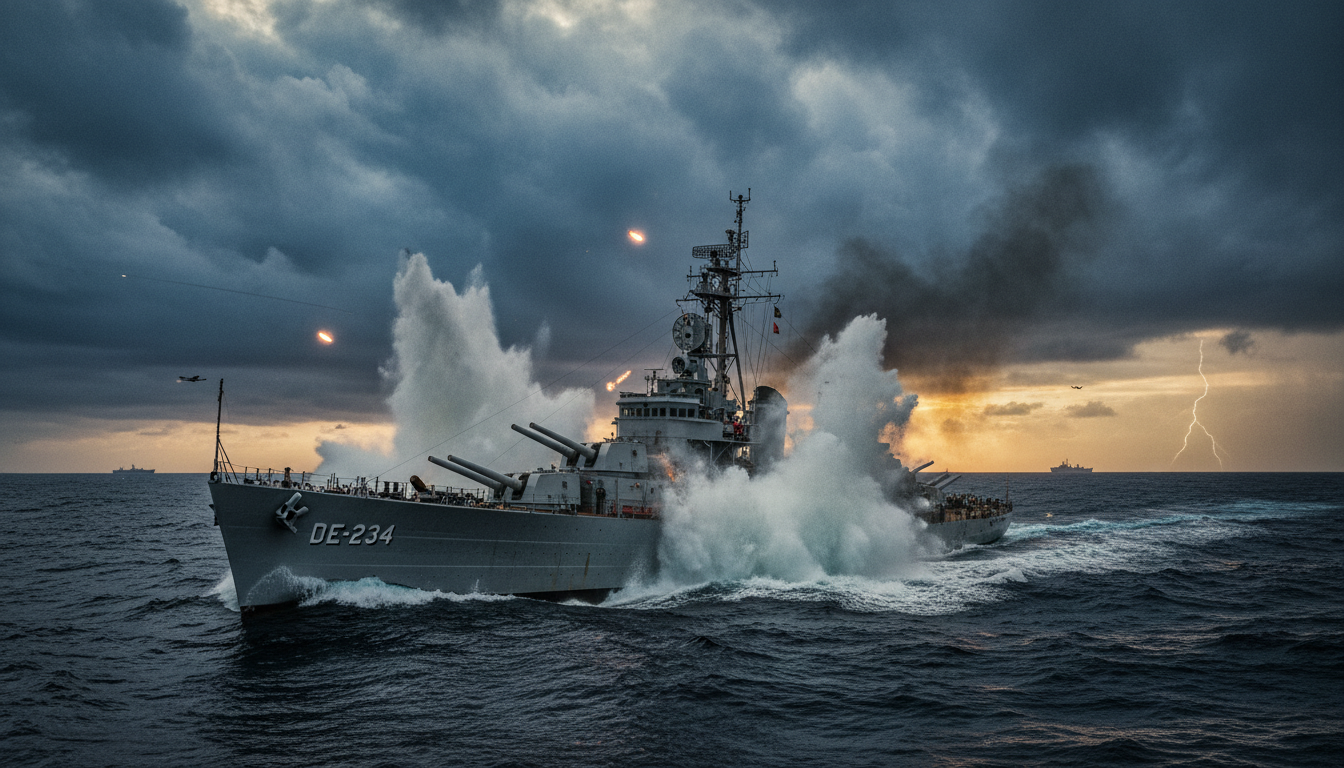


At 6,890 meters deep in the Pacific, explorer Victor Vescovo found the almost intact remains of an American warship that faced Japanese battleships in World War II — the USS Samuel B. Roberts is the deepest shipwreck ever documented, more than 2 km below the Titanic
At 6,890 meters deep in the Pacific Ocean, near the Philippines, the deepest shipwreck ever documented by a manned submersible was found. The USS Samuel B. Roberts (DE-413), a United States Navy escort destroyer, sank on October 25, 1944 during the Battle of Samar — and earned the nickname “the destroyer that fought like a battleship”.
The ship is more than 2 km deeper than the Titanic (which rests at ~3,800 meters in the Atlantic) and was found in June 2022 by Victor Vescovo, ocean explorer and former U.S. Navy officer, with his team from Caladan Oceanic.
The discovery was confirmed by the United States Navy as “one of the deepest shipwrecks ever found and documented”, in tribute to the sailors who fought against extreme numerical disadvantage, according to a report from G1.
-
Canadian Woman Who Donated Savings to Haiti Earthquake Victims at Age 5 Wins $48 Million in Lottery 13 Years Later

-
118-Year-Old Brazilian Man, Living in a Care Home for 55 Years, May Become World’s Oldest Man Pending Guinness Validation
-
Ferrari, BMW, Tesla, and Chinese Automakers Shift from Copper to Aluminum Wiring to Reduce Weight and Costs in Electric Vehicles

-
Understanding Plastic Codes: Numbers 1 to 7 on Packaging Aid Efficient Recycling and Boost Circular Economy



The Battle of Samar: when a small ship faced giants
The Battle of Samar, part of the Battle of Leyte Gulf (the largest naval confrontation of World War II), placed the Samuel B. Roberts against a Japanese force with much larger ships — including the heavy cruiser Chikuma and the battleship Kongō.
Despite being an escort destroyer (John C. Butler class), the “Sammy B” fired almost all its ammunition, damaging the Chikuma. The Kongō struck the ship fatally, splitting it in half. Of the 224 crew members, 89 died in combat. Another 25 perished from injuries, shark attacks, or ingestion of seawater.
The 120 survivors spent about 50 hours in the water before rescue. The last survivor died on March 20, 2022 — just three months before the discovery of the wreck.

6,890 meters: deeper than the Titanic
- USS Samuel B. Roberts: 6,890 m (Pacific, Philippines, 2022)
- USS Johnston: 6,470 m (same team, March 2021)
- Titanic: ~3,800 m (North Atlantic, 1985)
- Difference Samuel B. → Titanic: +2,800 meters (~2 Burj Khalifas stacked)
The Samuel B. Roberts rests in an area where only 2% of the ocean floors reach. Deep tectonic trenches like this exert pressure hundreds of times greater than the surface. Despite this, Vescovo found the ship almost intact, with the bow crumpled from the impact of the fall.

The expedition of Victor Vescovo
The team from Caladan Oceanic, in partnership with Deep Ocean Search and EYOS Expeditions, conducted six dives between June 17 and 24, 2022 to document the wreck. The same team had discovered the USS Johnston at 6,470 meters in March 2021.
The images reveal the hull with combat marks preserved by the darkness and extreme pressure of the deep. The discovery is private and focuses on historical documentation — laws of war prohibit the recovery of artifacts from sunken military ships.
The find honors the memory of the veterans who fought in extreme disadvantage during World War II. Just like the discovery of the wreck, the record of the bravery of the “Sammy B” continues to inspire generations of sailors. For complete details, see Divernet.