Portuguese
  Spanish


In the hinterlands of Paraíba, Giorggio Abrantes transformed discarded PET bottles into brooms, ropes, and recycling machines, in a story that mixes income, reuse, and popular innovation.
In the high hinterlands of Paraíba, the street cleaner Giorggio Abrantes turned PET bottles found on the streets into raw material for brooms, clothesline ropes, and a simple recycling machine sold to others.
A resident of Aparecida, he became known as the “ecological street cleaner” and started earning about R$ 7,500 per month with the equipment, according to a report by G1.
The story gained attention for combining recycling, income generation, and an invention created outside laboratories or large industrial centers.
-
In a city where every piece of land is worth gold, he began buying plots in the 1960s and built a real estate empire with over a thousand properties.

-
An artist sank over 500 life-sized human statues at the bottom of the Caribbean Sea, and what seemed like macabre art turned into a living reef covered with corals that attracts divers from all over the world.

-
A fossil kept for years in a small museum in Montreal concealed 450-million-year-old soft tissue, a discovery that has only happened once before in history.

-
Engineers spend a decade building a $2.3 million bridge, but the project features a surreal curve, becomes a joke, and ends with seven suspended.


Giorggio started by reusing discarded bottles he saw during his urban cleaning work and later learned to make his own machines to help people who asked on social media how they could do the same.
The case also connects to the recycling scenario in Brazil.
In 2025, data released by the Brazilian Association of the PET Industry indicated that the country recycled 410 thousand tons of post-consumer PET packaging in 2024, a volume 14% higher than recorded in the previous survey.
Even so, part of the packaging depends on collection, sorting, and local initiatives to return to the production chain.
In this context, the machine created by Giorggio began to circulate as an example of small-scale reuse.
The equipment cuts bottles into threads, transforms the plastic into reusable material, and allows the manufacture of simple products, such as brooms, clotheslines, bags, and hats.
According to the street cleaner himself, the idea was born out of the need to generate income and make use of a waste that appeared every day in his path.
Ecological street cleaner in the hinterlands of Paraíba
Giorggio Abrantes lives in Aparecida, a municipality in the Paraíba hinterlands.
Before becoming known on social media, he worked sweeping streets and collecting waste discarded throughout the city.
It was in this daily contact with urban waste that he began to observe the amount of PET bottles thrown away.
The perception appeared in a speech reproduced by g1/PEGN, in which he explained that he found many bottles during his shift and decided to use them to manufacture a sustainable product.
“I work sweeping the street and find many bottles daily. So, I decided to take advantage of the bottles I found and manufacture a good, sustainable product,” he stated.
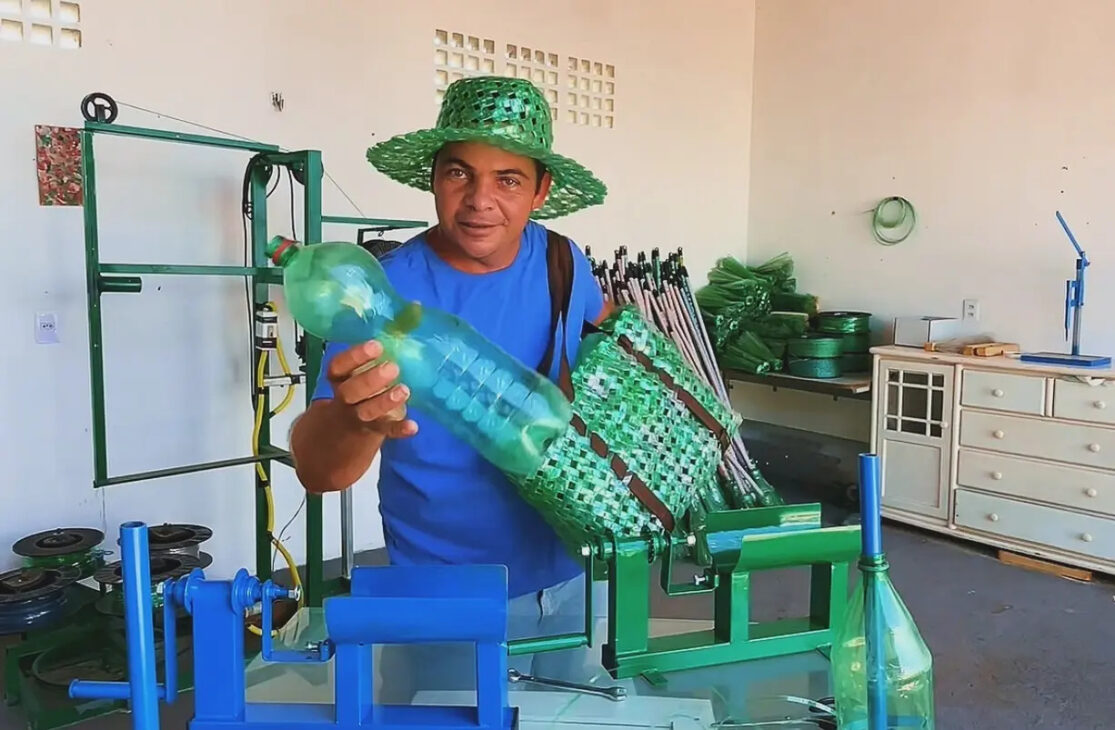
The first activity related to reuse was the production of brooms.
Over time, the process expanded to other items, such as clothesline ropes made with threads taken from the bottles.
The personal journey also appears in reports about the case.
Giorggio shared in interviews that he came into contact with the production of PET brooms during a stay in a rehabilitation clinic to treat alcoholism.
From the clinic to the recycling workshop
Reports published by UOL Ecoa and Terra record that Giorggio learned to produce brooms with PET bottles during the rehabilitation period.
After the treatment, he began to use this knowledge to supplement his income and reorganize the family routine.
According to a report to Terra, one of the tasks performed at the clinic involved the manufacture of brooms with reused bottles.
It was in this environment that he first came into contact with the process of transforming plastic into threads and shaping it into a domestic product.
Upon returning home, Giorggio continued as a certified street cleaner and began producing brooms.
The manual work became content for the internet, where he started publishing tutorials showing how to cut bottles, assemble equipment, and transform the material into objects.
The exposure on social networks expanded the reach of the initiative.
People began asking where they could buy the machines used in the process, and Giorggio decided to learn welding to manufacture the equipment.
“With so many comments, people asking where I got those machines, how they could buy them, I decided to learn to weld so I could make the machines and sell them to the customers who commented on my videos,” he reported to g1/PEGN.
How the PET Bottle Machine Works
The machine created by Giorggio is used to cut PET bottles into thin strips.
These threads can be used in the production of ecological brooms, clotheslines, and handcrafted items.
In the production of brooms, the bottles are transformed into filaments, wrapped in molds, and heated to take shape.
According to a report by Terra, Giorggio uses about 14 2-liter PET bottles and one 1-liter bottle to create a broom.


The equipment sold by him was priced at R$ 354 in the g1/PEGN report.
Meanwhile, the ecological brooms and clotheslines were sold for prices between R$ 10 and R$ 35, helping to supplement income.
The invention does not rely on complex industrial technology, but on mechanical adaptation, welding, and process repetition.
This characteristic helps explain why the product started to interest people looking to recycle PET on a small scale or generate income with handcrafted production.
In addition to brooms and clotheslines, Giorggio stated that artisans started using PET bottle threads to produce bags and even hats.
He also said he has already sent machines to countries like Italy and Mozambique.
Social Networks Expanded the Reach
The internet played a central role in the expansion of the project.
Giorggio started publishing videos teaching recycling techniques and attracted followers interested in reproducing the process.
In 2021, a UOL Ecoa report recorded that he had more than 125,000 subscribers on YouTube and 100,000 followers on TikTok.
In 2024, Terra reported that the channel had already surpassed 1 million subscribers and accumulated hundreds of millions of views in more than 500 videos.
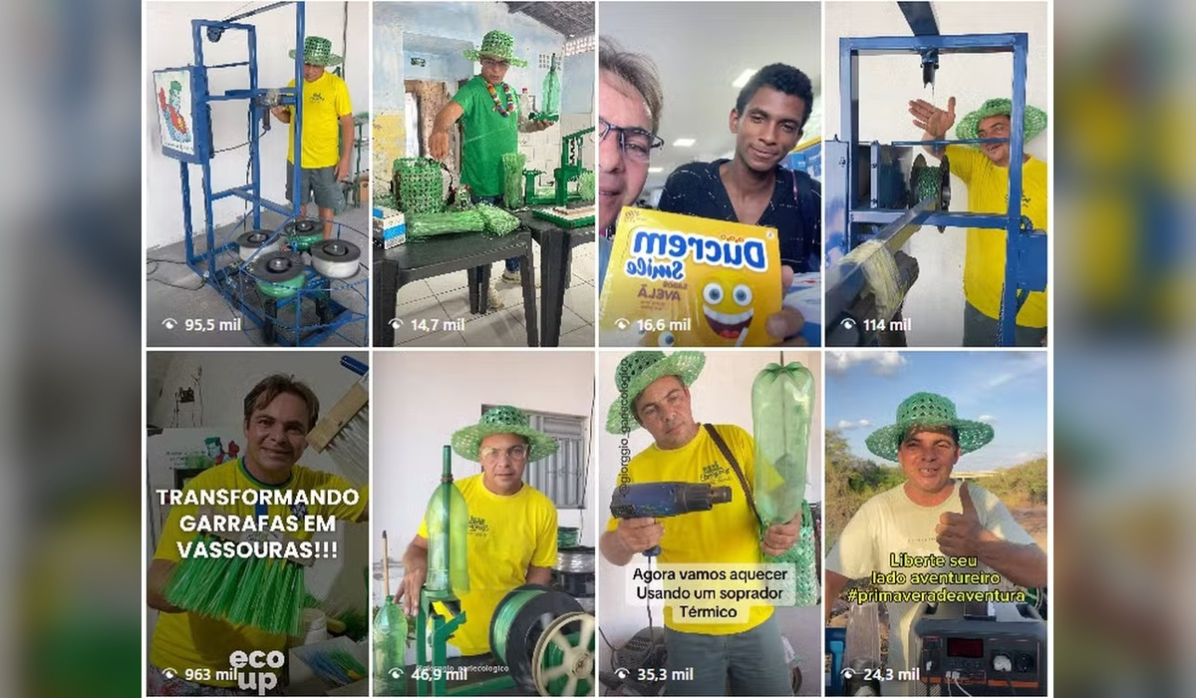
According to Terra, Giorggio also started offering online courses, publishing free tutorials, and selling equipment outside Brazil.
The content on social media became a showcase for work and a teaching tool for people interested in reusing bottles.
The initial growth also included a virtual fundraiser.
According to reports, Giorggio raised about R$ 14,000 to R$ 15,000 through donations, an amount used to buy tools, improve videos, and structure the workshop.
Income from brooms and recycling machines
In the g1/PEGN report, Giorggio was presented as an entrepreneur earning about R$ 7,500 per month from selling the PET bottle recycling machine.
The amount referred to the time of publication and should be treated as data from that report, not as confirmed current earnings.
The income also came from the production of brooms and clothesline ropes.
These items served as a second front of the business, while the machine allowed other people to buy the equipment to produce on their own.
The initial investment was R$ 14,000, raised through online fundraising and donations.
With this resource, Giorggio bought equipment, set up a work structure, and began producing more regularly.
The sale of the machines changed the business dynamics.
Instead of relying solely on selling ready-made brooms, he started selling the tool that allows other people to turn bottles into threads.
“Look, there’s a saying that ‘necessity is the mother of invention’ and all these machines that I made, everything that was developed, was really in search of money to be able to support the difficulties of daily life,” said Giorggio.