






 Portuguese
  Spanish


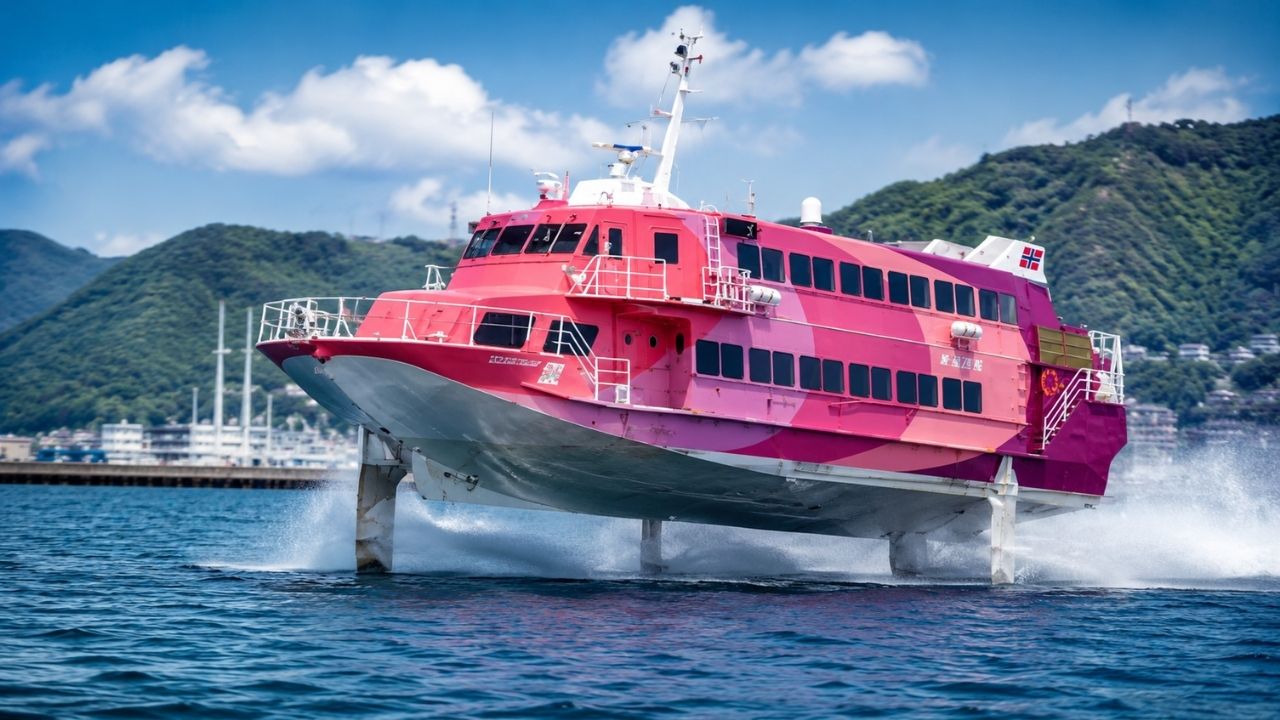


The ship known as Jetfoil lifts the hull with underwater wings, uses a gas turbine engine, and reaches high speed on Japanese coastal routes, shortening trips to islands like Sado and offering passengers noise, seat belts, and a sensation similar to that of an airplane over the Japanese sea.
The Japanese ship that seems to “fly” over the sea draws attention for operating differently from common boats. Instead of just cutting through the waves with the entire hull, the Jetfoil uses underwater wings to lift part of the vessel during high-speed navigation.
With information from the channel Kamisuke’s Journey to Japan, the technology creates a curious sensation for travelers: the sound resembles that of an aircraft, passengers use seat belts, and the hull seems to glide above the water. In Japan, this type of vessel connects coastal regions and islands, reducing trips that would be longer on conventional ferries.
Jetfoil lifts the hull with underwater wings

The Jetfoil is a type of passenger ship with hydrofoils, that is, wings installed below the waterline. When the vessel gains speed, these wings generate lift and help elevate the hull, reducing direct contact with the waves.
-
China Develops Custom 140-Ton Electric Mining Truck with 770 kWh Swappable Battery, Deploys 290 Units in Xinjiang’s Largest Zinc Mine

-
Meta to Launch Arena, a New Prediction App Targeting 3.56 Billion Users, Competing with Polymarket and Kalshi

-
Scientist Challenges Famous Human Evolution Theory, Argues Homo Sapiens Evolved Gradually Over Thousands of Years
-
15-Year-Old American Builds Ocean Generator with PVC Pipe and 3D-Printed Propeller for $12, Wins National Prize, Presents at White House, and Makes Forbes 30 Under 30 List




This is where the impression that the ship is flying over the sea comes from. In practice, it does not fly like an airplane, but moves supported by the lift produced by the underwater wings, making navigation faster and smoother.
This operation also explains why the visual is so different. At low speed, the Jetfoil behaves like a common vessel. Then, when it accelerates, it goes through a kind of “takeoff mode” until it reaches the so-called “wing mode.”
At this stage, the hull is higher in relation to the surface, and the vessel faces less water resistance. The result is a trip with less wave impact and higher speed compared to conventional passenger boats.
Turbine engine gives airplane sound to the ship

Another detail that draws attention is the engine. The Jetfoil uses a gas turbine engine, a technology associated with the idea of more intense propulsion and the loud sound that many passengers compare to that of an aircraft.
The experience starts to feel different even before the ship leaves the dock. The engine noise, internal warnings, seatbelt use, and acceleration reinforce the sensation of boarding something closer to an airplane than a traditional boat.
According to the model description, the Jetfoil was originally manufactured by Boeing, a company known for aviation. Later, the license was transferred to Kawasaki Heavy Industries, which produces the Kawasaki Jetfoil 929.
This origin helps explain the mix of languages: it is a ship, but with solutions that resemble the aeronautical universe. It does not replace airplanes or ferries on all routes, but it occupies a very specific niche between speed, maritime transport, and travel experience.
High speed reduces trips to Japanese islands

The main advantage of the Jetfoil is in travel time. On the route between Niigata and Sado Island, for example, the ferry trip can take about 2 hours and 30 minutes, while the Jetfoil makes the journey in approximately 1 hour.
This difference makes the ship important for both residents and tourists. In island regions, reducing crossing time means facilitating visits, routine commutes, and access to services.
The maximum reported speed reaches 80 km/h, although rough sea conditions may limit performance during the trip. Even so, the model maintains a clear proposal: to shorten maritime distances without relying on airports.
In Japan, the Jetfoil can be seen on specific routes, including areas like Tokyo, Niigata, Hakata, Nagasaki, and Kagoshima. It is not a common vessel in any port, which increases curiosity around the model.
Passengers travel as if they were on an aircraft

Inside, the experience also distances itself from the traditional image of a boat. Passengers travel seated, with crew guidance and use of seat belts during certain parts of the operation.
The reason lies in the vessel’s behavior. The Jetfoil can make sharp turns, quick stops, and transitions between navigation modes. Therefore, the seat belt functions as part of the safety during a high-speed journey over the sea.
The cited capacity for the model is 241 passengers, distributed in a two-story structure. The proposal is to transport a significant volume of people quickly, maintaining regular operation between ports.
Even in rough seas, the underwater wing system helps reduce part of the rocking sensation. This reinforces the Jetfoil’s reputation as a ship less prone to causing seasickness compared to vessels that face the waves with the entire hull.
Technology combines transportation, tourism, and local routine


The Jetfoil is not just a technological curiosity. On routes to islands, it functions as a relevant means of transportation for residents, visitors, and activities related to regional tourism.
Sado Island, for example, emerges as an important destination. With the shortened journey, access becomes more practical for those leaving Niigata and wanting to reach the island without facing the longer time of a common ferry.
This type of ship shows how engineering can change the relationship between coastal cities and islands. When the crossing becomes faster, the displacement ceases to be such a big barrier for tourism, work, and daily life.
At the same time, the Jetfoil requires adequate infrastructure, specialized operation, and careful maintenance. The speed and underwater wing system make the vessel efficient, but also more complex than a simple boat.
A ship that turns the crossing into a spectacle
The Japanese ship that seems to fly over the sea impresses because it combines three elements that are hard to ignore: speed, technology, and the sensation of flying. The hull rises, the turbine engine roars, and the water ceases to be just resistance to become a displacement track.
Even though it remains a vessel, the Jetfoil delivers a different experience for passengers. It shows that a sea crossing can be more than a connection between two points: it can become part of the attraction.
The future of this type of ship depends on cost, maintenance, viable routes, and passenger demand. But, while it continues to operate in Japan, it keeps attracting attention by making the sea seem less of an obstacle and more of a high-speed corridor.
Would you have the courage to travel on a ship that lifts its hull over the sea and looks like a plane on the water, or do you prefer the more traditional stability of a common ferry? Leave your opinion in the comments.






Meanwhile in Scotland,🤣🤣🤣🤣
Not exactly new technology, a hydrofoil used to travel from Southampton to Cowes on the isle of Wight in the 80s.