






 Portuguese
  Spanish


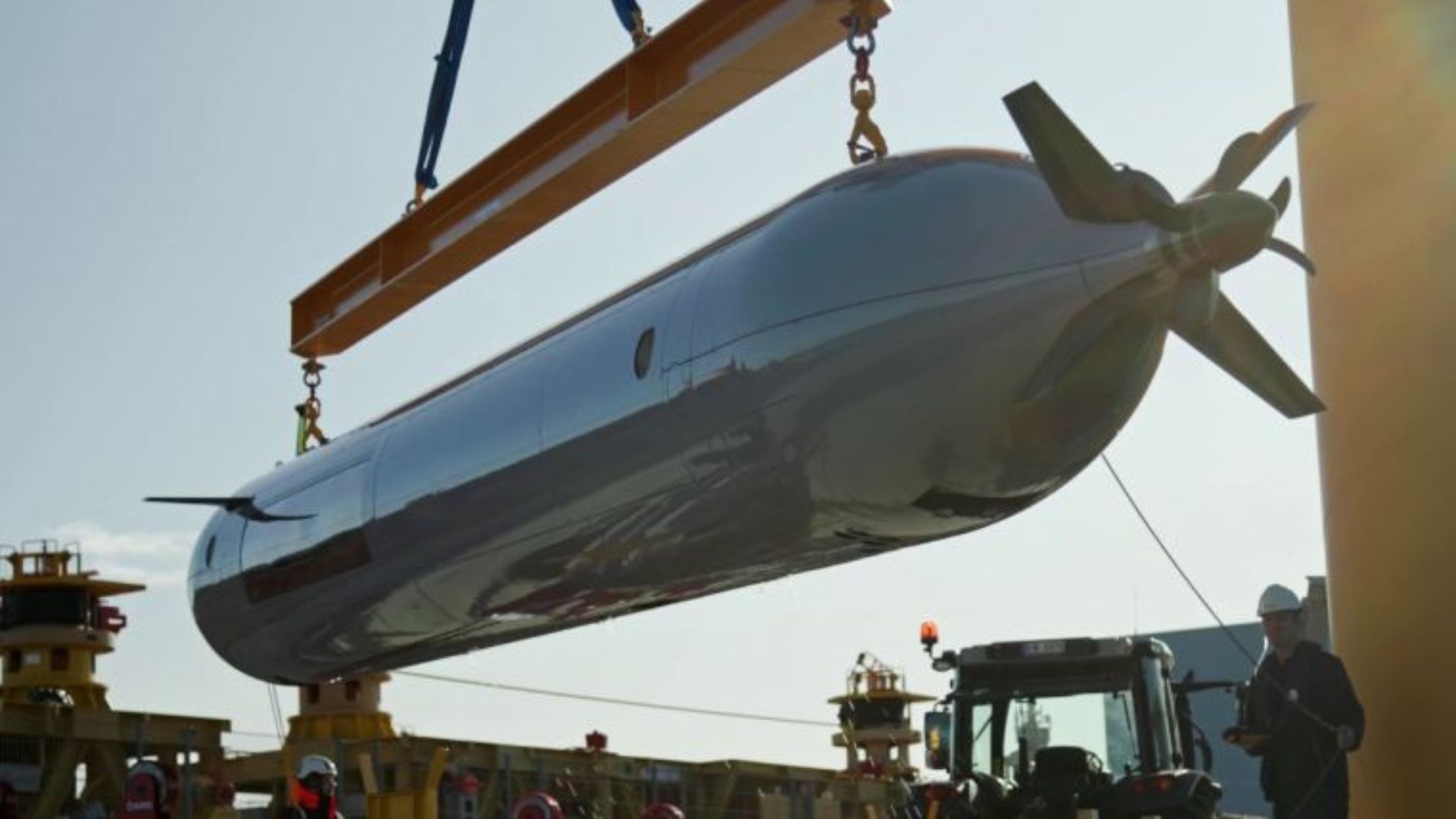


HUGIN Endurance is an autonomous submarine drone capable of operating at 6,000 meters depth for up to 15 days without direct human support.
At a time when submarine cables, pipelines, energy infrastructure, and strategic maritime routes have gained increasing importance in the global geopolitical dispute, naval technology companies have begun to develop systems capable of operating for entire weeks on the ocean floor without direct human presence. Among the most advanced projects is the HUGIN Endurance, an autonomous submarine drone created by the Norwegian company Kongsberg Discovery, a division of the KONGSBERG group, specialized in defense, maritime sensors, and submarine systems.
The vehicle was designed to dive up to 6,000 meters deep, operate for up to 15 days without a crew, and cover approximately 2,200 kilometers in a single mission.
The project began to gain international attention after maritime tests conducted in 2023 and 2024, when the company confirmed that the system had achieved a level of autonomy considered unusual even for modern underwater vehicles.
-
Chinese Student Builds Humanoid Robot for $2,100 at Age 20, Now Leads Robotics Startup in China

-
Sumatran Rhino: The Rare “Prehistoric Survivor” with Fewer Than 50 Left and a Fascinating Natural History

-
Chinese Humanoid Robots Transition from Labs to Real Factories to Assemble Tablets: AgiBot Deploys G2 Machines at Longcheer, Aiming for 100 Robots in Electronics, Cars, Chips, and Energy by 2026

-
Shopkeeper Buys Notebook at English Bazaar, Discovers Rare 1915 WWI Record Listing 900 Volunteers, 140 Fallen



Unlike traditional submarines, the HUGIN Endurance has no space for crew, kitchen, dormitories, or human survival systems. The entire internal structure was dedicated to batteries, sensors, navigation systems, and modular payloads aimed at surveillance, underwater mapping, and critical infrastructure inspection.
HUGIN Endurance was created to operate alone in the deep ocean for up to 15 days without a support ship
The HUGIN Endurance belongs to the category known as AUVs, which stands for Autonomous Underwater Vehicle. Unlike drones remotely controlled by cables, AUVs execute missions almost independently after being programmed before the dive.
According to Kongsberg Discovery, the HUGIN Endurance was specifically developed for “shore-to-shore” missions, an expression used to describe operations initiated directly from the coast and executed without the continuous need for a support vessel accompanying the vehicle throughout the journey.


This represents an important change from traditional underwater operations. In many previous systems, underwater drones constantly relied on a mothership for monitoring, recharging, and communication. The HUGIN Endurance attempts to eliminate some of this dependency.
The company claims that the vehicle can remain on mission for up to 15 days thanks to the use of lithium-ion batteries resistant to the extreme pressure of ocean depths.
This autonomy has drastically expanded the system’s operational range. According to official specifications, the underwater drone can travel about 2,200 kilometers or 1,200 nautical miles before needing to return. The distance is approximately equivalent to the journey between New York and Cuba or between Venice and Alexandria, a comparison used by Kongsberg itself to illustrate the system’s range.
Underwater drone measures 11 meters, weighs about 8 tons, and dives deeper than many military submarines
The HUGIN Endurance is the largest member of Kongsberg’s HUGIN family of autonomous underwater vehicles. According to official company information and data released during sea trials, the system measures approximately 11 meters in length, has a diameter of 1.2 meters, and weighs about 8,000 kilograms.

Even though it is smaller than conventional military submarines, the drone impresses with its extreme diving capability. The system is designed to operate at depths of up to 6,000 meters.
This depth places the vehicle in an operational range superior to that of many traditional manned submarines used by various navies around the world. In deep ocean regions, the pressure can exceed 600 times the atmospheric pressure at sea level.
KONGSBERG’s autonomous underwater drone is extremely resilient
To withstand these conditions, the vehicle uses reinforced structure, protected electronic systems, and batteries specifically designed for high-pressure environments.
Another important detail is that the HUGIN Endurance was not created solely for scientific exploration. The company itself states that the system can perform geophysical, environmental, hydrographic, naval, maritime security, critical infrastructure inspection, and underwater search operations.
This means that the drone can be used for everything from surveys for offshore wind farms to monitoring submarine cables, energy pipelines, and strategic maritime areas.
HUGIN sensors can map large areas of the ocean floor in a single mission
A large part of the operational capacity of the HUGIN Endurance comes from the set of onboard sensors. Kongsberg reports that the vehicle uses high-resolution synthetic aperture sonars, multibeam echo sounders, sub-bottom profilers, color cameras, laser profilers, and environmental sensors.
According to the company, the combination of the HISAS 1032 Dual RX sonar and the EM 2040 MkII multibeam system allows mapping approximately 1,100 square kilometers of the seabed in a single mission.

In addition to submarine relief, the vehicle can also collect data on temperature, sound speed in water, methane concentration, CO2 and dissolved oxygen.
These features make the system useful for both scientific applications and monitoring strategic submarine infrastructure.
In recent years, submarine cables have received increasing attention after incidents involving damage to communication networks and pipelines on the seabed. Defense and maritime security experts have begun to treat the deep ocean as a critical area of global infrastructure.
Today, about 95% of international internet data traffic passes through submarine cables spread across the oceans, according to widely used estimates by international organizations and telecommunications companies. In this scenario, submarine drones capable of operating for long periods without human supervision have begun to gain strategic relevance.
System was created to reduce costs and decrease dependence on large support ships
Traditionally, complex submarine missions require large support vessels equipped with cranes, laboratories, communication systems, and specialized technical teams.
Kongsberg states that one of the main objectives of the HUGIN Endurance is precisely to reduce this operational dependence.

According to Martin Wien Fjell, president of Kongsberg Discovery, the extended autonomy allows support vessels to be freed for other activities while the drone continues operating alone on the ocean floor.
Besides cost reduction, the company argues that operations without the continuous presence of ships reduce carbon emissions and extend the operational window in difficult weather conditions.

Another relevant factor involves safety. Launch and recovery operations of underwater drones can be dangerous in rough seas. The greater the system’s autonomy, the less frequent these operations need to be.
According to maritime industry experts, the global trend points to the increasing use of autonomous systems in ocean monitoring, naval defense, offshore energy exploration, and environmental research.
Growth of underwater drones expands technological competition in the deep ocean
The HUGIN Endurance is part of a larger technological race involving long-duration autonomous underwater vehicles. The United States, United Kingdom, China, Australia, and several European countries have been increasing investments in systems capable of operating without a crew at great depths.
The new generation of these vehicles aims to combine artificial intelligence, advanced sensors, energy autonomy, and more sophisticated underwater communications to enhance surveillance and data collection capabilities in the deep ocean. Interest has especially increased following the growth of geopolitical competition over maritime routes, underwater minerals, offshore energy infrastructure, and the protection of ocean cables.
In the case of the HUGIN Endurance, Kongsberg states that the system can be adapted for different types of missions thanks to the internal modular space designated for sensors and customized payloads.

This means that different operators can configure the drone for specific tasks, from inspecting offshore wind farms to monitoring sensitive underwater areas. The company itself describes the vehicle as a “game changer,” a term used to indicate a significant change in the capabilities of autonomous underwater operations.
Even so, experts point out that such systems still face significant challenges related to deep communication, navigation in complex environments, and cybersecurity.
Do you believe that autonomous underwater drones like the HUGIN Endurance can transform ocean surveillance and the protection of underwater infrastructure in the coming decades?





Sadly this underwater drone, like all countries, will become obsolete before they have provided any meaningful use.
The race to the bottom (as such) is no match for smart integrated systems.