






 Portuguese
  Spanish


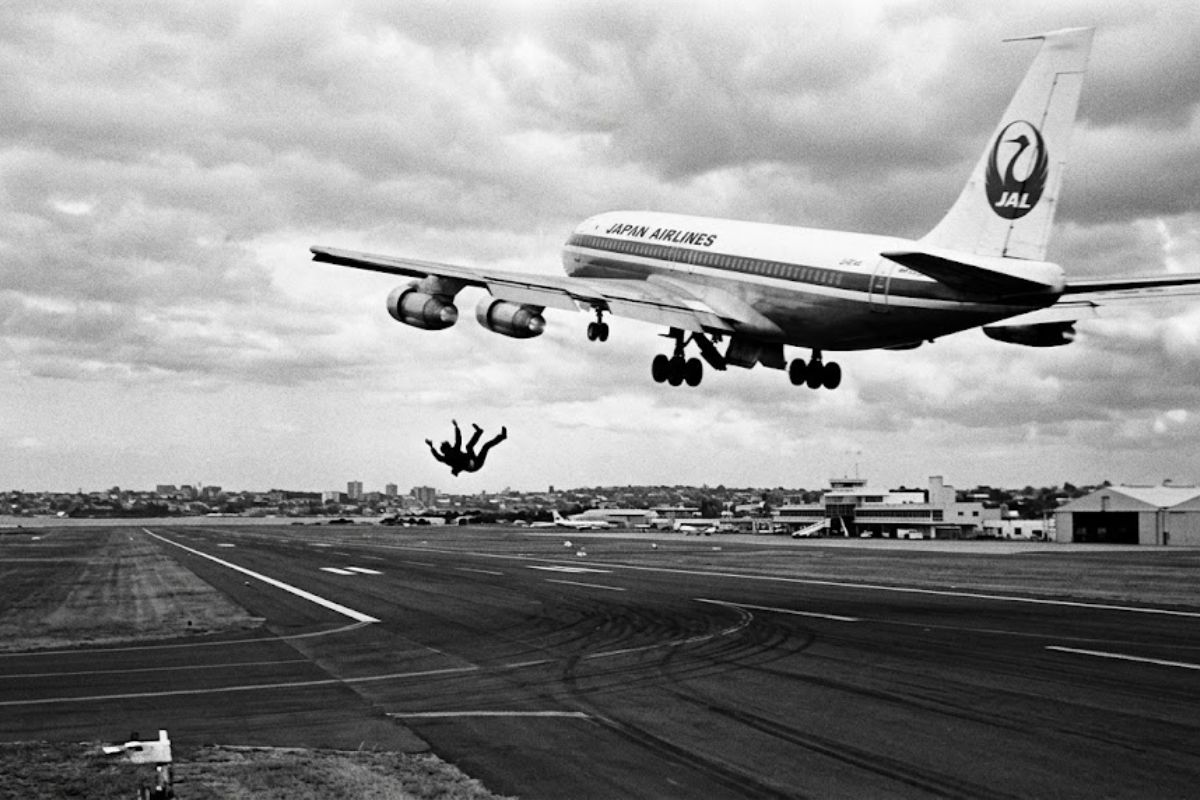

An amateur photographer named John Gilpin was testing a telephoto lens at the perimeter of Sydney Airport on February 22, 1970, when he unknowingly captured the exact moment when Keith Sapsford, a 14-year-old Australian boy, fell from the landing gear compartment of a Douglas DC-8 from Japan Airlines bound for Tokyo.
Gilpin only discovered what he had on the camera a week later when he developed the film at a regular lab. In the image, the silhouette of the boy appears suspended in the air between the plane and the ground, with arms and legs spread out. He had fallen from approximately 60 meters in height at the moment the pilot retracted the landing gear after takeoff. The compartment that served as a hiding place simply opened, and Keith had no way to hold on.
His father, Charles Sapsford, an engineer and university professor, summed it all up in a sentence that Australian newspapers reproduced for weeks: “All my son wanted was to see the world. That desire cost him his life.”
How a 14-year-old boy managed to enter the restricted area of an international airport

Keith had escaped from Boys’ Town, a Catholic boarding school in Engadine where his family placed him to try to curb his runaways.
-
Billionaire says the most valuable skill will help overcome job elimination caused by AI, following Bill Gates’ fears

-
A Dutchman created a ‘box’ that makes trees grow in the desert almost without water and without irrigation: the invention has already brought seedlings to dozens of countries and achieves up to 90% survival where common planting did not exceed 10%.

-
Abandoned warehouse hid a giant collection of rare computers, with over 2,000 artifacts from the 1930s to the 1980s.
-
Scientists warn that melting ice is triggering an alarming chemical transformation in preserved areas, and the first signs are already concerning researchers worldwide.




Before that, his parents took the boy on an international trip to satisfy his curiosity.
The effect was the opposite: seeing other countries only increased his restlessness, and the runaways became more frequent.
After escaping from the boarding school, Keith spent three days at Sydney Airport studying the routine of the tarmac, the shifts of the staff, the less busy times, and the gaps in the perimeter.
In 1970, airport security was focused on what was happening inside the plane, not around it.
Fences were low, surveillance was routine, and no one expected anyone to try to enter a landing gear compartment.
Keith found the gap and climbed onto the structure of a DC-8 that was preparing for takeoff to Tokyo.
Why surviving inside an airplane’s landing gear is practically impossible
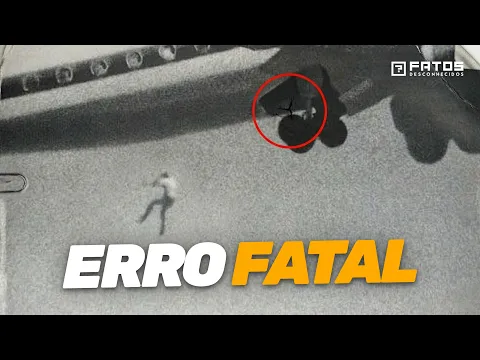

Even if Keith had not fallen during takeoff, survival was unfeasible. The landing gear compartment is neither pressurized nor heated.
At cruising altitude, the temperature can drop below minus 50 degrees, and oxygen becomes insufficient to maintain consciousness within minutes.
Moreover, the system itself is designed to collect heavy metal parts during flight, with no safe space for a person.
According to data from the FAA (Federal Aviation Administration of the United States), between 1947 and 2015, there were 113 documented attempts by stowaway passengers in landing gear compartments, all made by men, most of whom were under 30 years old.
The mortality rate is 76%. Of those who survived, many arrived unconscious, hypothermic, or with permanent damage.
In practice, anyone who enters there is betting against a 3 in 4 chance of dying.
What changed in airports around the world after this photo
The image of Gilpin became one of the most reproduced records in the history of Australian aviation and forced a revision of the concept of airport security.
Before the incident, attention was focused on passengers and luggage inside the terminal.
Afterward, airports began to consider that the risk also exists in the external perimeter, in the access areas to the tarmac, and in the aircraft compartments themselves.
The case of Keith was neither the first nor the last. Stowaway passengers in landing gear continue to happen today, many involving people fleeing wars and humanitarian crises who see that space as a desperate attempt at survival.
But it was the accidental photo taken by a photographer who didn’t even know what he had captured that transformed a restless teenager into an image impossible to ignore and forced aviation to look at a blind spot that seemed too unlikely to exist.
And you, did you know that the perimeter security of modern airports exists in part because of a photo accidentally taken in 1970? Comment below.





