






 Portuguese
  Spanish


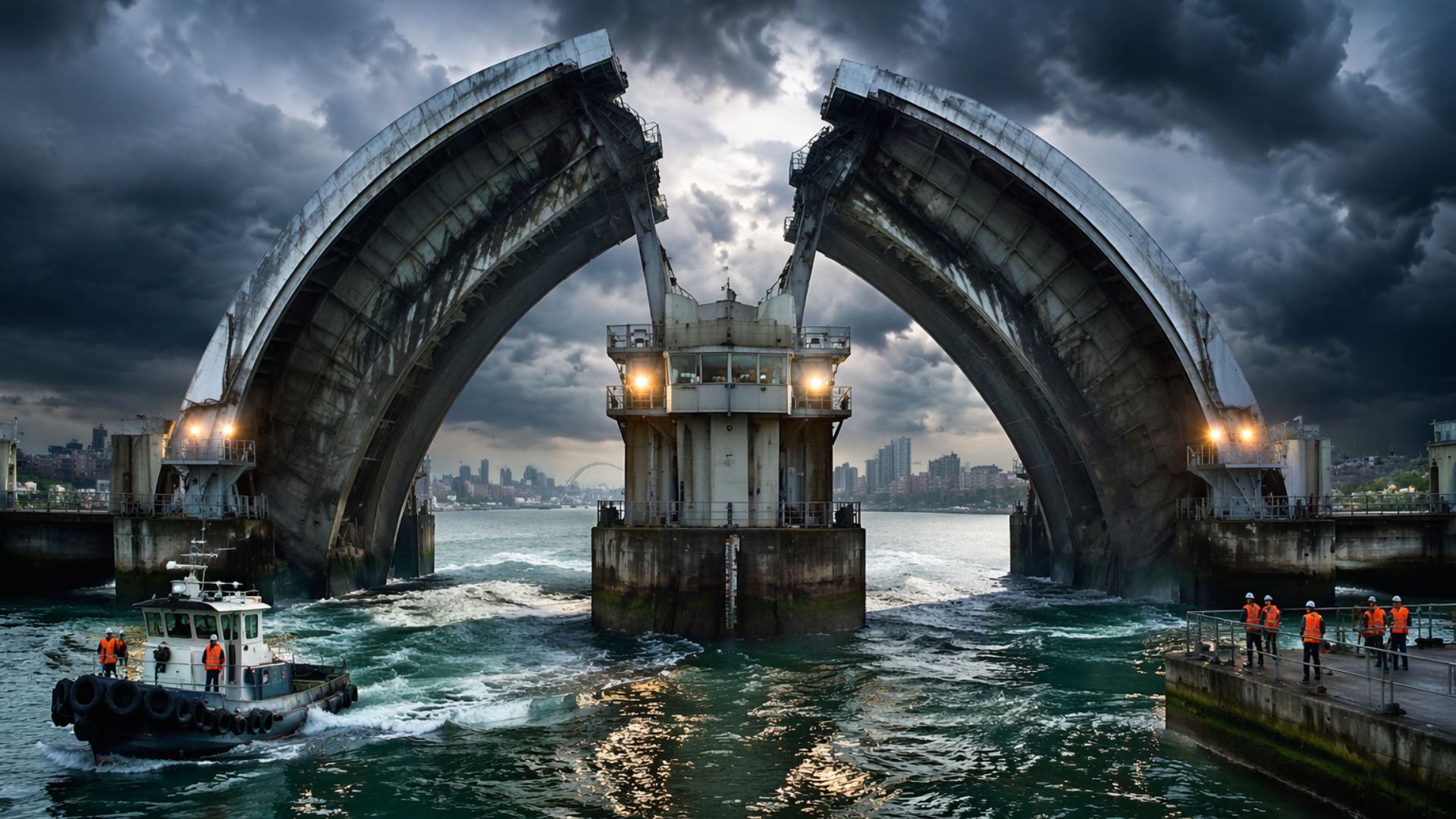

Monumental structures combine engineering, urban planning, and rapid response to natural disasters in one of the most vulnerable areas of Osaka, where rivers and the sea meet and require solutions capable of containing extreme tides without interrupting port and urban dynamics.
In Osaka, the arched structures that catch the eye at first glance are neither bridges nor monuments: they form a defense system against the advancing seawater through the rivers at the bay, and serve as the centerpiece of urban protection in the west of the city, where the province operates and renovates the sluices of Ajigawa, Shirinashigawa, and Kizugawa.
The logic of this set arises from the geography of Osaka.
In the western portion of the city, there are large areas of very low land, with about 21 square kilometers below 0 meters in altitude and approximately 41 square kilometers below the mean high tide level of syzygy, a condition that increases the risk when storms push bay water inland.
-
Workers renovating a playground in northern England uncover 176 World War II bombs buried underground; training artifacts still contained explosives.

-
Brazilian Architect Transforms Waste into Sustainable Homes with Solar Power and Rainwater Systems for 40 Years

-
Security Guard Becomes Doctor at Louisiana Hospital Where He Once Worked, Studied Chemistry Between Shifts

-
Woman Rescued from Luxury Complex in Brazil Worked Without Pay for 55 Years, May Be Entitled to Over $300,000





This history is not abstract. The province of Osaka itself relates the permanent coastal protection policy to the damage caused by major typhoons and storm tides, including Typhoon Muroto in 1934, Typhoon Jane in 1950, and the second Typhoon Muroto in 1961, episodes that marked the city’s memory and led to the reinforcement of flood infrastructure.
Flood protection system in Osaka
The three sluices are located at the mouths of the rivers that cut through the west of Osaka and flow into the bay, in an area historically exposed to the combination of high tide, strong winds, and high urban concentration, which is why the provincial government has adopted, since the 1960s, a permanent defense plan with levees, sluices, and drainage facilities.
In the case of the old Yodo River axis, the chosen solution was to close the storm tide progression with large sluices, instead of permanently blocking waterway traffic.
The decision considered the intense circulation of vessels in the three rivers and the need to maintain navigation, port operation, and hydraulic protection functioning in the same space.
How the arched sluices work
When there is a need for closure, the operation does not depend solely on lowering a panel over the water.
The official procedure provides for the activation of sirens, changes to navigation signals, raising protective barriers to prevent collisions, closing the main gate in an arch, and then the secondary gate, until the complete sealing of the section.
The dimensions help explain why these structures gained international fame.

In Ajigawa, for example, the main gate has a span of 57 meters, a usable width of 55.4 meters, a leaf that is 66.7 meters wide by 11.9 meters high, and weighs 530 tons.
The closure of the main gate takes about 30 minutes, within a total estimated operation of 50 minutes.
The data from Kizugawa and Shirinashigawa follows the same scale, with arched main gates of 57 meters span and leaves also in the range of 530 tons, in addition to auxiliary swing gate type gates, of about 100 tons, intended to complete the sealing of the channel after the main closure.
Ajigawa also has an additional historical value.
According to the official page of the province, it was the first arched gate built in Japan.
Not by chance, the arch shape ended up becoming the most recognized image of this system, although its function lies less in appearance than in the ability to reconcile structural resistance, navigation, and rapid response in risk scenarios.
Renewal of the gates and adaptation to natural disasters
Although they continue to operate normally with proper maintenance, the three gates completed in 1970 have already exceeded half a century of use.
Detailed inspections cited by the provincial government indicated an approaching end of life, which led Osaka to open a renewal program to preserve the safety level of the region and adapt the system to more recent requirements.
The review gained momentum after the earthquake and tsunami in March 2011 in eastern Japan.
The province concluded that closing the three gates could help reduce tsunami damage, but also recognized that the old structures could suffer damage under such extreme stress, which is why it decided to replace them with new equipment capable of also withstanding events of this nature.
The stage of the works varies according to the river. In Kizugawa, the construction of the new system progressed with the start of civil works in the fiscal year 2022 and a contract for the mechanical equipment signed in November 2024.
In Ajigawa, the contract for the new sluice gate was signed in March 2025. In Shirinashigawa, the replacement is still in the planning phase, with completion expected within the estimated lifespan of the current structure.
Coastal Infrastructure and Urban Routine in Osaka

The visual aspect of these sluice gates helps explain why images of them frequently circulate on social media, but the more accurate reading is less futuristic than functional.
In a densely populated city, partly built on low-lying land and open to a bay prone to storm surges, each of these pieces operates as a link in a larger chain of protection, which also includes levees, seismic reinforcement of the banks, and drainage structures.
This network does not only act in emergencies.
Since 2009, Osaka has maintained the Tsunami & Storm Surge Station, a complex focused on the centralized management of defense equipment and the dissemination of public information about tsunami and storm surge risks.
Around the rivers in the western part of the city, therefore, these arched structures continue to fulfill a role that goes beyond flashy engineering.
They support the routine of a metropolis that relies on the coexistence of water, port, transportation, and intensive land use, while the provincial government updates a system created over five decades ago to continue responding to current risks without interrupting urban life.


