






 Portuguese
  Spanish


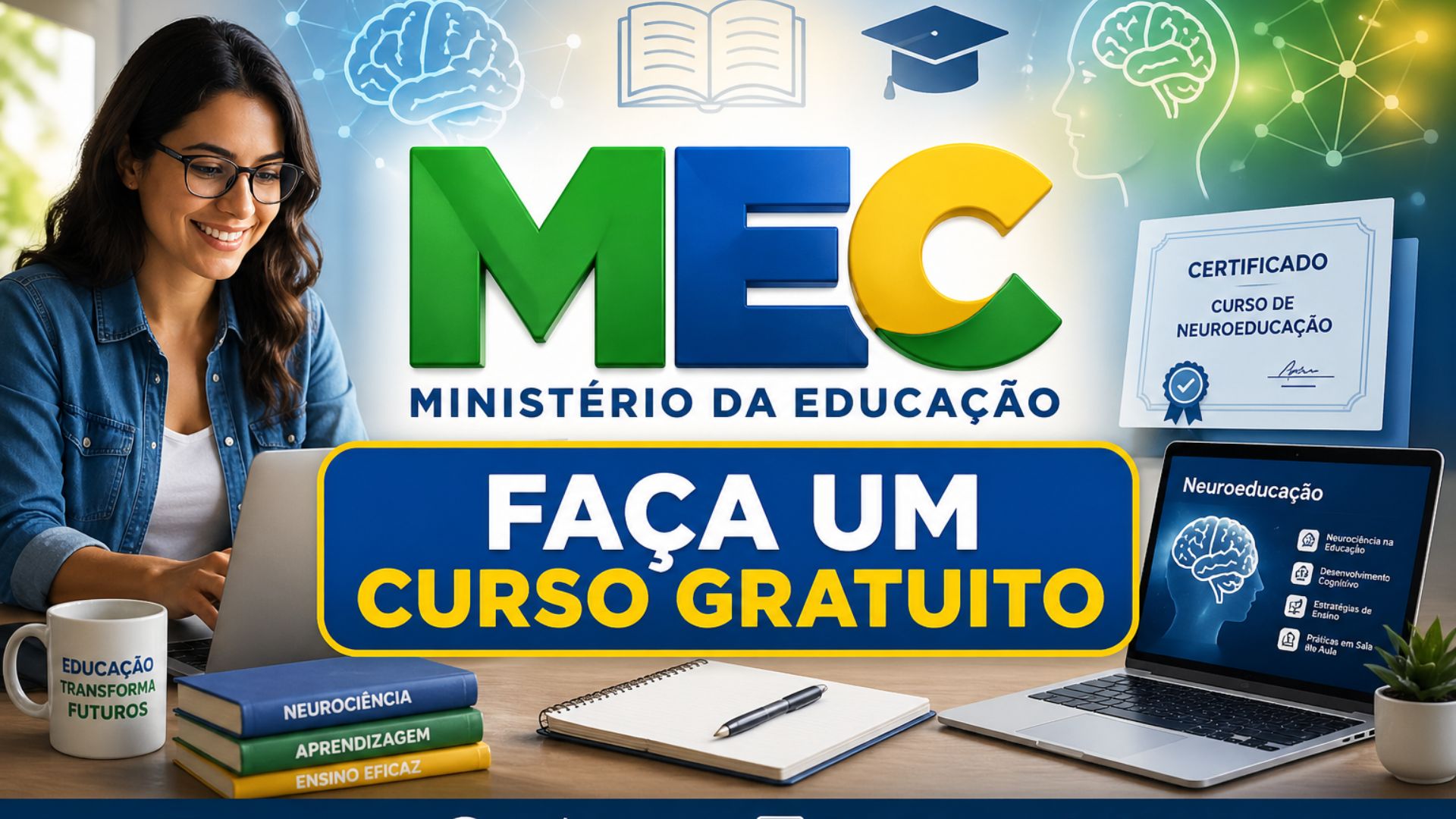

Free neuroeducation training expands teachers’ access to knowledge about the brain and learning, with a flexible online course, official certificate, and content applied to teaching practice at all stages of Basic Education.
The Ministry of Education offers spots for the free course Teacher Training in Neuroeducation, an initiative aimed at Basic Education professionals who seek to understand, in an applied way, how brain function relates to cognitive development and school learning.
Available on the AVAMEC platform, MEC’s virtual environment for continuing education, the training was structured to serve teachers from Early Childhood Education, Elementary School, High School, and Youth and Adult Education, considering the specificities of each educational stage.
With a workload of 200 hours, the training takes place remotely and adopts a self-instructional format, allowing participants to organize their study routine, access content at their own pace, and progress without direct tutor supervision.
-
Surprising opportunity in the railway sector: MRS offers a free course for assistant train driver and shunter in Juiz de Fora with a R$ 1,600 scholarship, specialized training, and the chance to join one of the largest railway operators in Brazil.

-
It’s official: IFMS opens spots in free courses on artificial intelligence, drones, and app creation, expanding technological education in 2026 and preparing students for areas with high professional demand and accelerated digital transformation.
-
Senai launches an unprecedented program with Petrobras and opens 2,000 spots in free courses with recognized certification, a monthly allowance of R$ 600, and training for industrial professions that continue hiring across the country.

-
Petrobras and SENAI open 480 spots in free technical courses with a scholarship of up to R$ 858, meal allowance, and training in Mechanics, Welding, Metallurgy, and Industrial Automation to meet the growing demand of the industry and the oil and gas sector.


Within this model, the student takes a leading role in the learning process, defining schedules, reviewing content as needed, and reconciling the training with professional activities, provided they respect the deadlines established by the platform.
MEC’s free neuroeducation course for teachers
In the educational field, neuroeducation articulates knowledge from neuroscience, psychology, and pedagogy, offering theoretical and practical foundations to understand how students process information, develop skills, and respond to different stimuli in the classroom.
Throughout the training, these concepts are presented with a focus on teaching practice, connecting theory and daily school life, especially in contexts that require adapting strategies to deal with different learning profiles.
Among the topics covered are fundamentals of the central nervous system, processes of memory, attention, language, emotions, and cognitive development, always related to the stages of Basic Education to facilitate pedagogical application.
Although it does not replace specializations or postgraduate courses, the training serves as accessible professional development, allowing educators to expand their repertoire and base pedagogical decisions with greater theoretical consistency.
Course structure with modules and official certification
Organized into six modules, the training path begins with an introduction to neuroscience applied to education and progresses to content aimed at Early Childhood Education, Elementary School, High School, and Youth and Adult Education, in addition to a final assessment module.
During the course, participants have access to theoretical materials, explanatory videos, academic references, and practice activities, forming a set of resources that promotes a gradual understanding of concepts and their relationship with pedagogical practice.
As the course takes place entirely in a virtual environment, access to content can be done flexibly, respecting the student’s availability and the minimum and maximum limits defined for completion.
To obtain the certificate, it is necessary to complete all modules and achieve satisfactory performance in the assessment activities, according to the criteria established by the platform used by MEC.
At the end, the issued document presents the workload, period of completion, and participant’s performance, consolidating the training path undertaken throughout the course.
Flexible deadline of 50 to 200 days for completion
Unlike courses with rigid schedules, the training does not establish fixed dates for meetings or live classes, operating based on a completion interval that offers greater autonomy to the participant.
In this model, the student must complete the course in a minimum of 50 days and a maximum of 200 days, adjusting the study pace according to their professional routine and time availability.
For teachers who balance pedagogical planning, classroom activities, and other institutional demands, this flexibility can facilitate the continuity of training without compromising other responsibilities.
Nevertheless, the absence of tutoring requires discipline and organization, as there is no individualized support throughout the training path.
It is important to note that the certificate is issued only after the full completion of the course, with no provision for partial declarations for participants who do not complete all modules.
Target audience and application in pedagogical practice
Aimed at Basic Education educators, the training includes teachers from Early Childhood Education, Elementary School, High School, and EJA (Youth and Adult Education), and may also be of interest to managers and pedagogical coordinators.
Through the study of neuroeducation, teachers enhance their ability to observe factors such as attention, memory, emotion, and development, recognizing how these elements directly influence students’ learning processes.
On the other hand, the application of this knowledge requires caution, avoiding simplified interpretations or generalizations that do not consider the complexity of human development and teaching conditions.
In daily school life, this theoretical foundation can contribute to the adoption of more diversified strategies, planning activities with clear objectives, and adapting to the different paces present in the classroom.
How to enroll in the MEC Neuroeducation course
To participate, it is necessary to access the AVAMEC platform, locate the course Teacher Training in Neuroeducation, linked to the MEC’s Secretariat of Basic Education, and register directly in the virtual environment.
After logging in, the interested party must confirm their enrollment while vacancies are available, ensuring immediate access to the content and the start of the training path under the conditions established by the platform.






