





 Portuguese
  English
  Spanish
  5 min of reading
  0 comments


Big Wind Used Two MiG-21 Fighter Engines, Consumed More Than 2,000 Liters Per Hour and Generated Supersonic Winds to Extinguish Oil Wells Burning in Kuwait After the Gulf War.
Extinguishing a burning oil well is not like putting out a regular fire. In some cases, the temperature exceeds 1,000 °C, the pressurized oil jet behaves like a continuous flamethrower, and any direct human approach becomes virtually impossible. It was to tackle this extreme scenario that Big Wind emerged, one of the most absurd and ingenious vehicles ever created.
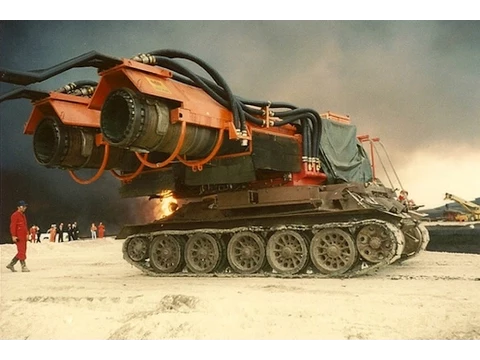
Mounted on the structure of a T-34 tank and equipped with two MiG-21 fighter jet engines, Big Wind consumed thousands of liters of fuel per hour to generate winds so violent that they literally ripped the oxygen from the base of the flames, allowing to extinguish fires that other methods couldn’t control.
In 1991, during the withdrawal of Iraqi troops from Kuwait, more than 600 oil wells were deliberately set on fire. The goal was to cause economic and environmental collapse. The flames burned day and night, releasing smoke plumes visible from space and temperatures capable of melting steel.
-
The race of humanoid robots in factories has truly begun, Hyundai announced that it will deploy more than 25,000 units of Atlas in its production lines starting in 2028, in a partnership that involves Boston Dynamics and training with Google DeepMind.

-
Russia wants to build new nuclear plants in Brazil and is negotiating an agreement with the Lula government to expand Rosatom’s presence in atomic energy projects, small reactors, and peaceful nuclear technology.

-
Microscopic fossils 1.7 billion years old found in rocks in Australia reveal complex cells living at the bottom of an ancient sea and may change what scientists know about the evolution of life on Earth.
-
Seen from space, an underwater volcano erupts in the Pacific, spewing smoke directly from the sea, spreading floating pumice, and may be creating a new island in a region so poorly mapped that scientists still do not know exactly which structure is erupting.


Specialized companies in industrial fire fighting were mobilized from around the world, but some wells presented such extreme conditions that conventional methods failed. It was in this context that Big Wind ceased to be an eccentric idea and became a practical solution.
What Is Big Wind and Who Developed It
Big Wind was developed by MB Drilling Company, from Hungary, in partnership with international specialists in well-fire fighting, including engineers with experience in extreme operations. The chosen base was a Soviet T-34 tank, not by coincidence. The vehicle offered:
- heat-resistant armor
- tracks capable of advancing in sand, mud, and debris
- robust structure, easy to modify
- full protection for the crew


On top of the tank’s tower, two MiG-21 fighter jet engines were installed, transforming a war vehicle into an unprecedented firefighting machine.
MiG-21 Fighter Engines: Why Use Aircraft Jets
The engines used were derived from the Klimov VK family, employed in MiG-21 fighters. These engines were chosen for their ability to generate extremely intense and continuous airflow. Technically, the operation was simple and brutal:
- the jets created directed supersonic winds
- the airflow displaced the oxygen from the base of the flame
- simultaneously, water or foam was sprayed
- the flame was suffocated and cooled within seconds
This method did not “extinguish” the fire in the traditional sense but instantly interrupted combustion, something essential in pressurized oil wells.
Fuel Consumption: Where Big Wind Becomes a Colossus
The big technical shock of Big Wind lies in its consumption. Each jet engine consumed between 1,000 and 1,500 liters of fuel per hour, depending on the operation mode.
With both engines operating together, the consumption exceeded 2,000 liters per hour; at peaks, it could approach 3,000 liters per hour.
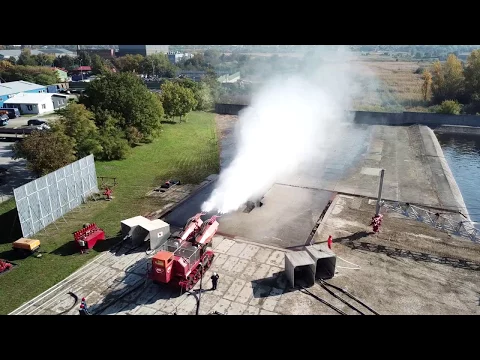
This figure is comparable to the fuel consumption of commercial aircraft at certain flight phases, but applied to a stationary or low-speed ground vehicle.
It is important to highlight: Big Wind did not operate for hours on end. It was activated for short periods, sufficient to extinguish the fire, precisely to limit the extreme fuel expenditure.
Why a Tank Was Essential for This Operation
Common vehicles would not survive this type of mission. The choice of a war tank was technical, not symbolic. The T-34 offered:
- resistance to extreme radiant heat
- protection against sudden explosions
- armor against debris ejected by the flames
- the ability to approach directly to the wellhead
Without this level of protection, no operator would even be able to get close to the fire.
Practical Results in Kuwait
Big Wind was effectively used in efforts to contain the fires in Kuwait. In specific situations, it managed to:
- extinguish wells in minutes, not hours
- dramatically reduce human risk
- operate where other methods failed
It did not replace traditional techniques but worked as a last resort tool, applied only in the most extreme scenarios.
International Recognition and Official Records
Big Wind entered the Guinness World Records as one of the most powerful firefighting vehicles ever built. It also appears in:
- adaptive military engineering records
- documentaries about the Gulf War
- technical studies on industrial firefighting
Its use is widely documented, unlike many exaggerated projects that circulate on the internet.
What Big Wind Was Not (Important for Credibility)
To avoid common mistakes:
- was not nuclear
- was not an original Soviet project
- was not used as a weapon of war
- did not operate continuously for hours
These confusions frequently appear in sensational versions of the story.
Why Big Wind Became a Symbol of Extreme Engineering
Big Wind represents a rare moment when military engineering, aviation, and the oil industry came together to solve a real, urgent, and gigantic problem.
It shows that, in certain scenarios:
- energy efficiency is irrelevant
- cost becomes secondary
- the goal is simply to make something work, at any cost
Few land vehicles have ever operated with such absurd levels of fuel consumption in an intentional and controlled manner.
With two MiG-21 fighter engines, consumption above 2,000 liters of fuel per hour and winds capable of suffocating giant fires, Big Wind entered history as one of the most extreme machines ever created by humanity.
It was not born to be efficient, elegant, or sustainable. It was born to face a colossal problem — and it did so using brute force, improvised engineering, and fuel on an absurd scale.
If there is a maximum symbol that, in certain situations, humanity simply floors the accelerator of engineering, that symbol is called Big Wind.







Be the first to react!