





 Portuguese
  English
  Spanish
  3 min of reading
  0 comments


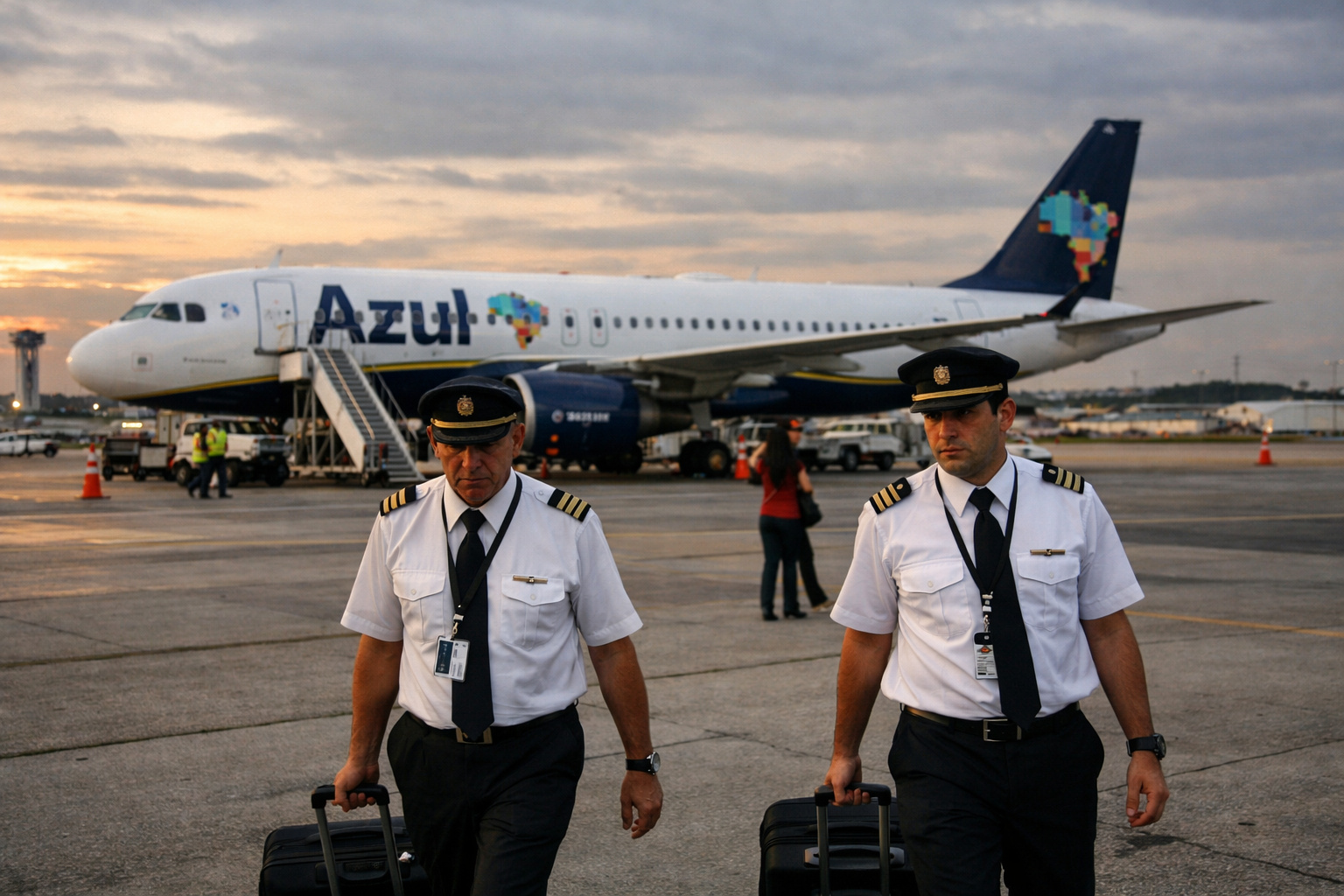
Fast-Track Exits Expose Internal Challenges of Airline

Azul Airlines ended 2025 facing one of the most delicate moments in its operational history. Throughout the year, more than 270 pilots resigned, a number that represents an absolute record for the company. The movement gained momentum especially in the last quarter and raised alarms in the aviation sector regarding professional retention, salary competitiveness, and operational stability.
The information was released by the portal AEROIN, which has been continuously monitoring the movements of the company’s technical crew since September of last year. According to the most recent data, at least 44 pilots left Azul in December 2025 alone, consolidating a trend that intensified month after month.
Since then, the scenario has changed significantly. At the beginning of the monitoring, the company recorded an average of 14 monthly resignations. However, as the year progressed, the pace accelerated. October marked a critical point, with 48 resignation requests, a monthly record that remained at similar levels in November and December.
-
Brazil has lost 85 air routes since 2019 and is still flying less than before the pandemic, leaving passengers with fewer destinations, fewer frequencies, and a more limited air network.

-
Anac and Decea are behind iFood’s drones in Barueri and explain how aerial delivery got the green light in Brazil, as orders leave the mall, cross the sky in a few minutes, and reveal the behind-the-scenes of new commercial drone deliveries in the country.

-
Air traffic control failure causes momentary chaos in São Paulo and forces planes to fly over longer before landing at Guarulhos and Congonhas.
-
Brazilian national team’s plane appears with Azul logo, but does not belong to the company and curious detail surprises before the 2026 World Cup



Distribution of Exits Reveals Direct Impact on Azul’s Fleet

When analyzing the distribution of layoffs by aircraft type, it becomes evident that pilot departures directly affect the airline’s operations. According to the most recent survey, Airbus A320 accounted for a significant portion of the departures, with 14 co-pilots and 7 captains resigning in December alone.
Additionally, the Embraer E195 fleet recorded the departure of six co-pilots, although no captains left the company on that model during the analyzed period. In the regional segment, the impact was also significant. On the ATR, used on lower-demand routes, nine co-pilots and one captain resigned.
Meanwhile, Azul Conecta, the subsidiary responsible for flights with the Cessna C208 Caravan, accounted for the departure of three co-pilots and one captain. These numbers show that the loss of professionals occurs in practically all operational areas of the company.
Although AEROIN had access to the complete list of names and registrations of the departed pilots, the data was not disclosed due to containing sensitive information. Nevertheless, the consolidated figures indicate that the total number of layoffs throughout 2025 has far surpassed the 200 mark, with an upward trend in the last quarter.
International Market and Competition Increase Pressure on Azul
In addition to internal challenges, the external scenario also contributed to the pilots’ departures. A significant portion of the departing professionals migrated to international airlines, particularly Etihad Airways from the United Arab Emirates. The foreign company has benefited from more attractive compensation packages and greater contract predictability.
At the same time, the Brazilian market is experiencing a strong competition for skilled labor. The recent opening of a recruitment process by LATAM, with high financial bonuses for already qualified pilots, has increased the pressure on Azul. However, so far, this movement has not yet directly reflected in the company’s numbers, as the competitor’s process remains in early stages.
Another noteworthy factor is that, despite the mass departures, no new class of technical crew training has been initiated by Azul recently. This heightens concerns about the company’s ability to replenish its operational staff in the short and medium term.
In light of this scenario, industry experts assess that the company faces a complex strategic challenge. On one hand, it needs to maintain its flight network and safety standards. On the other, it deals with a competitive environment, financial pressures, and the need to make its contracts more attractive to retain experienced professionals.
The record departure of pilots in 2025 thus exposes not only a specific problem, but a warning signal for the entire Brazilian commercial aviation.
In your view, does the pilot exodus at Azul reflect only a specific moment for the company, or does it reveal a structural problem in the Brazilian aviation market?






Be the first to react!